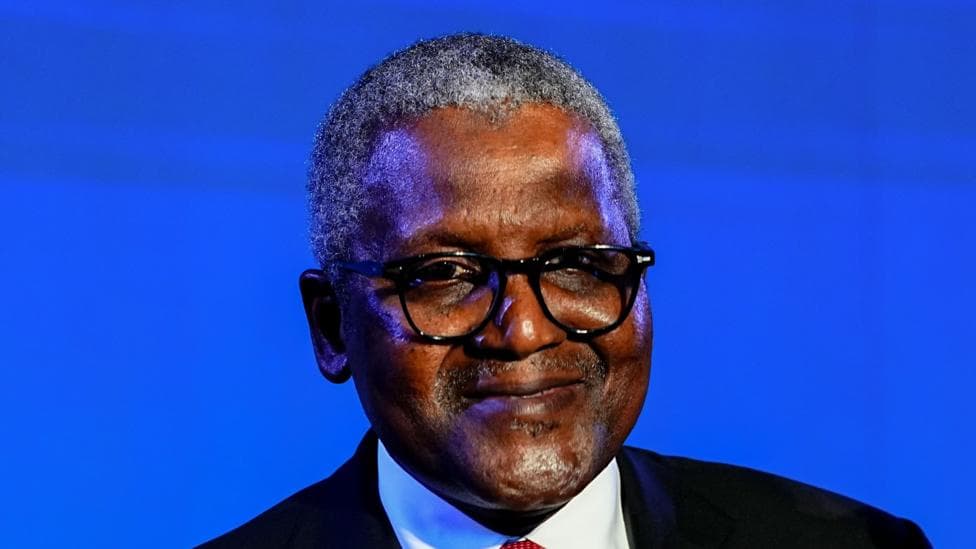
Nigerian billionaire Aliko Dangote has announced backing for a major infrastructure project connecting the Horn of Africa's fuel supply chains. The $660m (£500m) refined petroleum-products pipeline will link Djibouti's Damerjog port to a distribution facility in Dewele, Ethiopia, spanning 120km (75 miles) and featuring substantial storage capacity at both terminals.
The partnership, formally launched in Addis Ababa on 24 September 2026, involves Dangote working alongside the governments of Ethiopia and Djibouti, as well as Ethiopian Investment Holdings. According to reporting on the announcement, the project represents a significant step in regional energy infrastructure development.
Storage facilities will be substantial at each end of the pipeline. According to Bloomberg's coverage of the project, Billene Seyoum, spokeswoman for Ethiopia's Prime Minister's Office, confirmed storage capacity of approximately 375,000 cubic metres at Damerjog and 800,000 cubic metres at Dewele. Ethiopian state media reported the combined storage capacity would exceed 1 million cubic metres across both terminals.

How will this transform fuel transport?
The pipeline will dramatically accelerate fuel delivery to Ethiopia's interior. Ethiopian Prime Minister Abiy Ahmed stated that the infrastructure would reduce transport time from Djibouti's port to the Ethiopian capital, Addis Ababa, from five days to just one day. The first operational phase will handle key petroleum products including jet fuel, diesel and petrol.
Dangote, Africa's richest man, said at the ground-breaking ceremony that the project would strengthen Ethiopia's energy security and make its fuel supply chain more resilient. The initiative addresses a critical vulnerability for the landlocked nation, which depends heavily on Djibouti's port for imports of petroleum products and other goods.

What benefits will the region gain?
The new infrastructure is expected to reduce pressure on existing road transport systems that currently support industries including transport, aviation, agriculture and construction. By shifting fuel logistics from roads to pipeline, the project aims to cut reliance on overland routes and improve security of supply along the Ethiopia-Djibouti trade corridor.
Djibouti stands to gain from increased port activity, job creation and higher government revenues. According to reporting on the Djibouti fuel hub, the terminal alone will occupy approximately 80 hectares and be capable of handling up to 5 million tonnes annually.
What is Dangote's broader business strategy?
This pipeline project forms part of Dangote's wider expansion of infrastructure and manufacturing operations across the African continent. His cement business, Dangote Cement, operates with production capacity of approximately 55 million tonnes annually. His oil refinery in Nigeria currently processes 700,000 barrels of crude per day and is pursuing plans to double that capacity to 1.4 million barrels daily.
The Nigerian refinery recently listed 4.1 billion ordinary shares on the Nigerian stock exchange, targeting approximately $1.63bn (£1.2bn) in capital raising. In Kenya, Dangote's company is scheduled to begin construction next week on a proposed 700,000-barrel-a-day crude oil refinery in Lamu, further extending his regional energy infrastructure footprint.
When will operations begin?
The pipeline is expected to commence operations within 18 months of the 24 September 2026 announcement. Ethiopian state media indicated that the infrastructure is anticipated to transform the Ethiopia-Djibouti corridor and improve regional trade and energy flows throughout the coming development period.
Key Facts
- The $660m pipeline will connect Djibouti's Damerjog port to Dewele, Ethiopia, spanning 120km with combined storage exceeding 1 million cubic metres
- The project will reduce fuel transport time from Djibouti to Addis Ababa from five days to one day
- Operations are expected to begin within 18 months, with the first phase handling jet fuel, diesel and petrol
- The partnership involves Dangote, the governments of Ethiopia and Djibouti, and Ethiopian Investment Holdings
- The initiative is part of Dangote's broader African expansion, which includes cement production and oil refining operations across multiple countries