

As many workers prepare to step away from their desks for a break, they face one final task before logging off: composing an out-of-office auto-reply. Etiquette specialists and career experts say the wording of these messages matters far more than most people assume, since a poorly judged reply can generate confusion, unnecessary follow-up emails, or even strain a professional relationship. Their shared advice is that a good auto-reply should be polite, concise, and give a specific return date along with a backup contact where relevant.
What should a good out-of-office message include?
According to etiquette consultancy Debretts, an effective automatic reply should stay polite and to the point, name a clear date of return, and, where appropriate, point senders towards someone else who can help in the meantime. What it should not do, the consultancy says, is stray into oversharing, such as detailing exact holiday plans or mentioning things like second homes or costly hobbies that could come across as boasting.
Debretts director Rupert Wesson warns against what he calls \"virtue signalling\" about the reasons for taking leave, arguing it can appear smug or overly try-hard to colleagues left behind at their desks.
\"Some people will be delighted you are spending 'quality time with your family', but given that they are the ones emailing you and are hard at work, you could risk rubbing their noses in it.\"
At the same time, a message that simply reads \"I'm out of office\" without a return date or an alternative contact can leave senders with more questions than answers.

Why does vague wording cause problems?
Charlotte Davies, a career expert at LinkedIn, says the root of most awkward follow-up emails is uncertainty, when senders simply do not know when to expect a reply or who else might be able to help.
\"People don't know when to expect a reply or who else can help, and that uncertainty is what leads to the 'just-in-case' follow-ups.\"
Davies argues that a strong auto-reply achieves two things: it states clear dates and it directs senders to a named backup contact. She also recommends briefing whoever is covering for you before you leave, so they are prepared for anything urgent that comes in.
\"It helps whoever's emailing you, and it protects your break too.\"
Is it ever appropriate to use humour?
Opinions differ on whether jokes belong in an out-of-office message. While a lighter tone might suit teams with an informal culture, several specialists caution that humour does not always translate well in writing, particularly if a message is forwarded on or read by someone outside a close-knit team.
Paul Fitzsimmons, head of sales and marketing at law firm Wilford Smith, says overly sarcastic or glib replies can backfire, even when they are genuinely funny.
\"'I'm currently out of the office pretending this company doesn't exist'... 'If it's urgent, call someone who cares'... 'Emails received while I'm away will be deleted unread.'\"
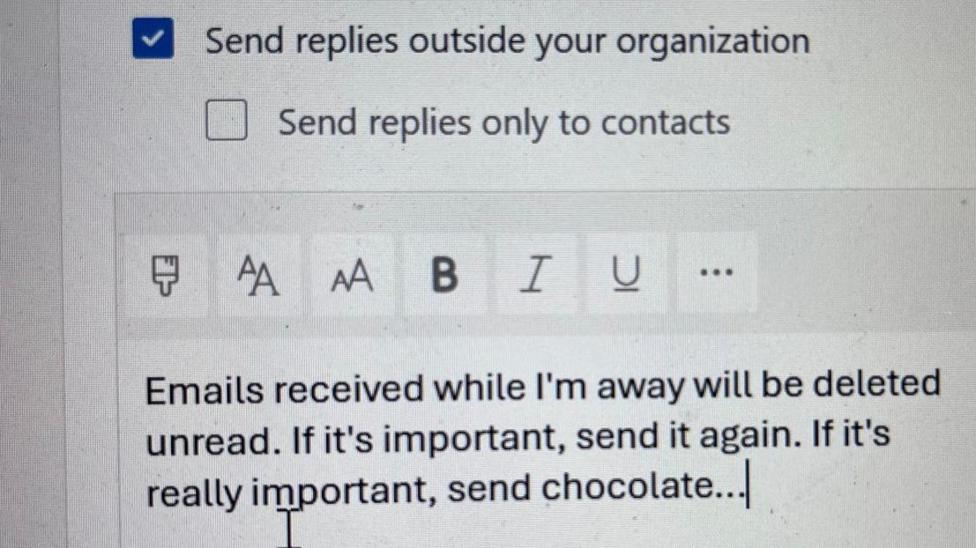
Adam Murfet, 41, a senior sales executive, recalls a former colleague who lost a deal after a joke in an out-of-office message irritated a client. Even so, Murfet believes humour can help someone stand out at a time when so much communication is automated or AI-generated.
\"Always ask, would you put the same thing in an email?\"
\"Anything you send will be read and people will judge you on it.\"
That caution is echoed in a 2026 guide from Shopify, which notes it can be useful to give a general reason for being away without sharing personal specifics, while warning that humour or sarcasm risks being misread over email, according to Shopify's guidance.

Should you say you won't be checking emails at all?
A recurring complaint among commentators is the phrase \"limited access to email\", which experts say can actually invite people to keep messaging as though the person were still working. Wesson suggests that anyone who genuinely intends to glance at their inbox while away should instead say they will be \"periodically checking emails\", since this sets a more honest expectation.
\"I will be periodically checking emails.\"
Davies takes a firmer line for those wanting a complete break, advising them to be explicit about switching off entirely.
\"Say so clearly - something like 'I won't be checking emails during this time'.\"
She also points out that workers in the UK have a legal entitlement to take annual leave without interruption, unless their employment contract states otherwise.
\"Remember, in the UK you have a legal right to uninterrupted annual leave unless your contract says otherwise.\"

What are the practical tips for writing one?
Drawing together the advice from Debretts and LinkedIn, several straightforward habits emerge for anyone drafting their own reply. Opening with a greeting such as \"thank you for your email\" rather than launching straight into \"I'm on annual leave\" is one simple courtesy. Including a specific return date and a backup contact, and double-checking that all details are correct, is another.
Being upfront about your actual availability, rather than leaving it ambiguous, helps manage expectations on both sides. It is also worth avoiding promises of an instant reply on return, since a backlog is normal and a phrase like \"within a few days\" is more realistic. For anyone using Outlook, remembering to tick both internal and external recipients is an easy step to miss. Finally, switching the auto-reply off once back at work avoids the slightly disorganised look of a stale out-of-office message still running days later.
How is guidance on out-of-office messages evolving?
Newer guidance published in 2026 builds on the same core principles but pushes for even greater brevity and clarity. According to a 2026 guide on out-of-office templates, the recommended structure now includes a return date, a backup contact, and a clear statement of when a reply can be expected, often condensed into just three to five sentences. The same guidance suggests it can help to note explicitly whether email will be checked at all during the break, and in some cases to include a redirect such as a booking page or other resource link.
Separately, updated examples from a guide on auto-reply templates now favour a fast path for urgent matters, such as a shared inbox or a named alternate contact, rather than leaving senders stranded without any next step. Some of these templates go further still, proposing that the core message stay under 20 words and cover just three elements: an acknowledgment, a timing for the next step, and an option for urgent contact, according to the same guide.
Career site Indeed's updated advice reinforces the basic principle behind all of this: setting an out-of-office reply is considered proper workplace etiquette whenever someone cannot check emails during their normal working hours, according to Indeed's career advice.
Why do these rules keep resurfacing?
The underlying reasoning behind all this advice, according to the 2026 out-of-office guide, is that ambiguity is what generates unnecessary follow-up emails and back-and-forth in the first place. Older etiquette sources and more recent workplace guidance converge on much the same basic formula of dates, return timing and a named backup contact, according to Shopify's advice on the subject. A long-running theme across email guidance more broadly is that clarity tends to matter more than personality, particularly given that a message may end up being read by people well outside a sender's immediate team, according to guidance on effective auto-replies.
What happens next?
There is no scheduled decision, ruling or fixed date tied to this guidance, according to reference material on out-of-office messages. Instead, the advice functions as an evolving set of best practices that workers can apply the next time they prepare to leave their desks, with 2026 guidance suggesting the trend is towards shorter, clearer messages rather than longer or more personal ones.
Key Facts
- Debretts recommends auto-replies be polite, concise, and include a specific return date and backup contact.
- LinkedIn's Charlotte Davies says unclear out-of-office messages lead to unnecessary \"just-in-case\" follow-up emails.
- Workers in the UK have a legal right to uninterrupted annual leave unless their contract says otherwise.
- 2026 guidance recommends keeping core messages to three to five sentences, or even under 20 words, covering acknowledgment, timing and an urgent contact option.
- Experts including Paul Fitzsimmons and Adam Murfet warn that humour in an out-of-office reply can misfire, even if intended lightly.


