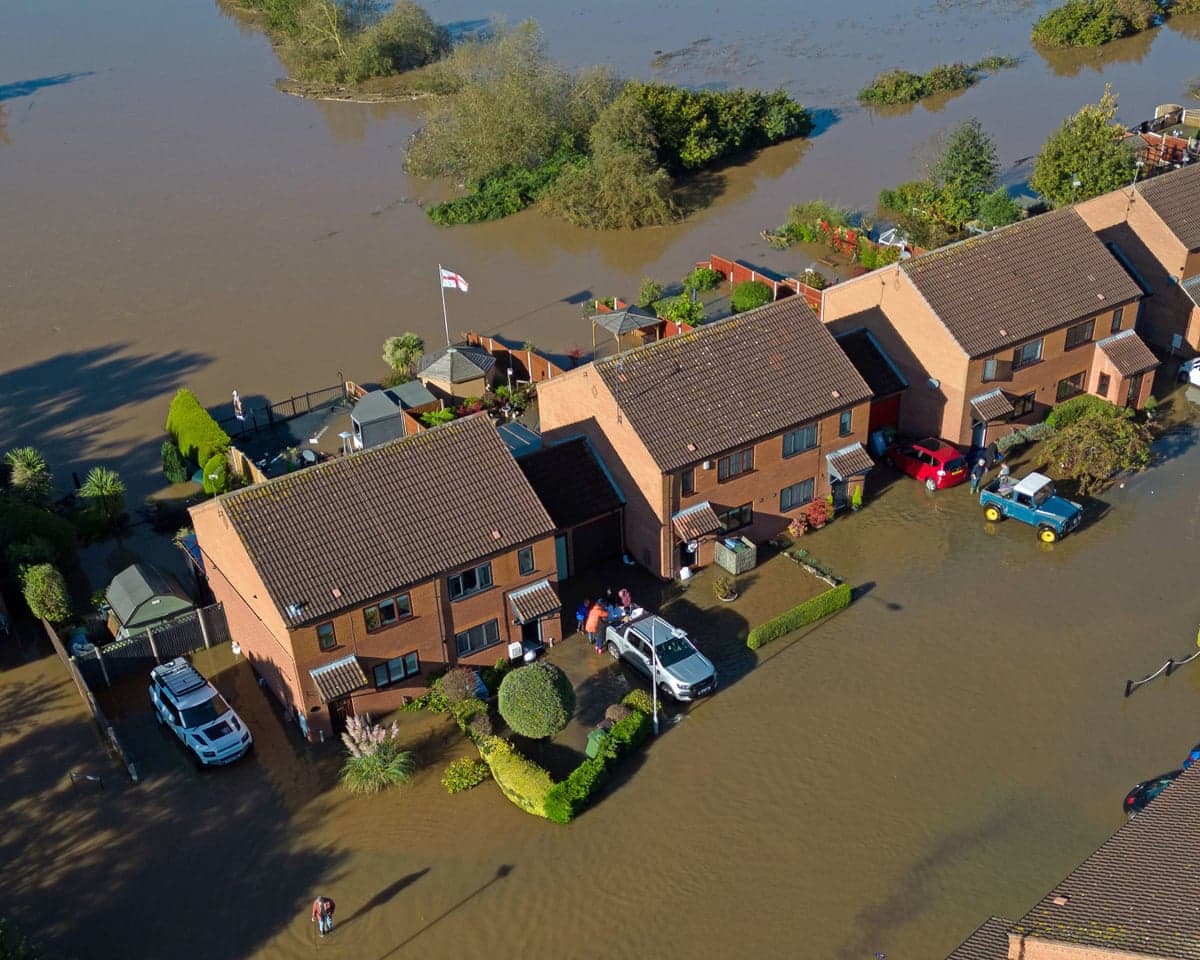
Amanda Blanc, chief executive of Aviva, has warned that residential properties currently under construction in flood-prone regions may prove impossible to insure within the coming decades. She highlighted that the frequency of flooding events is intensifying, and expressed concern about current building practices. If construction trends persist unchanged, approximately 115,000 homes will be erected in designated flood zones over the next ten years.
Blanc stated that the flooding hazard was "absolutely increasing" and told the BBC's Big Boss Interview podcast that England was "for sure" constructing dwellings destined to become uninsurable. "That doesn't seem to me to make sense. We need to think about where those homes are being built," she said, adding that construction bordering flood zones also requires a different approach.
What is the current scale of flood risk?
According to the Environment Agency, 6.3 million homes in England currently face flooding risk, with 4.6 million of those vulnerable to surface-water flooding. This figure could rise to approximately 8 million properties—roughly one in four—by the middle of the century as climate change accelerates. The Environment Agency's latest national flood risk assessment has tripled its estimate of properties at high risk compared with its previous evaluation, reflecting updated climate science and flood modelling.
Aviva's research reveals that nearly one-third of homes built in 2024 will face some flooding risk by 2050. More concerning, one in nine homes constructed between 2022 and 2024 were already at medium-to-high risk of flooding, with one in seven newly built properties facing medium-to-high flood risk.
What can be done to reduce flood vulnerability?
Substantial mitigation measures exist to lower a property's exposure to water damage. Blanc noted that homeowners and builders have multiple options available to reduce or increase resilience to flooding. "You can do all sorts of different things to your property to make it more or less vulnerable to flood," she said, emphasising that it is well known where flooding areas are located and that careful thought should be given to new construction in those regions.
How is government responding to flood threats?
Investment in flood defences is expanding. The Environment Agency announced that more than 600 flood schemes will receive £830 million in funding this year, as part of £1.4 billion of investment in flood defences for 2026/27.

A Department for Environment, Food and Rural Affairs spokesperson stated: "We've put a record amount of investment into protecting nearly 900,000 properties against billions of pounds of flooding damage. Meanwhile our planning proposals will help ensure that housebuilding will not go ahead in areas that are at risk of flooding, helping us to build 1.5 million homes without compromising on safety."
Following the exceptionally wet and stormy winter of 2023–24, climate scientists reported that such severe winters had shifted from once-in-80-year occurrences to once-in-20-year events, underscoring the accelerating pace of climate-related weather patterns.
What are Blanc's concerns about pre-budget policy announcements?
Blanc urged the government to refrain from policy "kite flying"—the practice of floating potential changes to gauge public reaction—before Chancellor John Healey's budget announcement on 28 October 2026. She cited damaging consequences from such speculation in previous years.
Aviva, a major private pension provider, experienced significant disruption when rumours of pension tax changes circulated before recent budgets. "Effectively we saw in the last year 30 times the normal withdrawal from pensions that we would normally see, which is clearly something which customers may regret afterwards because once you take your tax-free lump sum out, you can't put it back in," Blanc explained.
The tax-free pension lump-sum allowance is generally capped at £268,275 under current government guidance. In 2025, speculation about potential modifications to this entitlement prompted a surge in early withdrawals, with Blanc stating that customers would have been better served by waiting and calling on the Chancellor to suppress pre-budget policy rumours.
"So we would say be very, very thoughtful about the things that you are testing, thinking about."
A Treasury spokesperson responded: "The chancellor makes tax policy decisions at fiscal events. Speculation can be harmful which is why we do not comment on future changes to tax policy."
What is Aviva's investment position?
Blanc indicated that Aviva was "ready with capital" to invest in UK infrastructure, pointing out that the company already invests more than £100 billion in the UK, £35 billion of which goes into infrastructure including hospitals, schools and windfarms. "We've got that capital. We want to invest, we're a big UK employer. We want to invest in UK infrastructure. It provides good returns for our pension holders and for the members of those pension schemes," she said, but added that detail was needed to turn investment intentions into reality.
Key Facts
- Approximately 115,000 homes will be built in flood zones over the next decade if current construction patterns continue
- Nearly one-third of homes built in 2024 will face some flooding risk by 2050, according to Aviva research
- The Environment Agency estimates 6.3 million homes in England are currently at flooding risk, potentially rising to 8 million by mid-century
- More than 600 flood defence schemes will share £830 million in funding this year as part of broader flood resilience investment
- Pension withdrawal speculation before recent budgets led to 30 times the normal rate of tax-free lump-sum withdrawals