Household gas and electricity bills are set to increase by £443 annually from January, driven by surging energy costs that continue to push up the UK's inflation rate. According to BBC News, researchers at consultancy Cornwall Insight predict the annual price cap will rise by 26% in the new year. Energy regulator Ofgem will formally announce the new cap on 25 November.
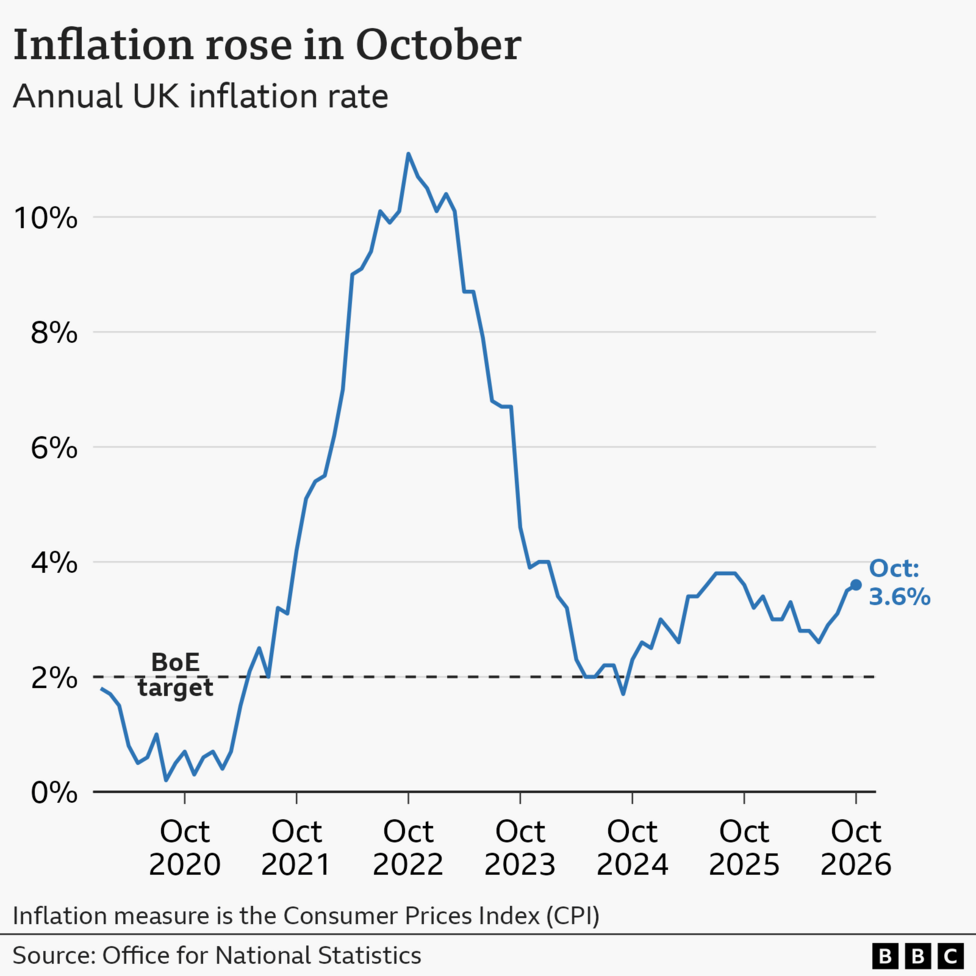
The sharp increase threatens to keep inflation elevated. Official data showed prices rose 3.6% in the year to October 2026, up from 3.5% in September, with higher petrol and diesel costs driving much of the acceleration. Inflation has reached its highest level in a year as energy prices have accelerated largely due to geopolitical tensions in the Middle East involving the US and Iran.
In response to the price surge, the Bank of England raised interest rates for the first time in three years earlier this month, moving the base rate from 3.75% to 4% in an effort to slow inflation back to its 2% target. The Bank signalled that further increases could follow unless the Middle East conflict is resolved. Higher interest rates increase borrowing costs for some mortgages, loans and credit cards, though they can also improve returns on savings.
The government has announced support measures to help households manage energy costs. VAT on electricity bills has been cut to zero until July 2027, and £100 will be distributed to 20 million homes in January. However, with annual household energy bills forecast to reach £2,166, Craig Lowrey, retail markets principal at Cornwall Insight, warned that
ultimately this support can only chip away at the edges of a bill that continues to be pushed up by events in the Middle East.
How are households responding to rising costs?
Many families are making significant changes to their daily routines to reduce energy consumption. Sophie, who manages a cafe at the Old Boat Corner community centre in Brighton, closely monitors her home's smart meter and has adjusted her household's energy use substantially.
I'm very conscious of the cost of energy, and it is having an impact on how we function in the home as a family, she explained. She has reduced oven use and delayed turning on heating, instead relying on layered clothing and electric blankets on the sofa.

What is driving the inflation increase?
Fuel prices remain the primary factor pushing inflation higher. Grant Fitzner, chief economist at the Office for National Statistics, confirmed that
fuel prices were once again a major contributorto October's inflation rise. Petrol prices increased by 5.2p per litre between September and October, reaching an average of 174.7p per litre—the highest since August 2022. Diesel prices climbed even higher, averaging 199.5p per litre in October, the highest level since records began 30 years ago.
Rising energy prices can lead to more expensive food and staples if businesses pass on higher costs to consumers. The Bank of England reported earlier this month that there had been
limited evidenceof widespread cost pass-through, with some firms absorbing increases and accepting lower profit margins. However, Fitzner noted that
annual costs of both raw materials and goods leaving factories continue to climb, driven by higher crude oil and petrol prices, respectively.
Price inflation in restaurants and cafes slowed in October, and hotel prices fell on average. Food price inflation rose by just 0.9%, marking the slowest pace in five years. Core inflation, which excludes energy and food, and services inflation remained largely unchanged from the previous month—a figure closely monitored by the Bank of England when setting interest rates.
Could the Bank of England pause rate rises?
The modest movement in core and services inflation could prompt the Bank to hold off on a further rate rise in December. However, policymakers remain concerned about longer-term inflation prospects. The Bank believes inflation could peak at 4.9% in the middle of 2027 and may not return to the 2% target until 2028. In an adverse scenario where the US-Iran conflict escalates and sends oil prices significantly higher, inflation could reach 6.2% in 2027.
A Bank of England spokesperson explained that the recent rate increase was designed to
limit how much higher energy costs affect other prices, and will continue to set interest rates to make sure inflation returns to the 2% target and stays there.
What is the political response?
Shadow chancellor Andrew Griffith attributed four successive inflation increases to the UK's
soaring energy costsand Labour's decisions to
hike taxes and employment costs. Emma Reynolds, chief secretary to the Treasury, stated that the government was providing assistance to households facing higher energy bills, pointing to the VAT cut and the January payment scheme as evidence of support.
The energy price crisis reflects broader economic pressures facing UK households. Earlier forecasts had predicted even steeper rises—Cornwall Insight had forecast a £332 annual rise in July 2026, driven by oil and gas price surges amid geopolitical tensions. More recently, millions of UK households faced their steepest winter energy bills in three years from October 2026, with unpaid energy debt reaching £6 billion.