The Bank of England's Monetary Policy Committee is expected to announce an increase to the benchmark interest rate on Thursday, marking the first rise in more than three years. According to BBC News, most analysts predict the rate will move from 3.75% to 4%, a quarter-point adjustment that would raise borrowing costs for households and businesses while providing relief to savers. The decision will be announced at 12:00 GMT.
Persistent inflation, particularly driven by elevated energy and fuel prices stemming from the Iran war, has prompted policymakers to consider tightening monetary policy. The Consumer Prices Index reached 3.5% in the year to September 2026, up from 3.1% the previous month and significantly above the Bank's 2% target. However, the economic backdrop remains mixed: Bloomberg Economics research notes that GDP grew unexpectedly for a third consecutive month in August, and the labour market appeared to be stabilising, challenging the Bank's earlier assumptions about spare capacity in the economy.
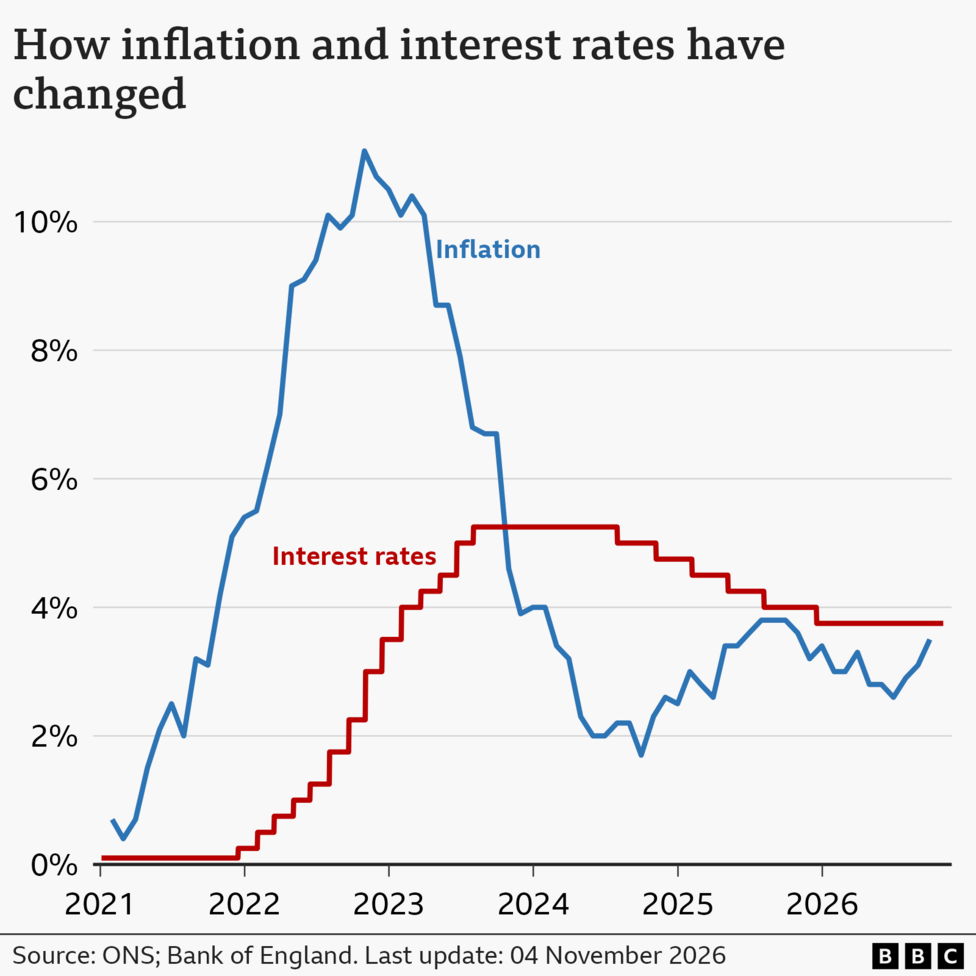
The Bank rate has declined from its August 2023 peak of 5.25%, and the Monetary Policy Committee has held it steady at 3.75% for six consecutive meetings. At its September meeting, the MPC held Bank Rate at 3.75% and warned that Middle East conflict had disrupted energy supply and prolonged price volatility could increase inflation risks.
Market participants and economists are divided on what happens after a potential November increase. One market scenario sees Bank Rate reaching at least 4.75% by next summer, while the economists' consensus sees only a 50-50 chance of another hike in the first quarter of 2027. Chris Cheverall, head of UK at trading platform CMC Markets, captured the shifting focus:
The decision is increasingly less about whether rates reach 4% and more about what follows after that. A quarter-point rise is already widely expected, but the Bank now has to balance inflation that is still too high against an economy where the growth outlook has weakened sharply.
How will tracker and variable mortgage holders be affected?
A rate increase would have an immediate impact on borrowers with tracker mortgages, which move in line with the Bank rate. Approximately 510,000 households hold tracker mortgages, and a 0.25 percentage point rise would increase monthly repayments by around £31 for someone with a typical home loan, according to calculations by UK Finance, the banking trade body.
The 470,000 mortgage-holders on variable-rate deals would experience a delayed impact. Their lenders typically take time to adjust rates in response to Bank rate changes, and a 0.25 percentage point rise would generally result in a £14 monthly increase in repayments.
What about those on fixed-rate mortgages?
Borrowers on fixed-rate deals face a more complex picture. While their current monthly payments remain unaffected by an immediate rate change, their future remortgage deals are already influenced by market expectations. Lenders have already factored in the anticipated rate rise when quoting new deals to customers.
As of 4 November, the average two-year fixed residential mortgage rate stood at 5.96%, while the average five-year rate was 5.99%, according to financial information service Moneyfacts. Those rolling off five-year fixed deals face substantially higher costs. Broker L&C found that average mortgage rates offered by the 10 biggest lenders suggest some borrowers now face paying almost £5,000 more each year in repayments on a £200,000 mortgage over 25 years compared to those who secured a remortgage deal in 2021, when the average five-year fixed rate among the 10 biggest lenders was just 1.30%.
The prospect of higher fixed rates has prompted some borrowers to consider switching to tracker mortgages, betting that the Bank rate might stabilise or fall in coming months. Rachel Springall from Moneyfacts cautioned:
The right choice ultimately depends on borrowers being confident they can stomach future rises. The devil is in the detail.
What impact will this have on other loans and savings?
Interest rates on other new loans, including personal loans and credit cards, could be influenced by any Bank rate adjustment. Savers, conversely, stand to benefit from improved interest rates on savings accounts and fixed-rate bonds if the Bank rate rises, as lenders typically pass on increases more readily to savers than to borrowers.
What does the broader economic context tell us?
The Bank of England faces a delicate balancing act. While inflation remains above target, economic growth signals have become more resilient than previously expected. Bloomberg Economics argues that UK rates may be near neutral rather than restrictive, strengthening the case for a hike, yet signs of consumers tightening spending and limited evidence of energy-driven price and wage feedback effects support a more cautious approach to future increases.
The ongoing impact of the Iran war continues to filter through to UK inflation via energy and fuel costs. Millions of domestic energy customers are braced for substantial price increases in January, which could further pressure the inflation outlook and influence the Bank's future decisions.
What happens next?
The Bank's next Monetary Policy Committee announcement and minutes are scheduled for 17 December 2026. Market participants and economists will scrutinise not only the rate decision itself but also any forward guidance from the MPC about the trajectory of future policy, as uncertainty about the path beyond November remains significant.