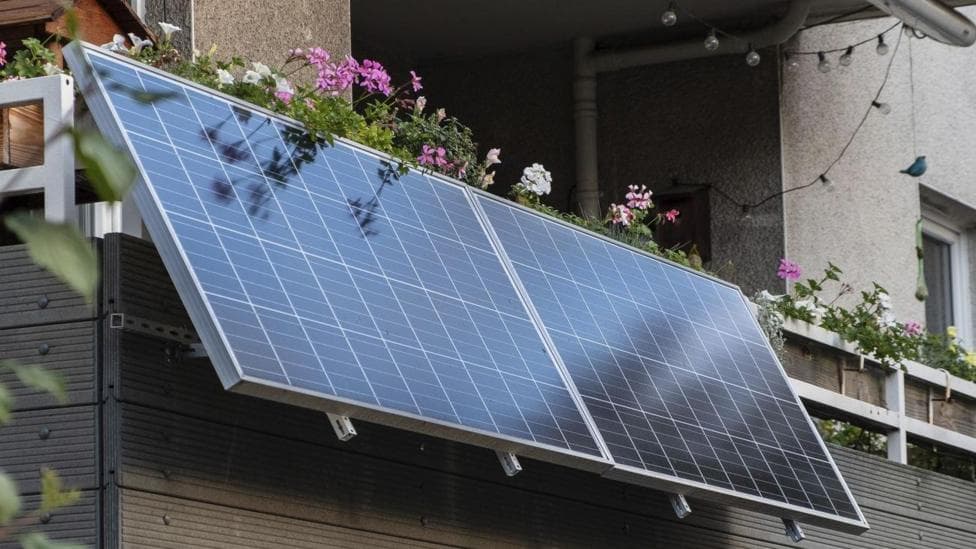
Plug-in solar panels are now legally available for purchase and self-installation across Great Britain following a government rule change that took effect on 27 August 2026. The regulation change, which came through SI 2026 No. 848 made on 16 July 2026, permits households to buy and install these systems without professional electrician involvement. Retailers including Argos, Amazon, Currys, B&Q and Screwfix are stocking or planning to stock the products, with initial pricing starting at £599 for a 460W kit according to UK solar company UKSOL.
These systems offer a more accessible entry point to solar energy than traditional roof installations. They are substantially cheaper than roof-mounted alternatives, require no professional installation, and suit properties with outdoor space including some balconies and patios. The government introduced this framework to help households reduce energy bills and decrease dependence on imported fuel sources, particularly given recent price volatility linked to international conflicts.
Before purchasing, experts recommend that customers have their home's electrical wiring inspected by a qualified professional to confirm safety. This precaution is especially important for older properties or where the condition of existing wiring is uncertain.
The government first announced in March 2026 that plug-in solar panels would become available in shops within months as part of a broader initiative on home energy and new-build solar adoption. This latest development represents a significant step in making renewable energy more accessible to renters, flat owners, and households unable to install roof-mounted systems.
Will plug-in solar panels save me money?
Households can expect modest but meaningful savings on energy bills, though the amount will be lower than roof-mounted systems because plug-in panels generate less power overall. According to government research, a typical household could save between £70 and £110 annually on energy bills, depending on panel orientation, installation location, and hours of operation. An unshaded south-facing position delivers optimal performance.
Current pricing from UKSOL stands at £599 for a single 460W kit and £999 for an 890W two-panel configuration. The government anticipates prices will decline to £400–£600 as market competition intensifies and manufacturers develop additional product lines. Households that consume electricity during daylight hours will benefit most, since the power generated must be used as it is produced.
Electricity not consumed flows back to the grid, but homeowners should not expect payment for this excess. Unlike rooftop solar panels, plug-in systems do not require certification under the Microgeneration Certification Scheme (MCS), the UK's official quality mark for small-scale renewable energy installations. This exemption also means they typically do not qualify for the Smart Export Guarantee scheme that compensates households for surplus solar electricity.
How much energy can they generate?
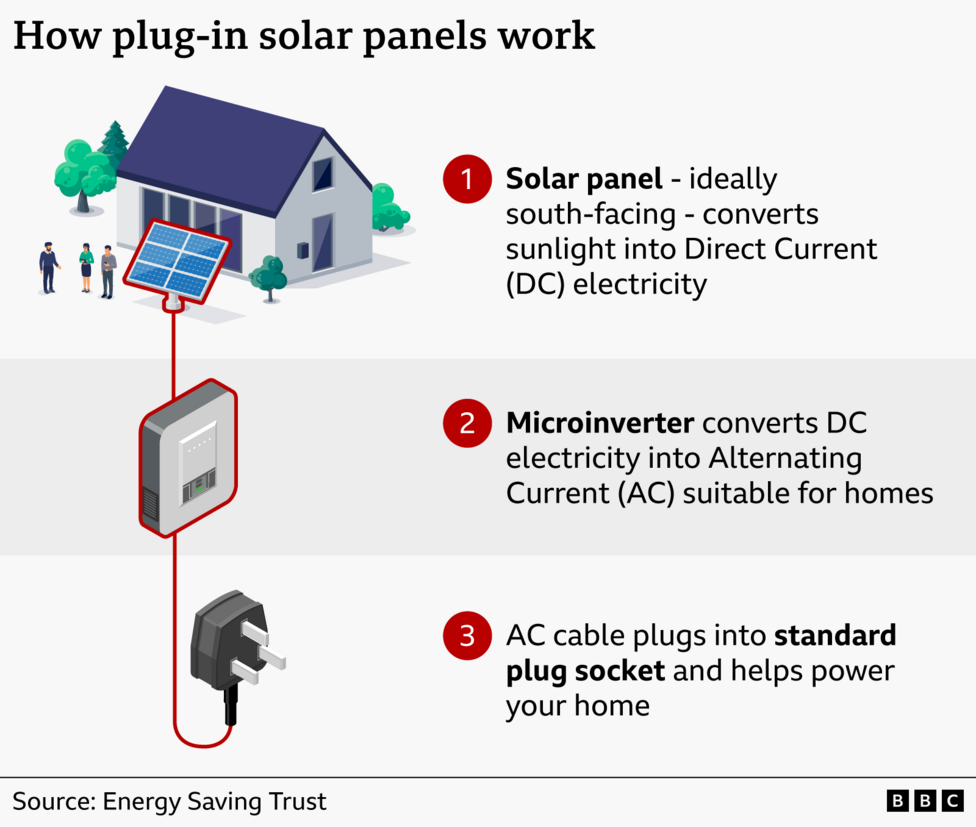
The panels will reduce household power consumption, though the reduction is deliberately limited for safety reasons. While panel kits may include components capable of generating higher power levels, the microinverter—which converts direct current from the panel into usable household electricity—restricts output to a maximum of 800 watts. According to industry analysis, this 800-watt capacity is sufficient to cover approximately 20% of an average home's electricity consumption while sunlight is available.
The 800-watt output is adequate to power "always-on" electrical devices such as refrigerators and equipment in standby mode. However, high-demand appliances like kettles, which require 3 kilowatts of electricity, will operate using a combination of the 800 watts supplied by the panel and the remainder drawn from the national grid. British Gas has stated that plug-in panels cannot power a home independently but can "meaningfully reduce how much electricity you need to buy during the daytime."

How safe are plug-in panels?
Government testing determined that sample systems could operate without unacceptable heating or unsafe energy flows. Each device incorporates a microinverter that continuously monitors the grid connection. Should the electricity supply fail—due to a power cut, for instance—or if the panel is unplugged, the microinverter detects this condition and shuts down within milliseconds, preventing any possibility of live electricity flowing into dead wiring.
To be sold legally in Great Britain, new panels must pass testing against the industry's G98 standard and the government's product specification. Panels meeting these requirements will be listed as compliant on the Energy Networks Association's public register, making it straightforward for buyers to verify compliance before purchase.
Consumer safety charity Electrical Safety First advises buyers to purchase from established retailers and their official websites rather than third-party sellers on online marketplaces. The charity cautioned that some platforms do not currently bear legal responsibility for the safety of goods sold through them.
Are these devices suitable for every home?
Not all properties are equally suitable for plug-in solar installation. Electrical Safety First has identified that plug-in solar can interact negatively with older safety devices in certain home electrical systems, particularly in properties built decades ago. The charity recommends having electrics inspected by a registered electrician before purchasing panels, especially in older homes or where the age and condition of wiring is unknown.
Households must never connect a plug-in panel through an extension lead, cable reel, or plug-in adaptor, as these can overheat and create fire hazards. For the present, the charity advises limiting installation to a single plug-in device per household to minimise risk.
How do I install one?
Panels arrive with a mounting kit and installation instructions. While some tools may be required, professional installation is not necessary. After mounting, users connect the microinverter and plug it into a standard mains socket—ideally an external weatherproof socket. Because the panels are not permanently fixed, they can be relocated to a different property if needed.
Tenants, leaseholders, and residents in shared buildings will need permission from their landlord, freeholder, or building owner before installation. Households must notify their local electricity Distribution Network Operator (DNO) within 28 days of plugging the panel in. The DNO is the company that owns the cables in the area, distinct from the energy supplier. Homeowners can identify their DNO using National Grid's postcode tool.
What happens next?
Retail availability commenced on 27 August 2026, with UKSOL indicating that additional product models should arrive in late September 2026 and hybrid-mount kits are planned for October 2026. According to reporting from a national news outlet, retailers beyond Argos—including Amazon, Currys, B&Q and Screwfix—are expected to stock plug-in panels in the coming weeks. A transition period concludes on 15 October 2026, after which all new installations must comply with the updated regulatory framework.
The government's initiative builds on earlier announcements and policy development. In March 2026, the government signalled that plug-in solar would be made available within months as part of a comprehensive push on home energy efficiency and renewable adoption. The framework evolved through stages, initially permitting certified kits under amended wiring rules before progressing to the current plug-and-play system. This latest development complements broader government targets, including a requirement for all new homes in England to incorporate heat pumps and solar panels by 2028.
Key Facts
- Plug-in solar panels became legal to buy and self-install in Great Britain on 27 August 2026 under SI 2026 No. 848; the regulation does not apply to Northern Ireland.
- Initial pricing starts at £599 for a 460W single-panel kit and £999 for an 890W two-panel kit, with government expectations of prices settling at £400–£600 as competition increases.
- The 800-watt output limit is designed for safety and covers approximately 20% of average household electricity use during daylight hours.
- Panels do not require Microgeneration Certification Scheme (MCS) certification and typically do not qualify for the Smart Export Guarantee payment scheme.
- Households must notify their Distribution Network Operator within 28 days of installation and should have electrical wiring checked by a registered electrician before purchase, particularly in older properties.