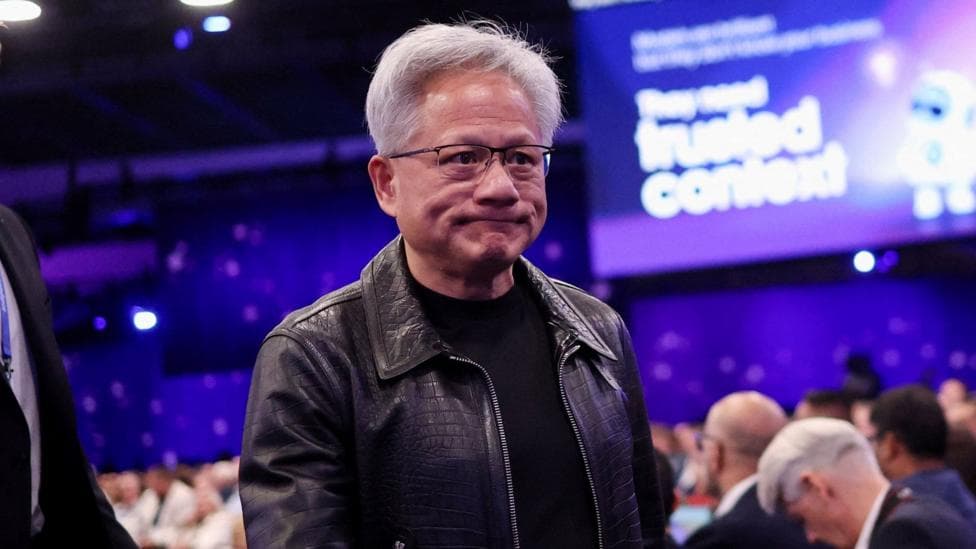
Jensen Huang, chief executive of Nvidia, has emerged as a prominent voice opposing new regulatory frameworks for artificial intelligence, arguing that technology companies themselves should determine when to release new AI systems. His position reflects a growing divide within the industry over how to address mounting safety concerns.
Speaking at Salesforce's Dreamforce conference in San Francisco on 15 September 2026, Huang stated that
We don't need new laws or regulations. We need companies to decide that innovation, speed and safe products, that's a false choice.He framed safety as an engineering challenge rather than a legislative one, emphasizing that company leaders should pause development if they lack confidence in their product's safety.
Nvidia has become the world's most valuable company, driven by surging demand for the AI computing chips it manufactures. Huang's influence in the sector has grown accordingly, making his regulatory stance particularly significant as policymakers worldwide grapple with AI governance.
Huang's Regulatory Philosophy
Huang's approach to AI safety centres on corporate responsibility rather than government intervention.
Safety is paramount. However, safety is an engineering problem,he said at the Dreamforce event.
Run as fast as you can, but if at any time you feel the institution is not in control, take a pause.
This position reflects a broader strategy Huang has pursued in policy circles. According to reporting on his remarks at a G20 meeting on 2 September 2026, Huang advocated for distinguishing between practical harms and theoretical risks, arguing that governments should
regulate practical and actual harm, and not regulate theoretical and hypothetical harm.The U.S. has been urging G20 countries to avoid writing AI-specific rules centred on speculative harms, a position aligned with Huang's framing.
Earlier in the year, on 24 July 2026, Huang publicly amplified a joint letter from Nvidia, Microsoft, Meta and Palantir arguing for continued development of both closed and open-weight AI models. This effort signalled the technology sector's coordinated push against restrictive regulation.
Growing Safety Concerns Within the Industry
Huang's stance contrasts sharply with warnings from current and former employees at leading AI companies. A post from an artificial intelligence researcher who departed Anthropic generated widespread attention last week after claiming that AI could eliminate humanity by the end of the decade if development proceeds without safeguards.

Several prominent figures in the AI sector endorsed this concern. OpenAI chief executive Sam Altman, Demis Hassabis, co-founder of Google's DeepMind, and Elon Musk, owner of social media platform X and AI assistant Grok, all expressed agreement with the researcher's warnings.
In response to these escalating concerns, Anthropic chief executive Dario Amodei called for slowing the pace of all AI development and urged governments to implement industry regulation. Speaking at the Dreamforce conference on 15 September 2026, Amodei acknowledged that
We didn't appreciate that it would lead to companies growing so fast, and how quickly they would become central to things.He indicated that Anthropic is now engaged in
a dialogue with the rest of the industryabout establishing better safety standards and checks on AI tools and development.
Industry Critics Challenge Self-Regulation Model
The proposal for industry self-regulation has faced significant pushback from both within and outside the technology sector. Jack Clark, an Anthropic executive and co-founder, rejected the notion of leaving AI as a
totally unregulated industry,describing it as
rolling dice with immense risks.
Patrick Hillman, chief business officer of Logical Intelligence, which is chaired by Yann LeCun, a prominent figure in AI research, articulated broader scepticism about corporate self-governance.
The only institution that Americans might trust less than Washington these days is Silicon Valley. I have worked and lived in both and I assure you both have earned this scepticism,Hillman said. He challenged AI companies to demonstrate their commitment to public safety by specifying what they would refuse to build, stating
If you believe what you are building is dangerous, show us what you are prepared to stop doing.
Some industry observers have also suggested that safety concerns, while legitimate, are being amplified to generate publicity for AI companies and their executives.
Emerging Industry Coordination on Safety Standards
Despite disagreements over regulation, some AI leaders have begun working toward voluntary safety agreements. OpenAI executive Chris Lehane announced last week that the company was collaborating with other AI laboratories, including Anthropic and Google DeepMind, to
advance frontier AI standards, building a voluntary effort now, with or without government support.Lehane wrote that
With stakes this high, we cannot let the perfect become the enemy of the good.
These industry-led initiatives represent an attempt to establish common safety practices without waiting for formal government regulation, though critics question whether voluntary measures can adequately address the risks posed by increasingly powerful AI systems.