

Ollie Priestley is training as a heritage vehicle technician at specialist car restoration business Tolman, where he has taken on a "heritage vehicle technician" apprenticeship. The 29-year-old Leicestershire-based apprentice is learning to restore modern classic cars using a mix of traditional methods and newer technologies.
Priestley says the work keeps him engaged because it allows him to make things connected to the cars he loves, including a Peugeot 205 GTi. He has recently fabricated a gearbox mount for a classic BMW, and says it is satisfying to know his work will help bring the car back to life.
Tolman founder Chris Tolman says the training Priestley is receiving is different from the experience of apprentices in mainstream car dealerships, where digital systems can leave staff acting mainly as parts replacers.
"I wanted to develop the skills that allowed me to work on the cars that I love and excite me, like the Peugeot 205 GTi," says Leicestershire-based Priestley.
"Getting to know how to make things keeps me focused and engaged. I've just fabricated a gearbox mount for a classic BMW. It's cool to know that the things I create will bring the car back to life."
"The computer identifies the issue and they swap the part. For specialist car businesses, our technicians need to identify and understand a problem, and then be creative and innovative to find the answer," says Tolman, who is based in Warwickshire.
His comments reflect a wider debate about how trade apprentices are taught as technology takes a bigger role across manufacturing and repair industries. In response, apprenticeships are moving further up the education value chain.
Priestley's three-year apprenticeship, which he is completing through the Heritage Skills Academy in Bicester (HSA), was introduced in 2018. It includes 3D printing and CAD, along with essential skills such as welding and glazing.
The course is a level three apprenticeship and is equivalent to three A-levels. It replaced the earlier level two and three "classic vehicle framework" apprenticeship.
HSA managing director John Pitchforth says the programme has been "radically improved" because it combines "modern technology with engineering fundamentals".
Government apprenticeship data also shows that the number of people starting level two intermediate apprenticeships has fallen by nearly a quarter over the past year, while more people have started higher level apprenticeships at level four to seven.
Level six and seven apprenticeships are equivalent to bachelors and masters degrees. Level three apprenticeship numbers have remained stable.
But with technology increasingly influencing the curriculum, there are concerns that apprentices may be learning mainly how to use software rather than the practical skills that define a trade.
Pitchforth argues that HSA apprentices leave with highly developed skills, and in some cases more than those trained on other programmes.
"When modern engineers come to us to transfer into our sector, they often lack the basic engineering principles and are unable to diagnose and repair vehicle systems without a computer telling them what's wrong," he says.
Chris Iveson says modern apprentices are learning practical and digital skills

Chris Iveson is chief executive of FourJaw Manufacturing Analytics, a platform that helps industrial businesses gain production monitoring data. Based in Sheffield, FourJaw works with a number of local businesses.

Iveson says the modern apprentice is now increasingly learning both how to make things and how to use digital tools to understand production.
"The modern apprentice is increasingly learning two things at once: the practical skill of making, and the digital skill of using technology to understand what is happening in production," explains Iveson.
"That might include CNC programming (coding for automated tools), CAD, robotics, additive manufacturing, quality control systems and production monitoring, all of which now appear in modern engineering and manufacturing apprenticeship routes."
He warns, however, that if training becomes too narrow, apprentices may not develop a full understanding of materials, methods, tooling, quality and process.
How is modern technology helping a centuries-old scissor maker?
Just down the road from FourJaw in Sheffield city centre is Ernest Wright, a scissor-maker operating since 1902 and one of only two scissor-makers left in the city. Sheffield once had a blade manufacturing industry with more than 100 workshops, but now only Ernest Wright and William Whiteley, on the other side of town, remain.
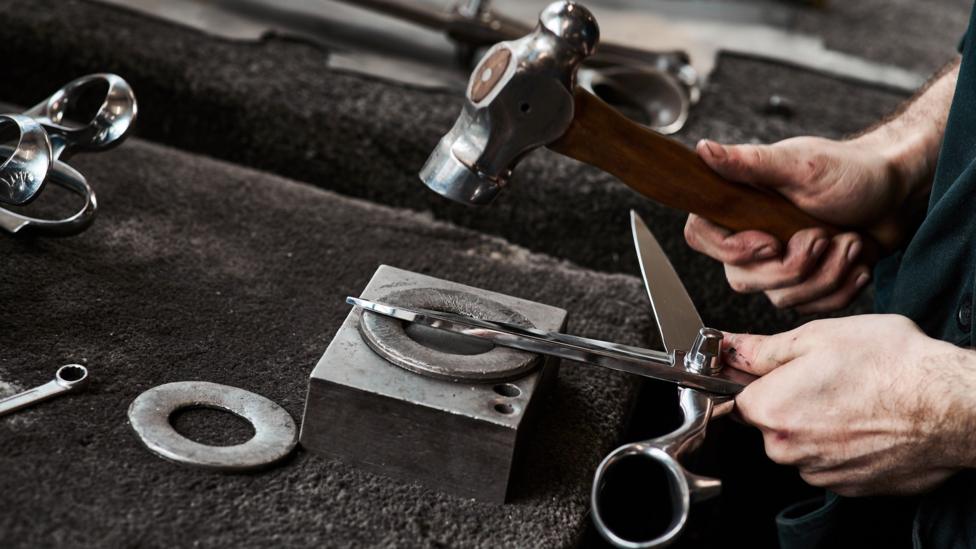
Ernest Wright is proud of its long history, but it is also using the latest manufacturing technology to carve out a niche in the scissors and shears market.
Working with the University of Sheffield, the firm introduced 3D metal printing to make new product development faster and less expensive. The technology allows the company to produce highly accurate prototypes before they are made using traditional methods.
The company used 3D metal printing to revive its 1960s "nurseryman scissors" and now uses it to develop a new product each year, largely based on vintage designs.
"Now we can make just six pairs of scissors through metal printing [as tests]. Then if we want to change things, we don't have to do it on 6,000 pairs," says Paul Jacobs who bought the company in 2018 along with fellow-Dutchman Jan-Bart Fanoy.
For trainee Elliott Nurcombe, who has worked part-time at Ernest Wright for the past three years alongside his aerospace engineering degree, the technology has added an exciting extra dimension to learning a trade he was already interested in.
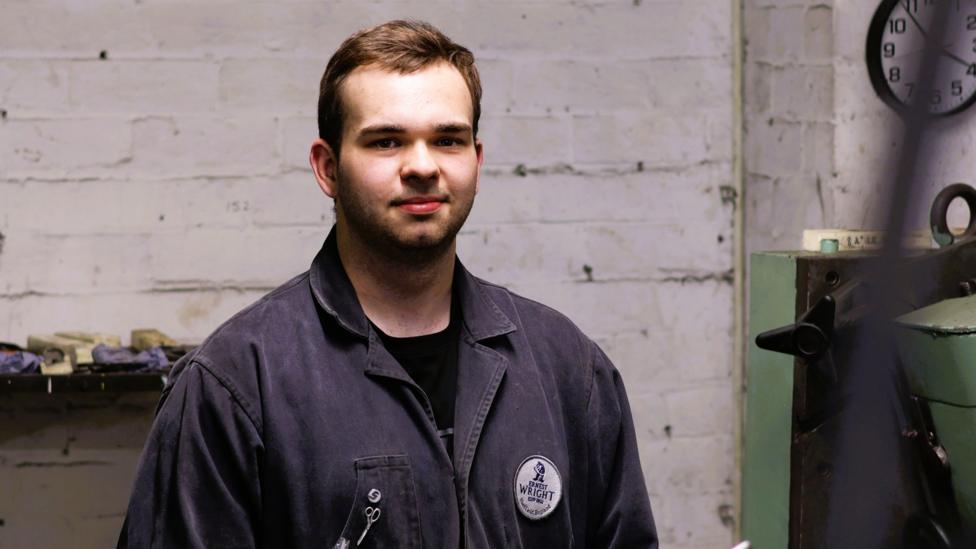
Nurcombe, 21, says many machine parts needed for maintenance no longer exist, so tools such as CAD and 3D printing have helped the business replicate some of them.
"Maintenance wise, a lot of the parts for our machines simply don't exist anymore, so using modern technologies like CAD and 3D printing, we've been able to replicate some," says Nurcombe, 21.
"But I don't think that technology will take over or overshadow what goes on in this workshop. In terms of actual production of what we make here and what we do day to day, there's no real opportunity for technology to take that over from the people that work here."
At Whiteley, a scissors business that dates back to 1760, 3D printing has also helped revitalise the company following a change of ownership in 2024. Sally Ward, an 11th generation member of the Whiteley family, and her husband Jeremy retired and sold the business to manufacturing company Kaymich.
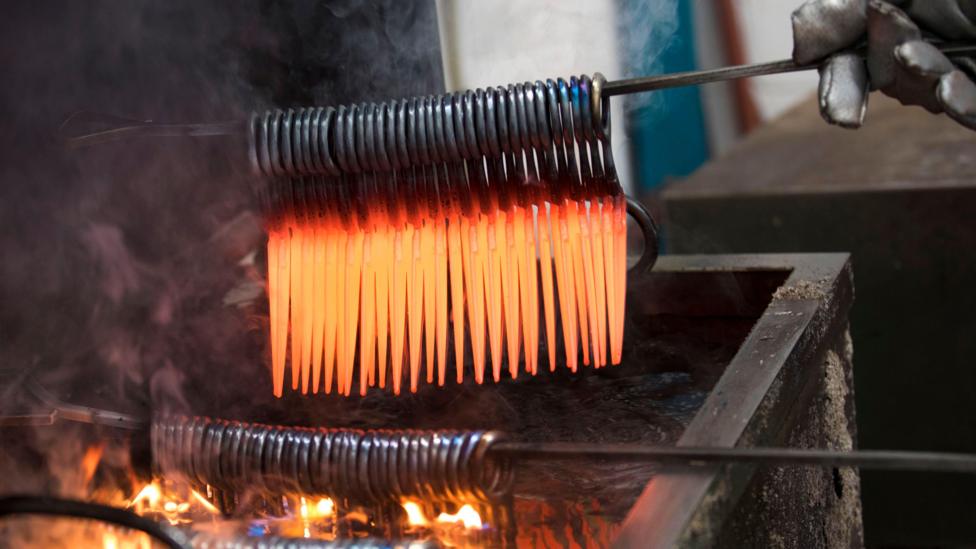
Managing director Mark White is considering new materials such as reclaimed titanium, but says he is taking a cautious approach to further technological change to preserve the craftsmanship behind Whiteley scissors.
"At the moment I'm looking to recruit trainee scissor manufacturers, as opposed to looking to put people out of work by investing in more technology," says White.
"What we're not about is loading something on a machine and pressing a button."
How are surgical instrument makers balancing machines and handwork?
Back in Sheffield city centre, Platts & Nisbett, which makes surgical instruments, now uses CNC at the first stage of production. That is when software directs machinery to cut components, which are then fitted and finished by hand.
Each instrument is also now laser tagged so it can be traced back to Platts & Nisbett, regardless of which hospital it ends up in.
Recruiting the next generation of craftspeople has not been straightforward, because technology has shifted many people's interests in that direction.
"There will be an abundance of people who want to press buttons. It's getting someone who likes to work with their hands, other than computers," says business development manager Julie Topham.
Key Facts
- Ollie Priestley is completing a three-year heritage vehicle technician apprenticeship through the Heritage Skills Academy in Bicester.
- The apprenticeship, introduced in 2018, includes CAD, 3D printing, welding and glazing.
- Government data shows level two intermediate apprenticeship starts fell by nearly a quarter over the past year.
- Ernest Wright has used 3D metal printing with the University of Sheffield to speed up product development.
- Whiteley traces its history back to 1760 and is taking a cautious approach to new technology.


