A groundbreaking cine-musical work that merges puppetry, live choreography and orchestral performance has emerged as one of the most inventive animated creations in recent memory. The Guardian reviews Oh to Believe in Another World, a 55-minute collage animation created by 71-year-old South African artist William Kentridge, presented alongside a live orchestral performance of Shostakovich's 10th Symphony. The production marks both the 120th anniversary of Shostakovich's birth and commemorates the composer's lifelong friendship and reportedly unrequited love for Azerbaijani pianist and composer Elmira Nazirova, his former student.
The work was commissioned by the Luzerner Sinfonieorchester and premiered in Lucerne on 15 June 2022, establishing itself as a major artistic achievement. Kentridge's film constructs an imagined Soviet museum from cardboard miniatures, featuring spaces including a theatre, swimming pool and quarry, into which viewers are drawn through meticulously crafted visual effects.
How does Kentridge visualise Soviet history?
Kentridge constructs an elaborate visual language using models and masks of famous and notorious Soviet figures—Stalin, Lenin, Trotsky and the poet Vladimir Mayakovsky, whose work provides both the title and the intertitles. These masks are variously blurred and scribbled; some remain blank with faces merely outlined, resembling constructivist cutouts. Lenin appears severe; Stalin bears a half-smile; Mayakovsky looks haunted; Trotsky seems oddly pained and outraged. Some faces are small and attached to models, while others are lifesize and mounted on actual human dancers. Both humans and models transform into two-dimensional cartoon-grotesque figures, their stern or noble facial expressions starkly at odds with their absurd, rickety flatness—like posters or placards. Their bodies below caper through a bizarre landscape in a danse macabre of history and tragedy.
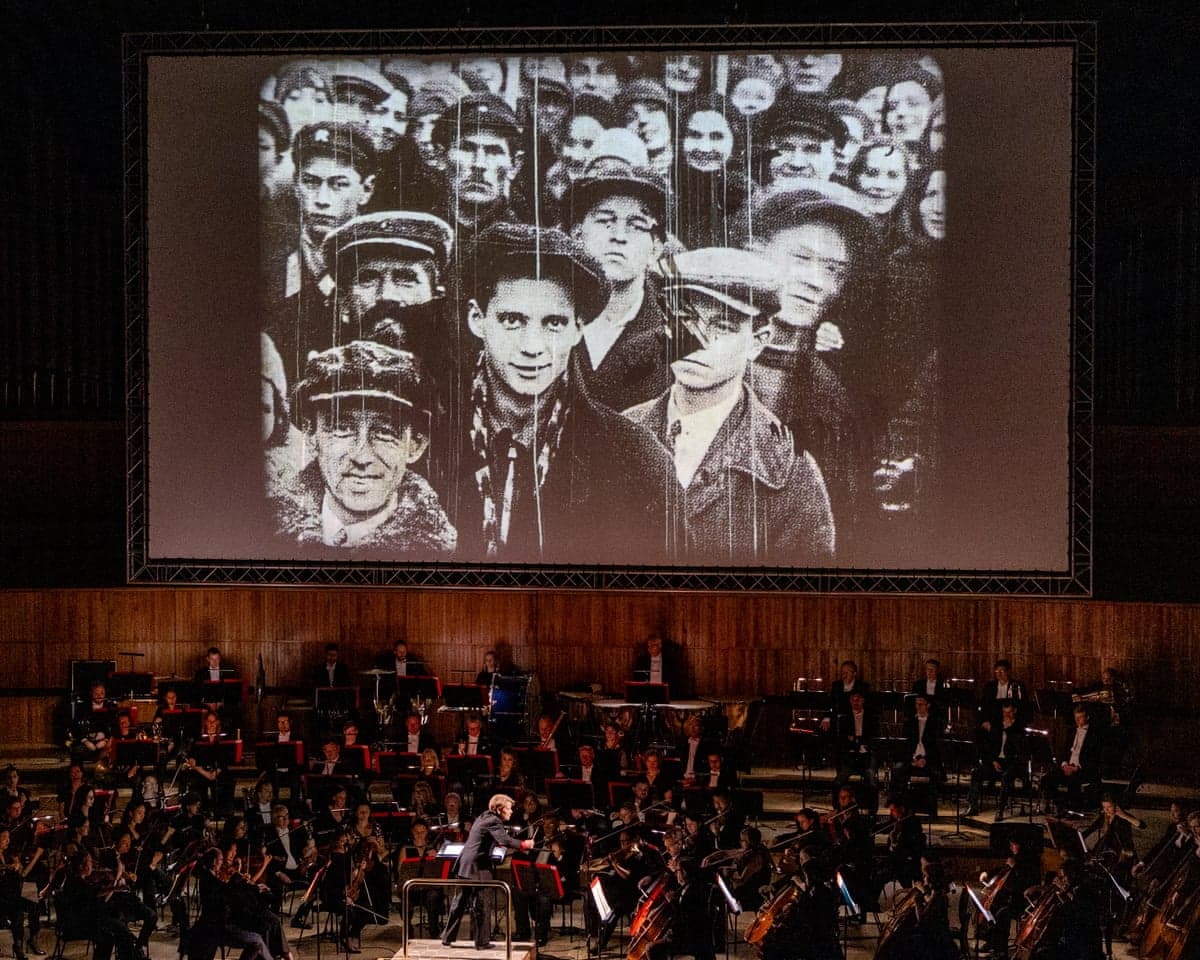
The models are composited into meticulously created model interiors through green-screen technology; viewers enter their tiny world, which becomes lifesize, creating a hyperreal effect where small models stand at the same height as full-size humans. The film reveals a dusty old Soviet museum, a wrecked auditorium where a newsreel still plays, and an eerily empty swimming pool where Lenin appears on a high diving board. In the opening Moderato movement, photographs of faces emerge—people destined to be eliminated by the state. Shostakovich himself appears as another puppet cutout, sinuously conducting his own work.
What role does humour play in confronting tragedy?
The work achieves an unexpected and powerful comedic dimension through its visual juxtapositions. The simple, preposterous effect of seeing Stalin's monumental face mounted atop a dancer's body, with that face remaining unchanged despite the physical exertions below, staring resolutely ahead at history's horizon, produces genuine hilarity—reminiscent of Terry Gilliam's animations for Monty Python. Yet this humour serves a deeper purpose. Just as Charlie Chaplin demonstrated that laughter could defy Hitler, Kentridge and his animated Shostakovich employ similar tactics with Stalin, though not identically. The result is a ballet of black comic pain, where laughter becomes a form of resistance against tyranny.
How does the film structure relate to Shostakovich's symphony?
The 10th Symphony, inspired by Stalin and premiered shortly after his death, likely occupied Shostakovich's compositional attention for an extended period beforehand. The music arguably combines fear, awe, revulsion and a hysterical reaction to the mad energy of Stalin's genocidal tyranny, alongside a darkly ambiguous respect for the great dictator whose 1945 victory anchored the postwar order. The symphony's swirl suggests that a great and terrible era has passed away, accompanied by grief for all that had been sacrificed to it.
The Allegro second movement accelerates in tempo, echoing the kinetic energy of Dziga Vertov's Man With a Movie Camera. The Allegretto third movement introduces Nazirova, Shostakovich's Azerbaijani love, dancing—but here Stalin, his poster-face perpetually bearing its mild half-smile, draws a gun and begins shooting. The final Andante and Allegro movements show the masks coming away, with Kentridge's own giant hand intruding into the frame.
Unlike many live-orchestral cinema events created for silent films, where ambitious new orchestral scores are composed but the music diffusely washes over the action without quite matching the screen, Oh to Believe in Another World reverses this dynamic entirely. The film has been created for the music. The yearning at the heart of Shostakovich's composition—to believe in another world, a better world—becomes the work's emotional centre. The October Revolution was pursued by those who wanted to believe in another world and lived to see one come into being. Yet under Stalinist tyranny, survivors yearned for another world as well, one that might overturn the existing order. The music mourns that lost idealism and acknowledges that another kind of idealism remains necessary.
What happens next?
The work is scheduled for performance at the Baku International Arts Festival on 30 October 2026, with the BIAF Festival Orchestra conducted by Dmitry Sitkovetsky. The screening, listed as approximately two hours including one intermission, takes place at Nizami Cinema Centre at 20:00. Featured performers include Andrea Fabi, Luc De Wit, Teresa Phuti Mojela, Thulani Chauke and the Phuphuma Love Minus isicathamiya chorus.