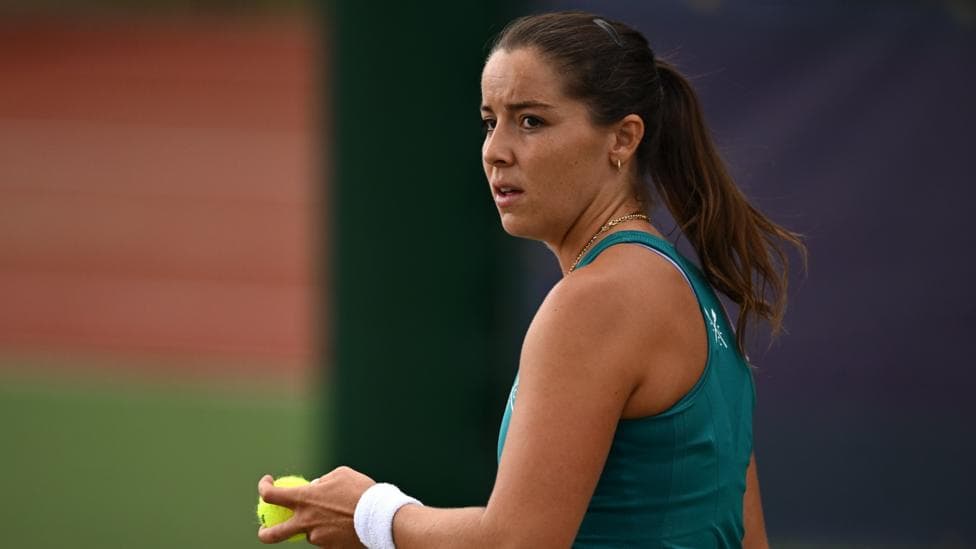
British tennis player Jodie Burrage received death threats and abusive messages on social media following her first-round defeat at the Chennai Open on 3 November 2026, marking her return to WTA Tour singles competition after 16 months away. According to BBC Sport, the 27-year-old, currently ranked 474th globally, lost to India's Vaishnavi Adkar in a three-set match 3-6 6-3 7-5. Burrage subsequently shared screenshots of the hostile direct messages she received on Instagram, describing the experience as a painful reminder of why she had stepped away from professional tennis.
The WTA has responded by offering additional support to Burrage, with staff in Chennai providing immediate assistance. A WTA spokesperson stated that the organisation has provided Burrage with a private channel to report abusive direct messages and moderation services that hide abusive comments on public channels before she sees them. The Threat Matrix service, the WTA's AI-led system launched three years ago in partnership with Wimbledon, the International Tennis Federation and the United States Tennis Association, is also reporting the abuse to social media platforms and investigating to identify those responsible.
In an interview with BBC Sport, Burrage explained that she struggled with her blood pressure during the match and checked in with a doctor and physiotherapist before discovering the abusive messages waiting on her phone. She described the harassment as endemic to professional tennis, saying: "It happens every match—whether it's win or lose. Playing in Wrexham, I won three matches and lost one. But after every single match there was some sort of abuse." Despite the severity of some messages, Burrage said she has developed resilience to the abuse. "Because we are so used to it—which is really quite sad—I don't fear for my safety," she told BBC Sport. "You've got to have thick skin. There was some brutal stuff that was said, but I don't take it to heart."
Adkar, who entered the tournament on a wild card, recovered from losing the opening set to secure victory. Burrage had used a protected ranking to enter the Chennai Open singles draw, allowing her to compete despite her extended absence from the tour. In her Instagram post, the London-based player wrote: "Nice welcome back to tour. I remember why I left," accompanied by a video compilation of the abusive messages she had received.
The incident prompted solidarity from fellow competitors. Germany's Eva Lys publicly called out the abuse by tagging the WTA on Instagram and asking: "When will something be done?" Her intervention highlighted growing frustration among players about the persistence of online harassment in professional tennis.
What is the scale of abuse in women's tennis?
Female tennis players face systematic online harassment at alarming levels. According to data from the Threat Matrix service, women's tennis players were subjected to more than 12,000 abusive posts and messages across social media platforms in 2025. Analysis of the abuse patterns reveals that angry gamblers represent a significant portion of perpetrators, responsible for 42% of verified abuse cases overall in 2025, though they were behind 59% of instances involving serious abuse—a category that includes death threats and threats of violence.
According to the WTA's 2025 report, the organisation analysed more than 1.2 million posts and comments, identifying 3,726 as serious abuse. The report found that 66% of serious abusive posts and comments were removed, while 35 accounts linked to 12 individuals were escalated to law enforcement. Where abuse is linked to betting, identified accounts will be added to the Bad Actor programme so betting operators can act against them.
Who else has experienced threats in professional tennis?
Burrage is not alone in facing such harassment. In 2025, British number one Katie Boulter disclosed that she had received death threats on a near-daily basis, adding her voice to a growing chorus of players speaking publicly about online abuse. These revelations have intensified calls for systemic change within the sport and on social media platforms themselves. The issue extends beyond individual incidents, with the UN's human rights office condemning racist and sexist abuse targeting athletes like Coco Gauff, warning that Black female athletes face systematic targeting.
The WTA's player board has previously issued statements condemning the abuse as "unacceptable" and acknowledged that the psychological impact on affected players can be "significant." In response to the escalating problem, several players have advocated for social media platforms to introduce identity verification requirements, arguing that anonymity enables abusers to act without fear of consequences. Burrage echoed this view, telling BBC Sport: "I think an ID should be put on every Instagram account, and then that way it makes more people more accountable for their actions on that platform. I think it would limit what people would say. People should be accountable for what they say and that's where I think there could be more of a push to change."
The issue of gambling-related abuse has prompted concern about tournament sponsorship deals. The Davis Cup has an official sports betting partner, while in August self-described "prediction-market platform" Kalshi signed a multi-year deal with the US Open, raising questions about the relationship between betting promotion and player safety.
What is Burrage's recent form?
Burrage's return to the WTA Tour comes after an extended period away from competition. Her last WTA Tour singles match prior to Chennai was in July 2025, when she lost to American Catherine McNally in the first round at Wimbledon. She achieved a career-high ranking of 85th in the world in September 2023, but has since dropped significantly in the rankings. Injury prevented her from playing singles for nine months, and when she returned for the grass court season, sickness held her back further. More recently, Burrage advanced to the second round of the Lexus Wrexham Open on 21 October 2026, defeating Eva Vedder 6-2 7-5, suggesting she was building momentum before the Chennai tournament. She has recently improved her singles ranking to 474, from a low of 888 in July.
Despite the abuse she experienced in Chennai, Burrage remains focused on her long-term goals. "I'm at a place where it's all bigger picture for me and everything I'm doing now is to have a good season in 2027," she said. "I'm building a team that is really good around me. They know where I've been, what I've gone through. It's not what you want, but if I have to go through it, then I will."
What happens next?
The Chennai Open women's singles final is scheduled for 8 November 2026 at 4 p.m. local time. Burrage is continuing to compete in the doubles event. The WTA's investigations into the accounts behind the abuse are underway, with betting-linked accounts potentially being referred to the Bad Actor programme for action by betting operators.
Meanwhile, the broader issue of online abuse in tennis remains unresolved, with players, governing bodies, and social media platforms under pressure to implement meaningful safeguards that protect athletes from harassment while preserving their ability to engage with supporters.