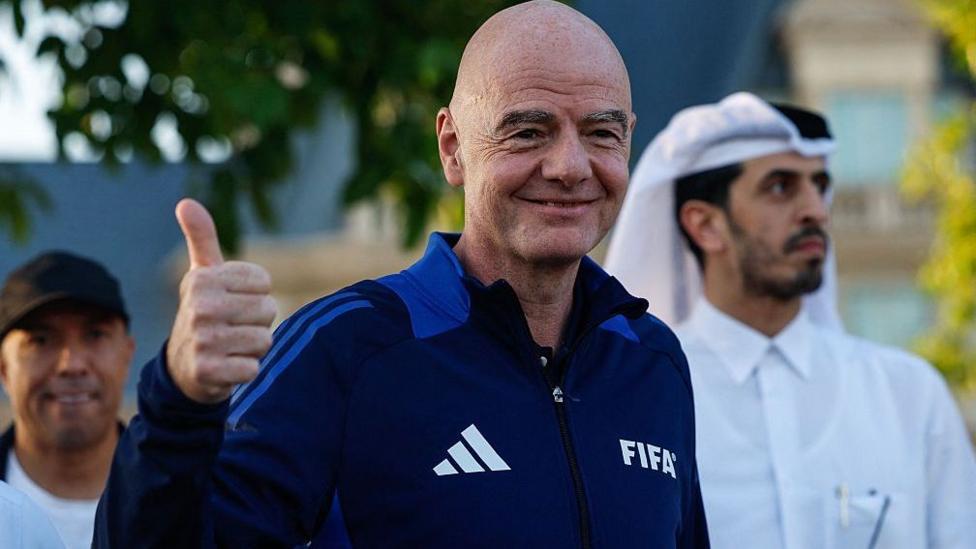
Gianni Infantino has served as Fifa president since 2016 and is seeking a third consecutive term in the organisation's leadership. With less than 48 hours remaining before the nomination deadline on November 18, 2026, European football's governing body has finally put forward a candidate to contest his re-election bid.
According to BBC Sport, Uefa's executive committee unanimously backed Philippe Diallo, president of the French Football Federation (FFF), to challenge Infantino in the March 2027 presidential election. The announcement came as a late surprise, with Uefa stating it had "full confidence in [him] to provide the leadership needed."
Diallo's nomination represents a significant moment in Fifa's internal politics, though it comes after Uefa's preferred candidate declined to run. Senior figures within European football had hoped to persuade Arsene Wenger, Fifa's head of global development, to stand against his own employer. Many believed only Wenger possessed the credibility and unifying potential to pose a genuine threat to Infantino's plans for a fourth term. However, Wenger chose not to proceed with a presidential challenge, forcing Uefa to seek an alternative candidate.
Who is Philippe Diallo?
Diallo has worked in French football administration since 1992 and assumed the FFF presidency in 2023, making him relatively unknown on the global stage. Despite his lower profile, he has already demonstrated willingness to challenge Infantino directly. In September 2026, Diallo stated that the Fifa president had "seriously damaged the image and unity of football" and claimed "trust has been broken" over Infantino's failed plan to sell stakes in World Cup competitions to private investors.
Uefa vice-president Laura McAllister characterised Diallo as a candidate capable of driving meaningful reform.
"We've always made it very clear that our objectives and motivations are driving culture change. That means wide-ranging, systemic reform of football governance rather than simply the replacement of an individual leader,"McAllister told BBC Sport. She praised Diallo's intelligence, honesty and governance experience, describing him as
"a fantastic advocate for the change agenda that football needs."
Diallo's family background includes his father, a Senegalese boxing champion who represented France at the 1960 Olympics, which some observers believe could help him secure support in African nations.
What is Infantino's current position?
Despite the challenge, Infantino remains the clear favourite to secure a majority of the 211 votes cast by Fifa's member associations. He is believed to have backing from most African nations (54 members), Asian federations (47 members) and South American associations (10 members). Infantino confirmed his re-election bid for a fourth term in September 2026, despite mounting pressure from Uefa and legal challenges.
The Fifa president's position strengthened considerably after the Asian Football Confederation backed Infantino on October 23, a significant reversal from earlier tensions. Infantino has also embarked on what observers describe as a world tour to consolidate support, and his position received a major boost when he proposed increasing Fifa's distribution of development funds by £2.6 billion globally.
High-profile critics have emerged, including Germany manager Jurgen Klopp, who stated this week that
"the opinion is unanimous that a change would make sense."However, such criticism has not yet translated into meaningful electoral disadvantage for the incumbent.
Is Diallo a credible challenger?
Uncertainty surrounds the extent of Diallo's support within Uefa's 55-member constituency. Senior officials at some European national associations have expressed frustration with the late timing of his nomination, telling BBC Sport they only learned of his potential candidacy on Sunday. One official complained that
"it would have been helpful if we'd had someone much earlier"and noted that
"a lot of eggs were put in the Wenger basket."
Concerns have also been raised about Diallo's lack of a published manifesto and his profile relative to other potential candidates. Another European official described him as a good man but
"not seen as a heavyweight,"and suggested that Uefa had
"lost the momentum. The process hasn't been great. I really hope they've got a rabbit to pull out of the hat."Some observers believe a non-European candidate would have greater capacity to unify opposition against Infantino.
McAllister remains optimistic about Diallo's prospects, stating:
"I have no doubt whatsoever that we will collectively mount a powerful campaign with the objective of winning the election next March."She emphasised that
"the really critical period comes next, once candidate nominations close and eligibility checks are complete."
What other candidates are running?
Diallo is not the only challenger to Infantino. Japan Football Association honorary president Kozo Tashima has announced his intention to stand, as has former Tottenham Hotspur defender Ramon Vega. However, uncertainty remains over the level of support either candidate will command. Candidates must secure letters of support from at least five of Fifa's 211 member associations and pass eligibility and integrity checks, a threshold that may prove challenging for lesser-known figures.
The presence of multiple challengers raises the possibility that anti-Infantino votes could be split, potentially strengthening the incumbent's position. Fifa has not overlooked an apparent inconsistency in Diallo's record: as recently as March 2026, he was quoted congratulating Infantino during a Fifa presidential visit to Paris to highlight a mini-pitch programme and football infrastructure development.
What obstacles could Infantino face?
Despite his apparent strength, Infantino confronts several potential challenges before the March election. Litigation represents the most obvious threat. Uefa has filed court documents in the US, which includes a potential criminal complaint against Infantino in Switzerland for alleged financial mismanagement, related to the failed World Cup investment scheme. While legal action has not yet troubled his re-election prospects, European officials remain hopeful that it could force Fifa to disclose evidence damaging to his candidacy.
The outcome of the US midterm elections has intensified scrutiny in another direction. Democrats on the House Judiciary Committee launched an inquiry into Infantino's ties with US President Donald Trump earlier in 2026. In September, a Democratic spokeswoman stated that Infantino and Fifa's cooperation with the investigation had been "woefully inadequate." With Democrats now holding additional powers, they could compel the release of relevant documents or testimony.
Fifa has agreed to make "key documents" relating to the failed investment plan available to council members, though access will be restricted to Fifa's Zurich headquarters and subject to "strict protocols." Infantino's critics believe this disclosure may reveal damaging details that could increase pressure on him before the election.
A series of damaging media stories about various aspects of Infantino's leadership have emerged in recent months. Fifa has responded by claiming
"it is evident that there is a concerted and ongoing effort by some to undermine [him]."However, such scrutiny has so far done little to harm his re-election prospects.
Could Infantino be ruled ineligible?
An additional legal question hangs over Infantino's candidacy. Portuguese lawyer Miguel Maduro, a former head of Fifa's governance committee, has argued that Infantino should not be permitted to stand, citing Fifa rules that limit presidents to three terms. In 2022, Fifa's Council determined that Infantino's first period in office—between 2016 and 2019—should not count, as he was completing the remainder of Sepp Blatter's term following Blatter's resignation. However, as Maduro has noted, a national association or confederation would need to challenge this decision at the Court of Arbitration for Sport (CAS) for the ruling to be overturned.
McAllister, speaking as a political scientist, cautioned against assuming any outcome:
"I'm a professor of politics so I never assume that there's a runaway favourite to win any election."She added:
"There are plenty of twists and turns to come in this story between now and the election at Fifa's Congress next year."
McAllister emphasised the broader stakes of the election:
"This is about structural change and a commitment to modernising the way in which football is governed so it benefits all who play and watch. Whoever wins the presidential election next year, that imperative will remain and we will hold the new president accountable for much-needed change. The current weaknesses of global football governance have been brutally exposed of late. This has helped coalesce and unite opposition to Gianni Infantino, but also to articulate the widely-held demands that things must change."
What happens next?
The nomination period closes on November 18, 2026, marking the final deadline for candidates to declare their intention to run. The Fifa presidential vote is scheduled for March 18, 2027, at the Fifa Congress in Rabat, Morocco. Between now and that date, campaigns will intensify, legal challenges may proceed, and further revelations about Infantino's tenure could emerge. The election will determine not only who leads world football's governing body, but also the direction of governance reform that Uefa and other confederations have demanded.