

The Hundred concluded its sixth edition with finals day at Lord's this weekend, capping a season in which more than £500m of private investment reshaped ownership, branding and player pay across all eight franchises, yet overall attendance fell by roughly 30,000 tickets compared with 2025. Organisers have described the campaign as another transitional year for English cricket's flagship short-format competition, even as it introduced its first full player auction and a sharp rise in salaries.
Fittingly, the story that dominated English cricket headlines in the closing days of July had nothing to do with the tournament itself. A viral clip involving a Saltburn CC fielder accused of clicking his fingers travelled the globe, underlining how the sport still struggles to command attention on its own terms even as the Hundred pushed through its most ambitious overhaul yet.
What changes has private investment brought this season?
The sale of stakes in all eight teams brought in Indian Premier League owners, technology entrepreneurs and high-profile individual investors including Birmingham Phoenix backer Jude Bellingham, alongside considerably larger paydays for players. As earlier coverage of the takeover process detailed, the influx of capital arrived with new team identities, bigger budgets and coaching reshuffles across the competition.
According to Sky Sports, the ECB's sale of the eight franchises valued the competition at more than £975m in total, drawing new investors including Reliance, Sun Group, RPSG, GMR, Knighthead and a Silicon Valley consortium. This was also the first year the Hundred used a genuine player auction rather than a draft system alone, with the men's salary cap rising to £2.05m per team and the women's to £880,000, as reported by ESPN. The men's overall salary pot climbed by 45%, according to the Independent, while Sky Sports reported that Danielle Gibson and Tilly Corteen-Coleman commanded fees of £190,000 and £105,000 respectively at the inaugural auction.
The rebranding has been impossible to miss, with franchises renamed MI London, Sunrisers Leeds and Manchester Super Giants among others as they chase fresh identities of varying success. Sunrisers Leeds drew ridicule after sharing footage of their men's players singing a new team song from printed lyric sheets, an uneasy homage to Leeds United's Marching On Together, and the clip was swiftly deleted. As commentators including Emma John have observed in an assessment of the tournament's fifth season, the commercial makeover has yet to give the competition a settled sense of identity.

Why have crowds fallen despite the investment?
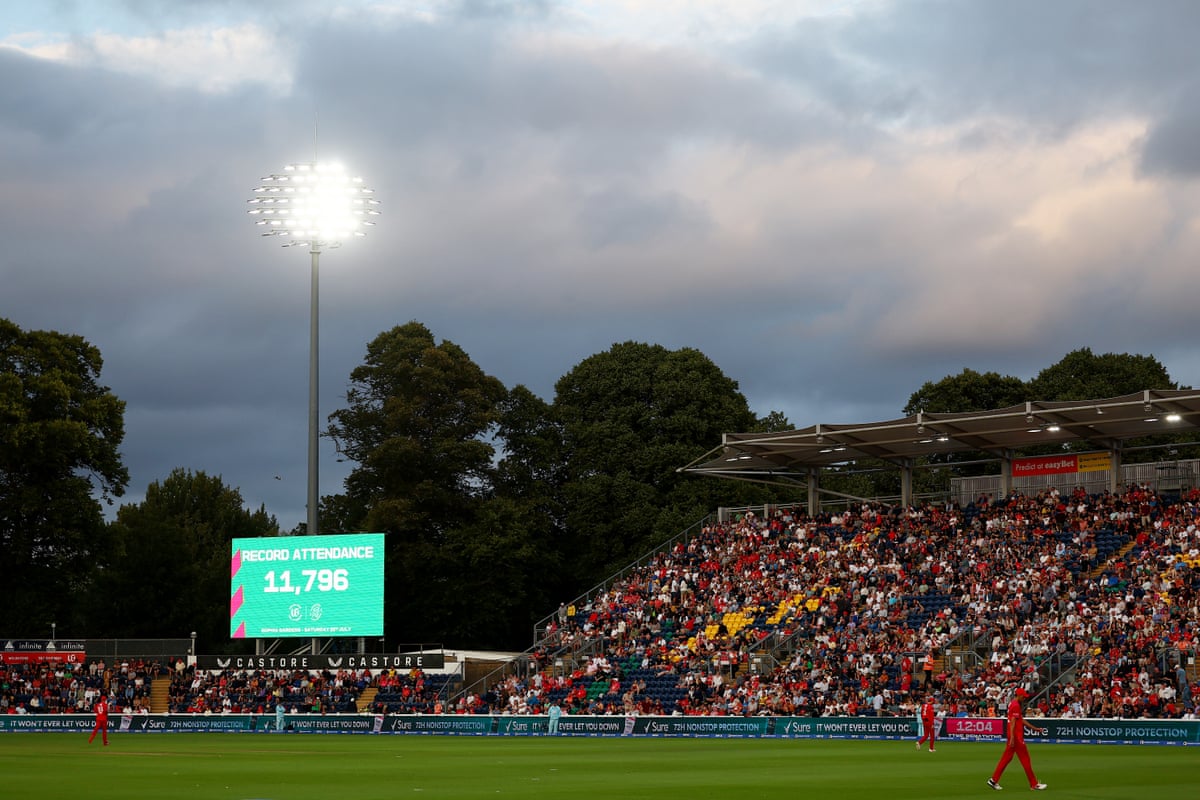
The ECB has confirmed that 550,000 tickets were sold and issued for this year's tournament, around 30,000 fewer than in 2025. Sunrisers Leeds suffered the steepest decline, with average attendance for men's matches at Headingley down 18% on last year's figures, a drop noted first-hand by several players. There were brighter spots elsewhere: Welsh Fire recorded their best-ever attendance in Cardiff, with a crowd of 11,796 turning out for the visit of MI London.

The governing body has pointed to operational changes as a key factor, since responsibility for ticket sales shifted from the ECB to individual franchises this year. It has also highlighted the historical link between crowd numbers and major international fixtures, noting that the competition's best-attended seasons in 2023 and 2025 directly followed an Ashes series and India's tour respectively, implying a weaker pull in years without such fixtures. Broadcast figures offered some encouragement, with average audiences on Sky Sports and the BBC up 7.5% on the previous year. Pricing has remained deliberately accessible throughout, with adult tickets for group-stage matches starting from £14 and tickets for children aged three to 15 fixed at £5 across every matchday, according to the Hundred's official pricing information.
How has the Trent Rockets found success?
Largely untouched by the investment management firm Cain compared with other franchises, Trent Rockets have been the standout side of the tournament, topping both the men's and women's tables to reach Sunday's finals at Lord's on the strength of runs from Sophia Dunkley and Ben Duckett. Mick Newell, director of cricket for both the Rockets and Nottinghamshire county side, credits continuity with the host club rather than any dramatic overhaul.
“It definitely was a conscious effort to put people in around the team who know the area, know the club and would make players feel comfortable very quickly. Even with private investment we're running it in a pretty similar way to the way we were doing it before.”
Peter Moores remains men's head coach across Notts and the Rockets, while Chris Read, who spent 20 seasons as a player at Trent Bridge, leads the women's side in the competition.
What has the transition meant for players like Georgia Adams?
Rockets all-rounder Georgia Adams has praised the environment built by Newell and Read after joining the franchise this year following four seasons with Southern Brave. Her move reflects the disruptive side of the tournament's reshaping: Adams reached three Hundred finals with the Brave and captained the side, but was released as teams rebuilt their squads through the new auction system, and Brave, now aligned with the IPL franchise Delhi Capitals, chose not to bid for her.
“It's a team that I cared so deeply about. Franchise cricket, for a lot of people, it's just walking into an environment, trying your best to perform for the team and leaving. For me, Southern Brave was so much more than that, naturally with the link with Hampshire.”
“My initial thoughts were that I probably was a bit pissed off, if I'm honest. A bit of anger but also a bit of disappointment that a franchise that I felt like I did my utmost for didn't even bid for me.”
Adams says her bond with supporters at Trent Bridge has been “epic”, but she has questioned what the wider rebranding has done to fan loyalty elsewhere in the competition.
“Looking at the competition, it's been quite sad. I remember watching a Sunrisers Leeds game and thinking, where is everyone? The ground's empty. And from our memories of playing at Leeds, it was a tough crowd to be the away team at. It was quite a loud, rowdy place to play your cricket. Maybe with the change of branding, changing of names, changing of ownership, it probably has deterred some fans. Equally, I guess some fans are also following players now.”
What is the historical context for the Hundred's struggles?
The competition launched in 2021 as a 100-ball format designed to produce matches lasting around two and a half hours, according to an early report on its launch. Financial projections at the time expected first-season revenue to come from broadcasting, sponsorship and ticket sales, with gate receipts estimated at around £6.5m, per ESPN's analysis of the tournament's finances. Before this year's private investment round, host counties held 51% stakes in their respective teams, according to the Economics Observatory, a structure now substantially altered by the sale process completed this year.
What happens next?
Finals day remains fixed at Lord's for both the men's and women's competitions, with fixtures and live match information continuing to be updated on the tournament's official website through the closing weekend of August. The unresolved questions raised by this season, over identity, attendance and the possible future shift towards a T20 format, are likely to shape discussions ahead of the 2027 edition.
- 550,000 tickets were sold and issued for the 2026 Hundred, around 30,000 fewer than in 2025
- Sunrisers Leeds saw an 18% drop in average men's match attendance at Headingley compared with last year
- Welsh Fire recorded their best-ever attendance figure, with 11,796 fans watching the visit of MI London in Cardiff
- The franchise sale valued the eight Hundred teams at more than £975m in total
- The men's salary cap rose to £2.05m per team and the women's to £880,000 under the new auction system


