

David Crowley formally accepted the Democratic nomination for Wisconsin governor at a press conference on 12 August 2026, promising to knit together a party still bruised from a bitterly fought primary ahead of the November general election. He thanked his progressive rival, Francesca Hong, for a campaign he said had shown Wisconsin voters that no cause is too ambitious to fight for, and he invited her supporters to join his coalition heading into the fall.
According to a national broadcaster's report, the Associated Press called the race for Crowley only after Hong conceded and confirmed she would not pursue a recount. That decision closed out one of the tightest statewide primaries of the cycle.
How close was the primary race?
The margin separating the two candidates was razor-thin. Per the same report, Crowley finished with 39.80% of the vote against Hong's 39.38%, according to figures compiled by Wikipedia's tally of the 2026 Wisconsin gubernatorial election, with the remainder split among other Democratic contenders. That gap was under a single percentage point, but it still cleared the 0.25-point threshold that would have required Hong's campaign to pay for a recount, the broadcaster's report noted.
Crowley's campaign said, per that same coverage, that he now intends to court not only Democrats but Republicans, independents and anyone who believes Wisconsin performs best when its residents cooperate, a notably wide framing for a candidate who only weeks earlier looked politically wounded.
What background led to this narrow victory?
Crowley's path to the nomination was anything but smooth. He briefly withdrew from the race before rejoining it after outgoing Governor Tony Evers threw his support behind him, a reversal archive reporting on the race traced back to delayed Milwaukee ballot counts that ultimately tipped the contest in his favor.
Polling in the run-up to the vote suggested Crowley faced a steep climb. A Politico analysis found he had trailed Hong by roughly 20 percentage points in surveys taken shortly before the primary, while a separate Wisconsin Public Radio report described Hong as holding a commanding lead even as Evers' endorsement bolstered Crowley's standing. Time magazine had also noted that, in the campaign's final days, roughly half of Democratic voters remained undecided, underscoring how unsettled the race was right up to polling day.
That volatility mirrored a broader argument playing out inside the party over strategy in swing states. Politico's coverage framed the Wisconsin contest as part of a larger debate over whether Democrats should back progressive standard-bearers in battleground territory or opt for more centrist figures seen as safer general-election bets.
What is Crowley's message to progressive voters?
Crowley pushed back on the idea that the primary had exposed an unbridgeable rift between the party's left and its center. He argued the divide was overstated even as he acknowledged real policy differences among Democrats.
We may not agree on every policy. We may not use the same labels, but we all want safe communities, strong schools, affordable health care, good-paying jobs, and a brighter future for all of our children.
He framed the general election as a fight against a shared threat rather than an internal Democratic squabble.
Every one of us has something much bigger to unite around, and that is keeping Maga extremism from bringing the chaos we see in Washington into our neighborhoods right here in the state of Wisconsin.
Asked how he intends to bring Hong's progressive base on board, Crowley said his approach would be to listen broadly rather than assume he already knew what voters wanted.
So many people have felt like they've been on the menu because nobody has asked them to lend their voices to the solutions.
He added that his focus now turns squarely to defeating his Republican opponent in November, congressman Tom Tiffany.
I look forward to earning their support.
For her part, Hong pledged to campaign for Crowley through the fall, framing her run as part of a longer movement rather than a single candidacy.
This campaign was not about getting one person into office. It is about a building movement for permanent affordability and a government that puts working people first. Our movement is strong and the work isn't done.
Hong said her priority going forward is ensuring Tom Tiffany, the Republican nominee, does not win the governorship.
Evers, who is not seeking re-election, praised Crowley's win and said his endorsement in July had been driven by confidence in Crowley's future within the party.
He's the future of our party. I can't wait for him to be our next governor.
Crowley will face Tiffany, a Trump-endorsed congressman who ran unopposed for the Republican nomination, in the November general election.
How is the Trump administration challenging mail-in voting rules?
Away from Wisconsin, the Trump administration escalated its legal fight over mail-in ballots. The Justice Department asked the Supreme Court on 12 August 2026 to intervene after US District Judge Indira Talwani in Boston blocked the US Postal Service from enforcing President Trump's executive order restricting mail voting nationwide.
Talwani ruled in favor of several voting rights groups represented by the American Civil Liberties Union, finding that the executive branch lacks authority to regulate elections, a power the Constitution assigns to individual states. Her decision built on an earlier June ruling that had already blocked the administration's mail-voting restrictions in 23 Democratic-led states and Washington DC, a ruling later upheld on appeal. The administration had already asked the Supreme Court to intervene in that earlier case.
Trump signed the underlying executive order in March, following years of criticizing mail-in voting and repeating the unsubstantiated claim that his 2020 election loss resulted from widespread fraud. The order directs the Department of Homeland Security to send states lists of voters it deems eligible, empowers the Justice Department to pursue local officials who issue ballots to people excluded from those lists, and requires the Postal Service to deliver ballots only to voters on state-approved mail-in rolls. The Postal Service had recently begun moving to implement the directive before Talwani's rulings intervened.

In its new filing, the Justice Department argued the lawsuits are premature, contending federal agencies have not yet taken concrete action that has harmed the plaintiffs and that any claimed harm remains speculative.
What happened aboard Air Force One during a security scare?
Separately, new details emerged about an episode last month in which President Trump was quietly moved off Air Force One via a catering truck and onto a different aircraft, reportedly in response to a possible Iranian assassination threat while he was in Turkey. More than a hundred aides, officials and journalists remained aboard the original plane without being told a threat existed.
Steven Cash, executive director of the Steady State and a former CIA intelligence officer who also advised the Department of Homeland Security's intelligence branch, criticized the arrangement.
It appears that the idea was we can reduce the danger to President Trump by offering up 100 or so people to be killed by the Iranians in his place.
Reporting indicated the president was accompanied on the switch by some of his closest, longest-serving aides, but no Cabinet officials. Those aboard the truck reportedly included Dan Scavino, the White House deputy chief of staff; Natalie Harp, the president's executive assistant; and Walt Nauta, director of Oval Office operations, according to an official familiar with the operation. Secretary of State Marco Rubio and other senior Cabinet figures were not among them, and it remains unclear whether every senior official involved knew in advance that they were flying separately from the president, much like the reporters assigned to cover him.
Trump addressed the episode publicly for the first time at Joint Base Andrews, saying the decision to move him to a different aircraft was made by the Secret Service.
The plane that I was on was at greater risk. Because that would be the plane that I think that they would be more likely to go for.
Senator Chris Murphy of Connecticut, a Democrat, called the operation \"unprecedented and surreal\" and \"downright scary,\" and pressed for a congressional briefing.
There has to be a congressional briefing because it involves not just the safety of the president. I want to know what precautions were taken to make sure that all of the passengers on that Air Force One, which was judged too dangerous for the president to fly on, what precautions were taken to keep the staff and reporters on that plane safe?
Why won't Mike Lindell concede in Minnesota?
In Minnesota, pillow salesman and election denier Mike Lindell refused to accept defeat in the Republican gubernatorial primary despite trailing by a double-digit margin. The Associated Press called the race for Lisa Demuth, the Minnesota House speaker, late on election night, with Demuth leading Lindell by more than 45,000 votes, 43.4% to 32.5%, once nearly all ballots were counted. Businessman Kendall Qualls, backed by the state Republican party, finished third.
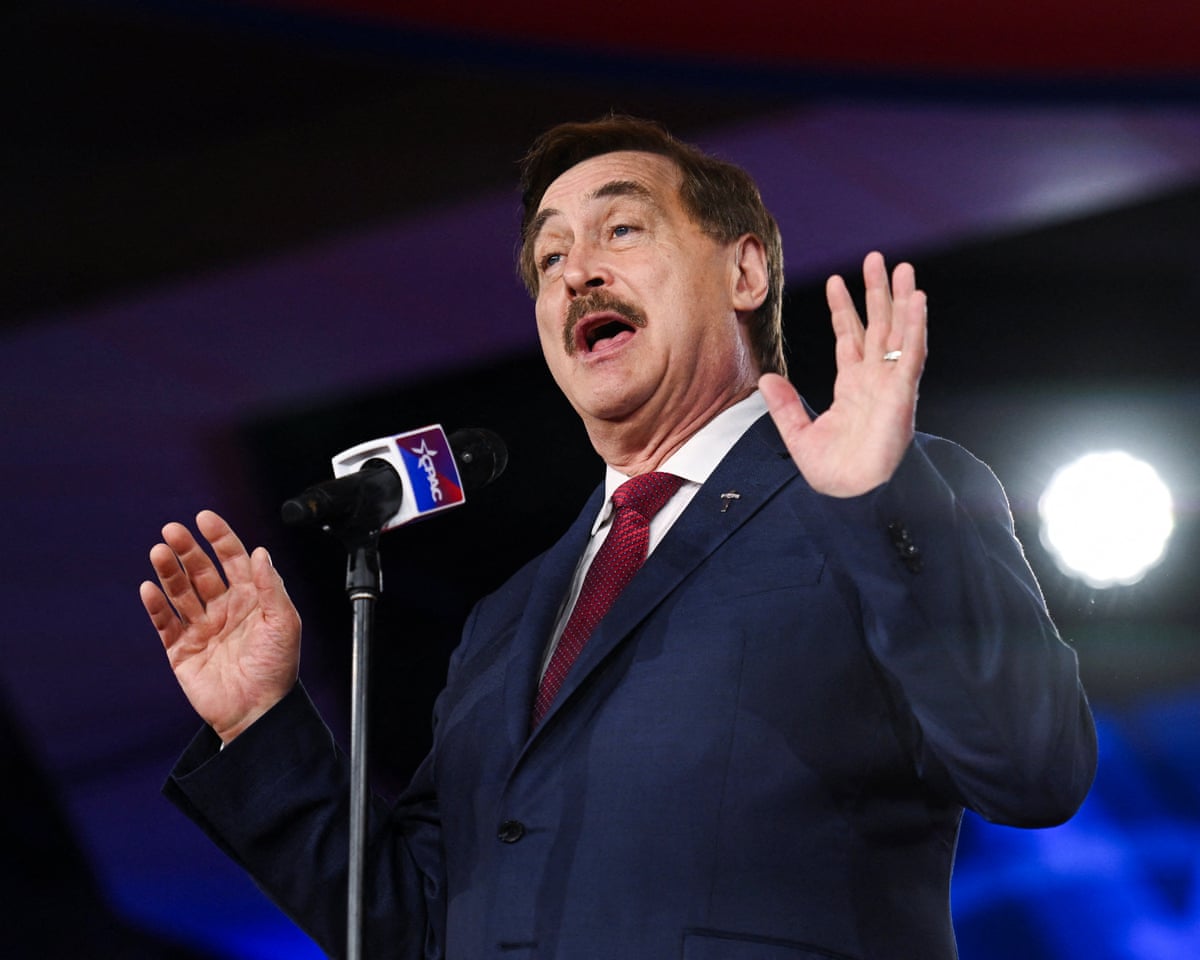
Told on his own streaming channel, LindellTV, that the AP had declared the race over, Lindell dismissed the call outright.
I'm not going to give up this race until the votes are counted. That's nonsense.
Lindell did not respond to a request for comment on what steps he might take to contest the outcome. He built his political profile on the false claim that Trump's 2020 defeat resulted from a rigged election, spending tens of millions of dollars pursuing that theory through lawsuits, documentaries and conferences even as courts repeatedly dismissed it. Last month he lost a lawsuit brought by voting technology company Liberty Vote, formerly Dominion Voting Systems, over his stolen-election claims.
His campaign was also dogged by questions over his eligibility to run, since his voter registration remained active in Texas, tied to a property in Lufkin owned by a company, even as he told reporters he had re-established Minnesota residency. The state's same-day registration rules allowed him to vote and run regardless. Trump, who has lost Minnesota in three consecutive presidential elections, made a late personal push for Lindell on social media, urging voters to hand him a decisive win. Lindell's loss extended a run of setbacks for Trump-endorsed candidates, including House races involving Tennessee representative Andy Ogles and Michigan navy veteran Amir Hassan, who lost to a candidate who had already dropped out.
What other primary results are shaping November's races?
Minnesota's other marquee contests also set up historic possibilities in the general election. In the governor's race, Democratic Senator Amy Klobuchar will face House Speaker Demuth; whichever wins will become the state's first female governor, and a Demuth victory would also make her Minnesota's first Black governor. In the race to succeed retiring Senator Tina Smith, Democratic Lieutenant Governor Peggy Flanagan and Republican Michelle Tafoya both won their primaries; a Flanagan win would make her the first Native American woman elected to the US Senate.
How does Alabama's new congressional map affect Black voters?
In Alabama, voters cast ballots for the second time this primary season after the Republican-controlled legislature redrew four of the state's seven congressional districts. The new map followed the US Supreme Court's decision to strike down a key section of the Voting Rights Act of 1965, prompting several Southern states to redraw districts in ways that consolidated Republican power. In June, the Supreme Court allowed Alabama to use a map that eliminates one of the state's two majority-Black districts for this year's elections.
The revised boundaries pose a significant challenge for Democratic Representative Shomari Figures, first elected in 2024 in a district created to include the largely Black cities of Mobile and Montgomery. The new district no longer includes Mobile, Figures' hometown. Rhett Marques, a Republican state representative and small-business owner newly placed in the district, won the Republican primary and will challenge Figures in November.
What other Wisconsin race made news?
Back in Wisconsin, Michael Alfonso, the 26-year-old son-in-law of Transportation Secretary Sean Duffy, won the Republican nomination for the state's seventh congressional district, a seat currently held by Tom Tiffany, who ran unopposed for the GOP gubernatorial nomination. Alfonso, who had Trump's backing, won in a landslide over four other Republican candidates in a district Duffy himself represented from 2011 to 2020 before leaving Congress.
What is the new Medicaid rule on gender-affirming care?
The Trump administration also finalized a rule ending federal Medicaid funding for gender-affirming care for transgender minors. Under the policy, the Centers for Medicare & Medicaid Services will bar states from seeking federal reimbursement for what the administration terms \"sex-rejecting procedures,\" a category that includes puberty blockers, hormone therapy and, in rare cases, surgery for transgender youth.
The rule takes effect on 13 October 2026. Beneficiaries will have up to six months afterward to claim coverage for hormone therapy medications already prescribed, while federal funding for talk therapy related to gender dysphoria will continue. President Trump wrote on Truth Social that his administration would not fund such treatment for minors, describing the procedures in stark terms.
We are not going to pay for our innocent children to undergo these barbaric surgeries and practices, which result in unthinkable and irreversible harm to their young bodies.
The rule extends the administration's broader campaign to cut federal support for providers treating transgender youth, despite such care being endorsed by major US and international medical bodies, including the American Academy of Pediatrics; providers have said treatment plans follow extensive evaluation and involve families throughout. Trump claimed dozens of US hospitals have already stopped offering the care under pressure from his administration. STAT News reported earlier this year that more than 40 hospitals had paused or ended some services for transgender youth since Trump returned to office, and separate reporting in February described New York City's NYU Langone Health ending its gender-affirming care program for minors. The new rule draws on a Department of Health and Human Services report that challenges the medical consensus on the benefits of such care for transgender youth.
What happens next?
Wisconsin's general election is set for November 2026, when Crowley will face Tiffany in a contest both parties view as pivotal to control of the governor's mansion. According to the earlier report on his nomination, Crowley's campaign says its immediate priority is uniting Democrats and expanding his coalition before then, a task complicated by the narrowness of his primary win and the polling deficit he overcame along the way. Meanwhile, the Trump administration's mail-in voting case now awaits a response from the Supreme Court, which is already weighing an earlier appeal covering the 23 states affected by Judge Talwani's June ruling.
Key Facts
- David Crowley accepted the Democratic nomination for Wisconsin governor on 12 August 2026, defeating Francesca Hong by 39.80% to 39.38%.
- Crowley will face Republican congressman Tom Tiffany in November's general election.
- The Trump administration asked the Supreme Court to overturn a ruling by Judge Indira Talwani blocking enforcement of restrictions on mail-in voting.
- Mike Lindell refused to concede Minnesota's Republican gubernatorial primary despite trailing Lisa Demuth by more than 45,000 votes.
- A new federal rule ending Medicaid funding for gender-affirming care for transgender minors takes effect on 13 October 2026.


