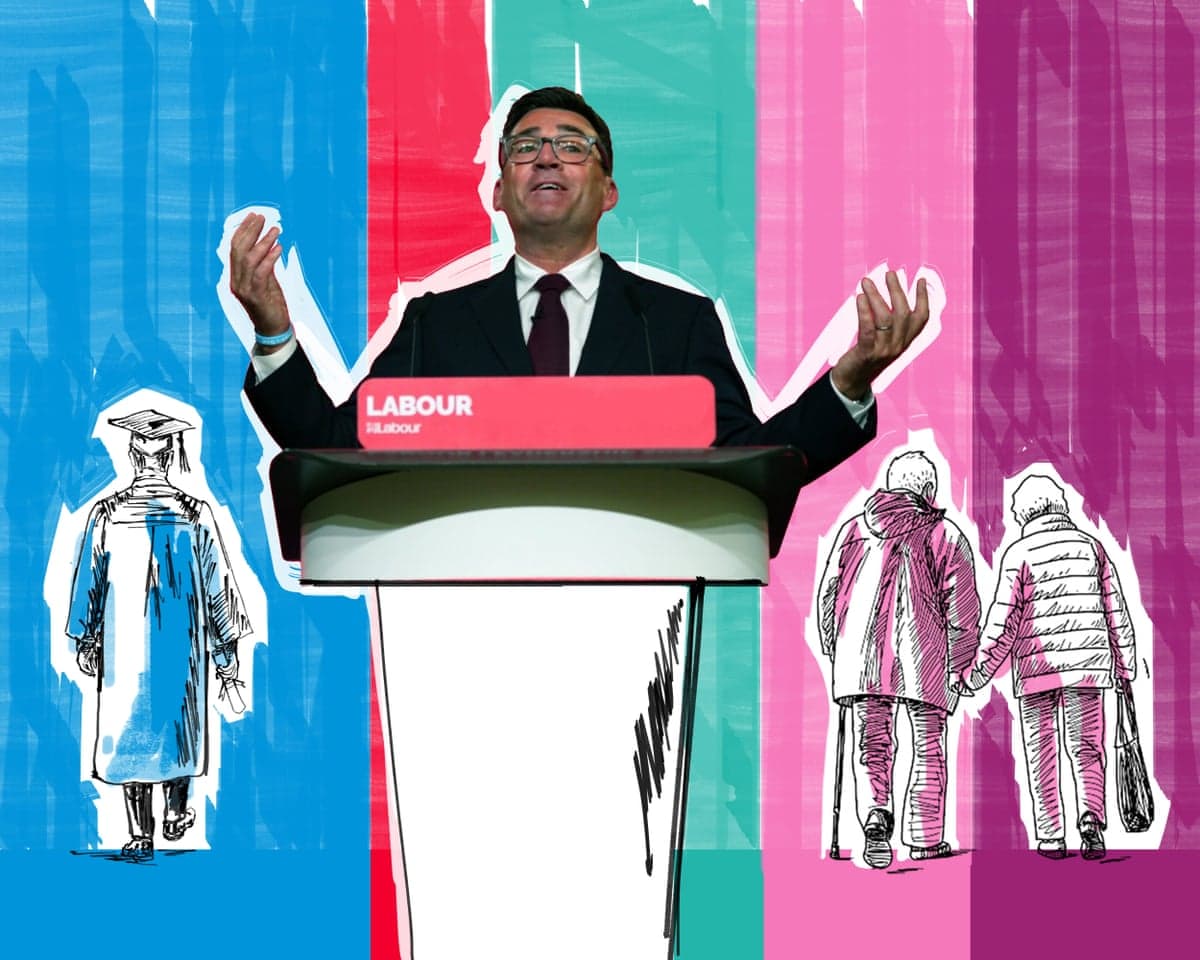
Widespread tactical voting at the next election could dramatically reshape parliament, pushing Reform into fourth place and bringing Labour within six seats of an overall majority, according to a major poll conducted in the first month of Andy Burnham's premiership.
The research, conducted by Survation and the progressive activist organisation 38 Degrees, surveyed more than 8,000 voters and included a detailed seat-by-seat MRP model. It reveals that left-leaning voters are returning to Labour in significant numbers, motivated primarily by a desire to prevent Nigel Farage's party from gaining power. Twice as many voters have switched back to Labour from the left as from the right since April.
The findings suggest that Burnham's strategy of uniting centre and left voters represents Labour's strongest path to victory, contrasting sharply with the approach taken before the 2024 general election, when the party pursued conservative older voters. According to YouGov's September 2026 analysis, Labour would defeat Reform 41% to 26% in a direct constituency contest, with Reform's support down 5 percentage points since February and Labour's up 6 points.
What would the current parliament look like?
Under the poll's base scenario, Labour would emerge as the largest party with 272 seats—a four-point lead—achieving 42% of parliamentary seats despite winning only 28% of the popular vote. Reform would become the official opposition with 153 seats, representing 24% of all seats and matching its vote share. The Conservatives would fall to third place with 85 seats.
The research identifies 200 seats as tight marginals decided by fewer than five percentage points, meaning a swing of just two to three points could determine the outcome in roughly 100 seats likely to decide the next election. However, a far higher proportion of voters in these marginal constituencies express willingness to vote tactically than currently do so.
How much could tactical voting change the outcome?
The transformative potential emerges when voters switch from their preferred party to whichever of the two frontrunners is best placed to win locally. Approximately 18% of voters living in seats where tactical voting would make a substantial difference say they are willing to vote tactically but are not yet doing so. If these voters acted as they indicated, Reform's seat count would collapse to just 62 seats, while Labour would reach 319 seats—only six short of an overall majority.
Of the 91 seats Reform would lose under this scenario, 46 would go to the Conservatives and 43 to Labour. Reform's chances of winning fell by more than 50 percentage points in 59 seats, including the Wrekin, Torridge and Tavistock, and North West Cambridgeshire, all of which currently favour Reform under standard assumptions but would flip to the Conservatives with increased tactical voting.
In Rawmarsh and Conisbrough, held by Chancellor John Healey with 49% of the vote in 2024 while Reform came second on 28.6%, the MRP model suggests Reform has a 51% chance of winning under normal circumstances. However, this probability plummets to just 24% if tactical voting increases, giving Labour a 76% chance of retaining the seat.
Bassetlaw presents an even starker illustration of tactical voting's power. Reform could lose the seat even as its own vote share rises from 35% to 40%, because tactical switching would lift Labour further—from 32% to 40%. The forecast shifts the likely winner from Reform, with a 77% probability, to Labour, with a 58% probability.

Newark, held by Conservative-turned-Reform MP Robert Jenrick, is forecast to flip to the Conservatives under both scenarios, though under heavier tactical voting the probability of a Conservative victory increases from 68% to more than 99% should Labour supporters vote Conservative to block him.
What do voters say about tactical voting?
Damian Lyons Lowe, Survation's chief executive, described the mechanics of tactical voting as straightforward despite its complexity in estimation.
Four in 10 voters are currently backing a party that can't finish in the top two where they live and are willing to vote tactically. But when we ask whether they would lend their vote to the stronger local contender in a two-horse race, around half said yes. That gap – worth some 18 points of the national electorate – is an enormous untapped reservoir for parties looking to squeeze voters.
Should these voters act as they say, our model shows Reform falling from second place to fourth, losing around 90 seats, despite its own vote share actually going up. Reform-leaning Conservatives will consolidate too. Reform doesn't collapse; it risks being outnumbered, seat by seat, by voters coordinating around whoever is best placed locally on the left and right.
The prediction faces complications from the substantial number of Conservative-held seats where the party has polled as low as third over the past year. Progressive voters in seats such as Labour-held Southend would be unlikely to vote Conservative even if technically best placed to beat Reform, illustrating the limitations of tactical voting predictions.
How is Labour recovering lost voters?
The poll indicates Labour is reclaiming considerable numbers of voters from other left-wing parties but not from Reform. The share of Labour's 2024 defectors going to the Greens, Liberal Democrats, Plaid Cymru or the Scottish National Party has fallen from 60% to 46%. By contrast, among those lost to Reform or the Conservatives, the recovery rate has fallen only from 27% to 24%, suggesting Reform retains stronger hold over its supporters.
This recovery of left-wing voters reflects Burnham's appeal since his election as Labour leader on 17 July 2026, when he won support from 379 Labour MPs and 23 affiliate organisations. Lord Ashcroft's September 2026 polling found that Labour's lead disappears entirely when the right unites, with the Labour advantage shrinking by 2 percentage points if voters face a Conservative-Reform alliance. The same analysis showed that the Conservative-Reform alliance's combined vote share of 41% translates into only 28% support in tactical-voting scenarios, a 13-percentage-point shortfall.
Veronica Hawking, campaigns director at 38 Degrees, emphasised that the polling indicated a far more optimistic public mood than before Burnham's election, though voters also held significant expectations that he would deliver results.
There are signs of optimism and even hope, but what has not changed is the way voters are crying out for bold action, fast. The results show a huge amount of common ground between voters, especially when it comes to the cost of living. Voters who have moved in different directions since the general election two years ago are united by the fact that action on the cost of living crisis will have the single biggest bearing on their future vote.
What happens at Labour's conference?
The poll was released on the eve of Labour's annual conference in Liverpool, where Burnham will deliver his first leader's speech. According to reporting on his conference plans, Burnham will set out a "new direction" and say it is "time for Britain to believe again". However, the conference weekend faces disruption from protests over Labour's trans policy, which threaten to overshadow Burnham's first major event as party leader.
The findings will encourage those within Labour considering an early election while Reform's ratings are declining and left-wing parties such as the Greens appear to be losing momentum. The research suggests that Burnham's leadership has begun to shift the electoral landscape in Labour's favour, though the projection is unlikely to prove exact at this stage in the electoral cycle.