

Reform UK has laid out a plan it says would strip more than £50bn a year from the UK's welfare bill by 2030 if the party wins power, largely by removing most benefits from foreign nationals and overhauling disability payments. Analysts have cast doubt on whether the figures are achievable, noting that key details remain unclear and that some savings could be offset or blocked by legal and diplomatic obstacles.
The party's finance spokesperson, Robert Jenrick, set out the package on 16 August 2026, with reporting at the time indicating it would include a sweeping ban on almost all benefit entitlements for foreign nationals, according to a report by a national newspaper. The plan was formally detailed the following day, on 17 August 2026, and included a new flat-rate "health security allowance" of £429.80 a month intended to replace Personal Independence Payments (PIP) and part of Universal Credit for some claimants, according to a report by a national newspaper.

How big a cut is Reform proposing?
The UK government is expected to spend £353bn on welfare benefits this year, with roughly half of that going towards the state pension - a payment Reform says it would leave untouched. That leaves around £207bn in remaining welfare spending, meaning Reform's proposed £50bn reduction would amount to close to 25% of everything left, a target analysts describe as extremely ambitious.
Of that £50bn target, Reform says around £21bn would come from changes to health and disability benefits, including PIP. The Institute for Fiscal Studies has said there is "relatively little detail" about how the party intends to achieve this.
What would change for disability benefit claimants?
PIP is a working-age payment designed to help people cover the extra costs associated with a physical or mental health condition or disability. The number of claimants has climbed sharply, from around 2.4 million before the coronavirus pandemic to four million across England and Wales this year.
Reform says it would protect those with the most severe disabilities, but around 2.89 million existing PIP claimants would be "reassessed over time," a process that could see current payments "modified or withdrawn" and replaced by a new "Disability Needs Assessment." Separate reporting from ITV on 16 August 2026 suggested that almost three million people could see their disability and sickness payments withdrawn or altered under the proposals, according to ITV.
Campaigners warned on 17 August 2026 that the changes, combined with a proposed reinstatement of the two-child benefit limit that had been scrapped by the current government, could push hundreds of thousands of children into poverty and destitution, according to a report by a national newspaper.
The scale of change to the disability benefits system is not confined to Reform's proposals. A government-commissioned review published in July 2026 concluded that the existing PIP assessment process was "dehumanising" and not fit for purpose, a finding that has already fed into the current administration's own plans for reform, according to Bloomberg.
How would foreign nationals be affected?
A second major plank of Reform's savings plan involves removing benefit eligibility from foreign nationals. The party estimates this could save around £20bn towards its £50bn target if people were barred from claiming benefits including Universal Credit.

More than a million Universal Credit claimants were born overseas, among them roughly 700,000 EU citizens who arrived in the UK before Brexit and retain the right to live and work in the country. Around half of EU citizens claiming Universal Credit are also in employment. The government does not publish comparable figures for foreign nationals claiming other benefits.
Reform has separately said that ending foreign nationals' eligibility for almost all benefits except pensions could save closer to £21bn a year within five years, according to The Telegraph, which also reported that the ban could apply to as many as 4.5 million EU citizens holding settlement rights in the UK.
Removing these entitlements would not be straightforward, since it risks conflict with the European Union. Around 4.5 million EU citizens hold long-term settlement rights in the UK entitling them to claim benefits, while an estimated one million UK citizens living in the EU have equivalent rights. Stripping EU citizens of these rights could prompt retaliatory measures from member states.
Reform says it would seek to renegotiate the post-Brexit settlement underpinning these rights, effectively reopening an agreement that was intended to have been finalised in 2020. There is also a risk that any projected savings could shrink significantly if large numbers of EU nationals respond by applying for UK citizenship, which would allow them to retain their benefit entitlements.
What other savings measures has Reform proposed?
Reform says it is considering switching to a less generous measure of inflation when calculating annual benefit increases, a change it estimates could save £4.8bn a year. The party also plans to increase spending on tackling benefit fraud, projecting savings of up to £2.8bn a year, though other governments have had mixed success pursuing similar anti-fraud drives in the past.
The party has additionally pledged that long-term welfare claimants who are fit to work would be required to complete 20 hours of unpaid community work each week through council-run schemes. Reporting on 17 August 2026 confirmed the compulsory workfare element would apply to thousands of long-term unemployed people, according to a report by a national newspaper. It remains unclear how much this scheme would actually save on welfare spending, given that councils would incur their own costs running the programmes.
Reform is far from alone in proposing an overhaul of the welfare system. A review of PIP led by a government minister concluded the system was "not fit for purpose," and the current administration is expected to publish its own reform proposals later this year. Separately, changes that took effect in April 2026 already reduced the Universal Credit health element for new claimants while increasing standard Universal Credit rates, according to government guidance. Reform had also previously linked its welfare cuts to protecting the pensions triple lock and targeting recent arrivals, including those who entered the country illegally, according to the BBC, reported in April 2026.
Could this be a political risk for Reform?
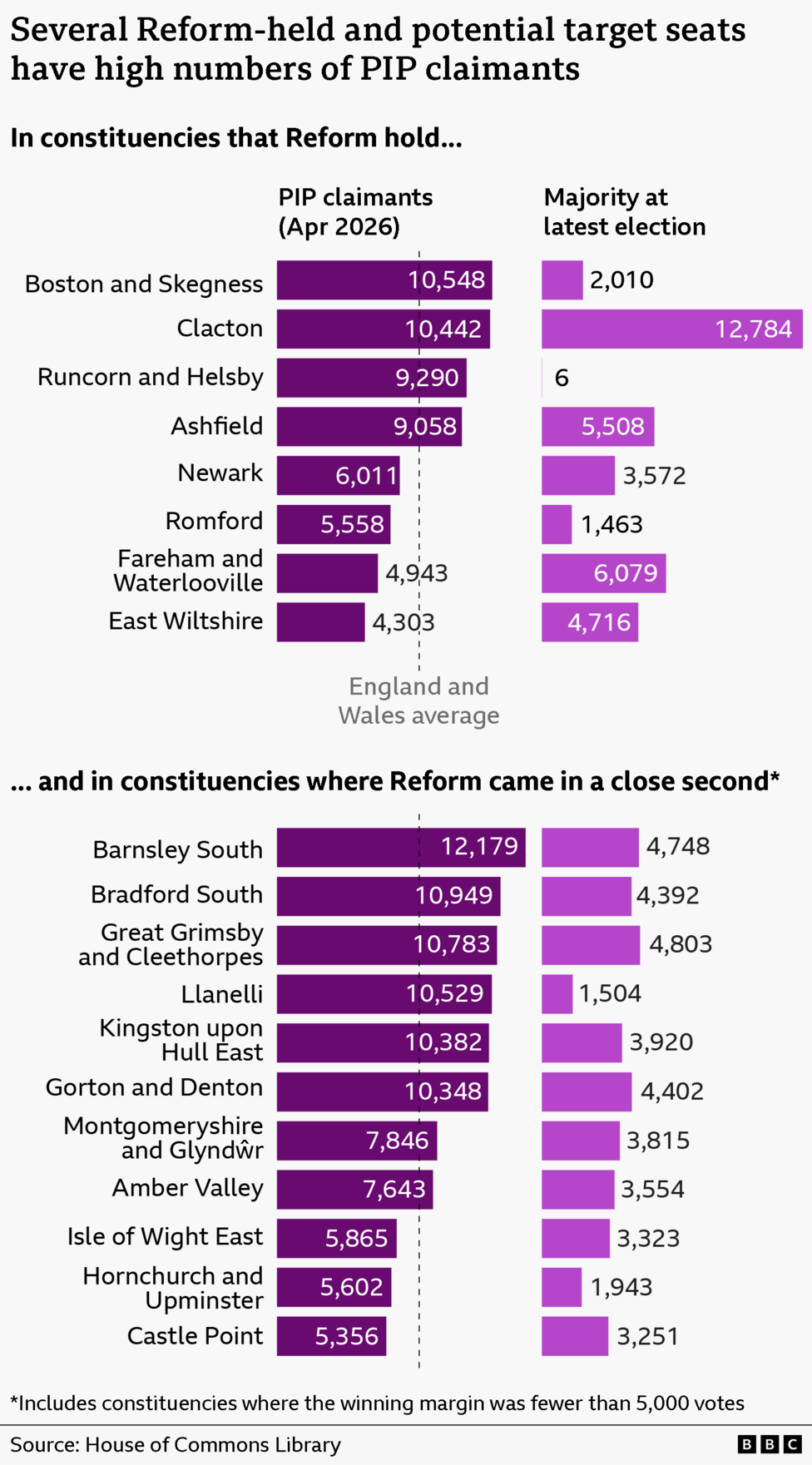
Several prominent Reform MPs represent constituencies, including Boston and Skegness and Ashfield, where the number of PIP claimants exceeds the national average. In some of these seats, the number of claimants is larger than the MP's electoral majority - a pattern that also holds in several of the party's key target seats. Pursuing such deep cuts to disability benefits therefore carries clear electoral risk in areas the party currently holds or hopes to win, a trade-off Reform appears willing to make.
What happens next?
The government's own welfare eligibility changes are set to tighten further from November 2026, marking the next scheduled shift in the system regardless of Reform's proposals, according to the BBC. Under the existing official timetable, the Work Capability Assessment is due to be abolished entirely in 2028, according to the BBC. Reform has said its own changes, including the reassessment of PIP claimants, would be phased in "over time" rather than applied immediately, according to the BBC.
Key Facts
- Reform says its plan would cut over £50bn a year from welfare spending by 2030, roughly 25% of the £207bn left after excluding the state pension.
- Around 2.89 million PIP claimants would be reassessed, with payments potentially replaced by a new £429.80-a-month "health security allowance."
- Reform estimates £20bn-£21bn in savings from barring foreign nationals, including up to 4.5 million EU citizens, from most benefits.
- The plan also includes reinstating the two-child benefit limit and compulsory 20-hour weekly unpaid work for long-term claimants.
- Government eligibility changes tighten from November 2026, with the Work Capability Assessment scheduled for abolition in 2028.


