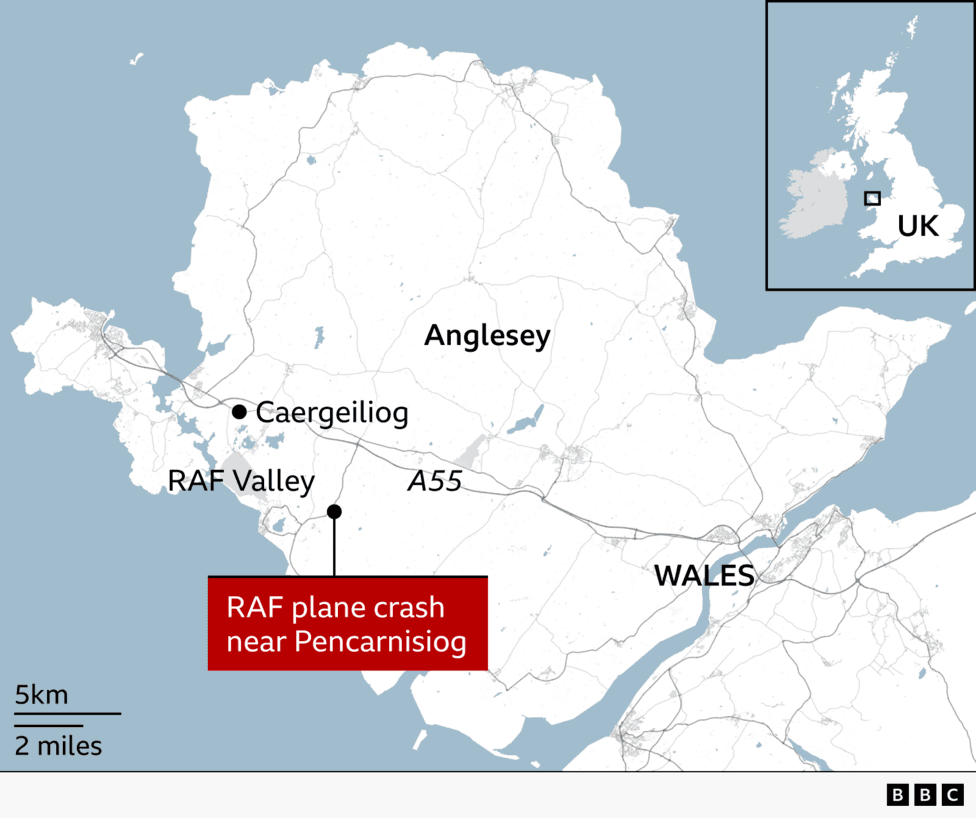
Two pilots successfully ejected from an RAF Hawk T2 training jet moments before it crashed and erupted in flames near Pencarnisiog on Anglesey. The aircraft had been operating from RAF Valley when the incident occurred, prompting the RAF to temporarily pause all training flights on these jets as a precautionary measure. North Wales Police confirmed that both pilots sustained only minor injuries during the emergency evacuation.
Video footage captured during the incident shows the two aircrew ejecting from the aircraft before it plummeted to the ground in a dramatic sequence that experts have described as remarkable. According to aviation reporting, eyewitnesses described a "wall of fire" erupting at impact, with the jet narrowly missing residential properties in the vicinity. An official investigation is now underway to establish the cause of the crash.
Where did the incident occur?
The Hawk T2 was operating from RAF Valley, a major fast-jet training establishment on Anglesey, when it encountered difficulties during flight. The aircraft came down at Pencarnisiog, a location in close proximity to the base. RAF Valley serves as both a basic and advanced fast-jet training facility for the Royal Air Force.
According to security analyst Mikey Kay, who served as an RAF pilot for 20 years, the geography of the Anglesey region made it ideally suited for the type of advanced training these jets conduct. The area forms part of the RAF's designated low-flying system, which comprises 20 tactical training areas distributed across central Wales, northern Scotland, the Scottish borders, and northern England.
The crash site lies near the Machynlleth Loop, a series of valleys stretching between Dolgellau in Gwynedd and Machynlleth in Powys. This location, also known as the Mach Loop, has become well-established as an attraction for aviation enthusiasts and photographers who monitor military training operations. The proximity to this popular spotting area meant the incident drew immediate attention from local residents and aviation observers.
Kay explained the strategic value of the location for pilot development:
These pilots they train in low level, they train in instrument flying, formation flying, general handling, so that area, the Anglesey area and its accessibility to all of those landscapes for the requirement of training is perfect.
What aircraft was involved in the crash?
The jet involved was a Hawk T2, a twin-seat advanced training aircraft manufactured by BAe Systems. This variant represents the most sophisticated fast-jet trainer in RAF service, featuring an advanced glass cockpit and control systems designed to mirror those found in the Typhoon fighter jet. The T2 is specifically used to provide the most advanced fast-jet training available to RAF pilots preparing for operational squadrons.
The RAF also operates the older Hawk T1 variant, which is notably flown by the Red Arrows aerobatic display team. The service's decision to pause training affected both versions of the aircraft. The Red Arrows were not scheduled to resume flying until the Le Touquet Airshow in France, and the timeline for lifting the restriction remained unclear at the time of the incident.
What does the footage reveal about the sequence of events?
Video evidence shared by Kay shows flames rising visibly from the rear section of the T2 as the aircraft accelerates along the runway. As the jet climbs into the air, these flames appear to diminish. The exact timing of the pilots' ejection relative to takeoff cannot be determined from the available footage.
Kay provided technical analysis of what the video demonstrates about the aircraft's condition. The Hawk T2 is a non-reheated jet, meaning it lacks afterburner capability—a secondary combustion system that injects raw fuel into the engine's exhaust stream to provide rapid thrust increases. This distinguishes it from aircraft such as the F-18 or Tornado, which produce distinctive orange flames from their exhausts during afterburner operation.

The critical observation from the footage is that flames visible in the video appear to emanate from the side of the engine housing rather than from the engine exhaust itself. Kay identified this location as the area where the aircraft's main hydraulics system is positioned—the system responsible for controlling the jet's flight surfaces and overall controllability.
You never ever see flames coming out of the back of a Hawk,Kay stated, emphasizing the unusual nature of the visible flames in this incident.
While preliminary assessment suggests the cause may not be a conventional engine failure, Kay cautioned that it remains too early to draw definitive conclusions about what triggered the emergency.
Why did the flight continue after the problem was detected?
Video evidence examined by Kay included footage of a red and white van positioned at the side of the airfield. This vehicle was not part of air traffic control infrastructure but rather belonged to aviation spotters monitoring the training operation. These spotters lack direct communication capability with the aircraft and possess no authority to instruct a jet to abort its flight.
Although the spotters' van maintains a direct line to air traffic control, the timing of any communication creates a critical constraint. Kay explained that
by the time that conversation has happened, the jet is already airborne.This means that even if spotters had detected an anomaly and reported it, the aircraft would already be in flight and beyond the point where ground personnel could intervene to prevent takeoff.
How did the pilots successfully escape?
Video footage captured the dramatic moment both pilots ejected from the aircraft before it entered its final descent. The sequence shows the two aircrew departing the jet successfully, followed by the aircraft nosediving toward the ground where it impacted and burst into flames. The ejection seats proved decisive in saving both pilots' lives during this critical emergency.
The Hawk T2 provides two distinct ejection options for its crew. In the typical configuration, which pairs an experienced instructor pilot with a student, each pilot can initiate individual ejection by pulling a black and yellow ring positioned between their legs. Alternatively, a command ejection system allows one pilot to eject both seats simultaneously, with the rear-seat occupant departing first.
When a pilot initiates ejection, the system activates a miniature detonation cord (MDC)—a thin explosive line designed to shatter the aircraft's canopy instantaneously, creating an opening for the seats to clear the airframe. Kay described the engineering achievement:
The aircraft seat is designed for the pilot to be able to eject at zero speed and zero height, and that will allow enough time for the parachute to inflate, and then the pilots hit the ground.
Kay noted that this incident represented
the first known case of this variant, the T2, ejecting pilots out of it,while emphasizing that the safety record of these aircraft remains
obviously very good.The successful ejection and parachute deployment in this instance demonstrated the effectiveness of the system's design and engineering.
What happens next?
The RAF investigation into the crash remains ongoing, with the service declining to provide further commentary at this stage of the inquiry. Training restrictions on Hawk T1 and T2 aircraft remain in effect while the RAF conducts its assessment of the incident and determines whether systemic issues require attention before operations resume. The service will not lift the pause until investigators have established the cause and confirmed that similar incidents can be prevented.
Key Facts:
- Both pilots ejected successfully and sustained only minor injuries in the incident near Pencarnisiog on Anglesey
- The Hawk T2 is an advanced twin-seat training jet featuring glass cockpit technology and control systems mirroring the Typhoon fighter
- Video evidence suggests the problem may have originated in the hydraulics system rather than the engine itself
- The ejection seat system successfully functioned at low altitude, allowing both pilots to deploy parachutes and reach the ground safely
- RAF training on both Hawk T1 and T2 variants remains paused pending completion of the official investigation