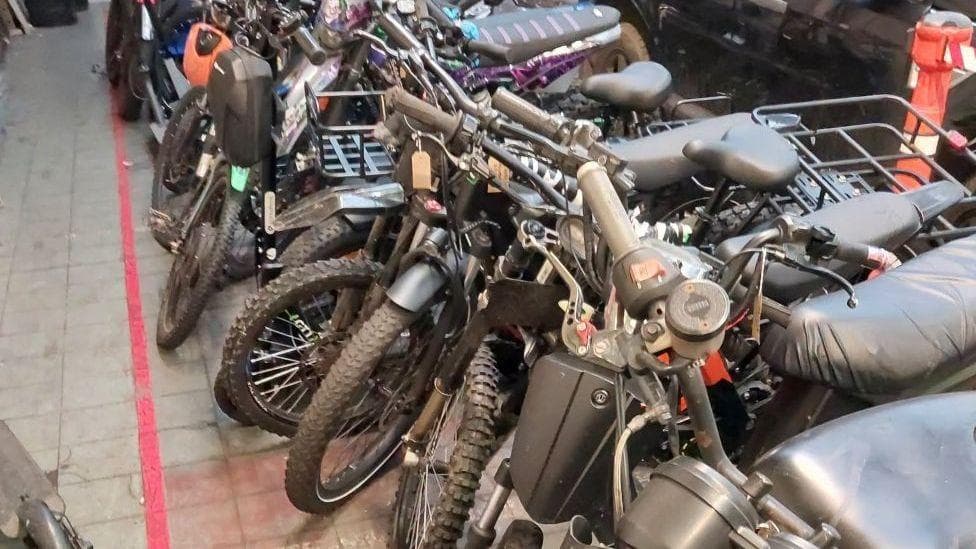
Police Scotland will destroy more than 140 electric bikes and scooters that were confiscated during a week-long enforcement operation in October. The seizures are part of an intensifying nationwide effort to remove illegally modified vehicles from public roads, with BBC News reporting that officers took 99 e-bikes and 43 e-scooters during Operation Overlap, which ran between 19 and 25 October.
The confiscations bring the year's total to 1,000 vehicles seized up to 16 October, with Glasgow accounting for the largest share. According to Police Scotland, Greater Glasgow alone accounted for 54 of the 142 vehicles seized during Operation Overlap.
The scale of enforcement has grown dramatically. Police Scotland figures show that officers seized 373 e-bikes and 196 e-scooters in 2025, representing a rise of more than 60% compared to the previous year.
Why are these vehicles being targeted?
Superintendent Andy Barclay explained that illegally modified e-bikes present significant dangers and are unsuitable for use on public roads.
They pose a risk to their own riders, the emergency services and other road users, particularly pedestrians.He emphasised the importance of public awareness regarding legislation and personal responsibility when using such vehicles.
We also want to make sure that people are aware of the legislation and their personal responsibilities if using an e-bike or e-scooter. Please be mindful of where you can and can't use vehicles of this type and take responsibility for your own actions and the safety of other road users.
E-bikes and e-scooters have become increasingly prevalent across Scottish towns and cities. While most users operate their vehicles in accordance with legal requirements, some modify them to exceed permitted speed and power limits, which can reclassify them as motor vehicles subject to stricter regulations.
What are the legal requirements for e-bikes?
E-bikes are permitted on public roads only when they meet specific technical standards. The motor must be incapable of propelling the bike when travelling faster than 15.5 miles per hour, and the maximum power output cannot exceed 250 watts. Vehicles exceeding these limits are classified as motor vehicles under the Road Traffic Act, requiring the rider to hold a full UK driving licence, possess valid insurance, and wear an approved helmet. Non-compliance with these requirements can result in enforcement action.
What about e-scooters?
E-scooters face stricter restrictions than e-bikes. They are not permitted on public roads, pavements, or other public spaces because they do not meet the necessary legal standards. Their use is only lawful on private land with the explicit consent of the landowner.
How does this fit into broader enforcement efforts?
Operation Overlap is part of a wider crackdown on illegal e-bike and e-scooter use across the UK. In June 2026, fifty people were charged in Aberdeen following Operation Armour, which seized 34 vehicles and identified 154 crimes. That operation reflected growing concern about antisocial use of modified e-bikes in the city, with government officials subsequently meeting police leadership to discuss the issue. In September 2026, Belfast police seized 65 e-bikes and e-scooters during a three-day crackdown, with seven arrests made and £3,600 in cash recovered.
Police forces across the UK are deploying increasingly sophisticated enforcement methods. Specialist teams, drones and seizure powers are being deployed, while authorities explore additional measures including face-covering restrictions, parental accountability schemes and youth engagement initiatives.
Recent enforcement activity in Scotland
The crackdown continues beyond Operation Overlap. On 29 October, Renfrewshire police seized an e-scooter and charged a 15-year-old with multiple road-traffic offences after spotting him riding in Renfrew. In Fife, officers seized 13 e-scooters and one e-bike during Operation Overlap activity from 22 to 24 October, targeting reported hotspots following antisocial-behaviour incidents.
Key Facts
- Police Scotland seized 99 e-bikes and 43 e-scooters during Operation Overlap between 19 and 25 October, bringing the year's total to 1,000 vehicles
- E-bikes must not exceed 15.5 mph or 250 watts; those that do are classified as motor vehicles requiring a driving licence, insurance and helmet
- E-scooters are illegal on public roads and pavements; they may only be used on private land with owner consent
- Police Scotland seized 569 e-bikes and e-scooters in 2025, a 60% increase on the previous year
- Enforcement operations are ongoing across Scotland, with recent seizures in Renfrewshire and Fife following antisocial-behaviour reports