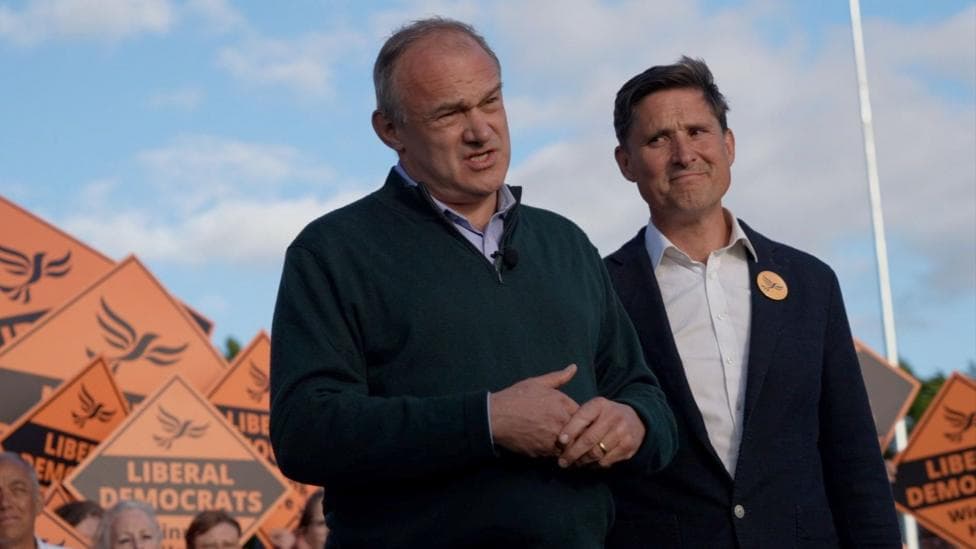
Liberal Democrat MP Charlie Maynard has stepped down from his position as Treasury spokesman, signalling growing discontent within the party over Sir Ed Davey's continued leadership. The Witney MP's departure, first disclosed by the Financial Times, reflects tensions that have simmered beneath the surface of the party since its strong performance in the 2024 general election.
Those familiar with discussions among senior Liberal Democrats acknowledge that a faction of MPs harbour reservations about Davey's direction, with Maynard now openly among them. Daisy Cooper, the party's deputy leader, moved quickly to defend the leader, stating that
"the vast majority of our MPs support Ed, want him to lead the party into the next election, and are furious at this distraction."The party has not yet provided a statement from Maynard himself on his reasons for resigning.
The resignation comes against a backdrop of internal frustration that has been building for months. At the party's September conference in Brighton, tensions surfaced when Devon County Council leader Julian Brazil declared the Liberal Democrats were
"sleepwalking into irrelevance"and questioned whether Davey remained the right person to lead the party forward. These concerns have persisted despite the party's historic 2024 election result, which delivered 72 seats—its best performance in decades.
What would trigger a formal leadership challenge?
Under Liberal Democrat party rules, a leadership contest can be initiated if a majority of all parliamentary MPs pass a vote of no confidence in the leader. To stand as a candidate in such a contest, an MP must secure nominations from at least 10% of the parliamentary party, excluding themselves, and demonstrate backing from 200 members spread across a minimum of 20 local parties. These thresholds mean that while Maynard's departure signals discontent, a formal challenge would require significantly broader support to materialise.
Why has Davey faced recent criticism?
Much of the recent internal friction has centred on Davey's response to the government's plans to modify the pension triple lock—the mechanism ensuring the state pension rises annually in line with inflation, wage growth, or 2.5%, whichever is highest. When Andy Burnham announced adjustments to the policy, Davey criticised the move, arguing it would
"put more pensioners into poverty"and harm younger workers. He elaborated:
"This would mean people who are working hard now - the millennials - when they retire would have a very poor pension."
Several Liberal Democrat MPs have privately disagreed with this stance. One frontbench figure dismissed his argument as
"nonsense,"while another countered that
"Most millennials don't think there will be a state pension when they retire so this isn't being done with them in mind."These disagreements reflect deeper strategic divisions within the party about how to position itself and which voters to target.
How has the party performed since the election?
Despite winning 72 seats in 2024—a landmark achievement—the Liberal Democrats have struggled to build momentum. Polling numbers have remained relatively subdued, and the party has grappled with questions about its relevance and direction. Davey's allies have argued that his strategy is designed to appeal to former Conservative voters, but critics within the party have pushed for bolder messaging and a clearer vision for what the Liberal Democrats stand for.
The internal pressure intensified at the September conference, where senior figures demanded more assertive positioning. According to reporting on the conference, frustration extended to both strategy and leadership, with some questioning whether Davey's approach was sufficient to sustain the party's growth.
What is the current state of party unity?
Davey has led the Liberal Democrats for six years and remains the architect of their 2024 election strategy. However, his position has become increasingly scrutinised. The party's parliamentary chair, Roz Savage, won her role uncontested and has also publicly criticised Davey, suggesting that discontent extends beyond backbench MPs to senior party figures.
Cooper's assertion that the vast majority of MPs support Davey appears designed to contain the narrative around Maynard's departure and prevent it from triggering further resignations or public dissent. Nevertheless, the fact that such a statement was necessary underscores the fragility of the consensus around the leader.
What happens next?
No immediate leadership challenge has been reported. However, one MP indicated to the Spectator that a potential crunch point could arrive after the local elections scheduled for spring, particularly if the party's performance disappoints. In the meantime, Davey is preparing the party for the possibility of an early general election. On 9 October, Davey announced that the Liberal Democrats had established a manifesto working group and would be ready for a snap election, signalling his intention to move forward with his leadership intact.

Key Facts
- Charlie Maynard resigned as Treasury spokesman on Friday, citing concerns over Davey's leadership
- A formal leadership challenge would require nominations from at least 10% of Liberal Democrat MPs and backing from 200 members across 20 local parties
- Internal tensions have centred on Davey's response to pension triple lock reforms and broader questions about party strategy
- The Liberal Democrats won 72 seats in 2024 but have struggled to build on that success, with polling remaining subdued
- A potential leadership crunch point could occur after local elections in spring 2027, depending on the party's electoral performance