

Hundreds of thousands of students across England, Wales and Northern Ireland are preparing to collect their GCSE results, with England's results falling on Thursday 20 August 2026, according to Ofqual's guidance for 2026. In England, GCSEs are marked on a numerical scale running from 9 down to 1, having replaced the earlier A*-to-U letter system, while Wales and Northern Ireland continue to use letter grades and Scottish pupils sit Nationals rather than GCSEs.
How does the 9-1 grading scale work?
The numerical system was introduced alongside a wider overhaul of the English curriculum in 2014, with English language, English literature and maths becoming the first subjects to switch to number grades in 2017. By 2020, every GCSE subject had moved onto the new scale.
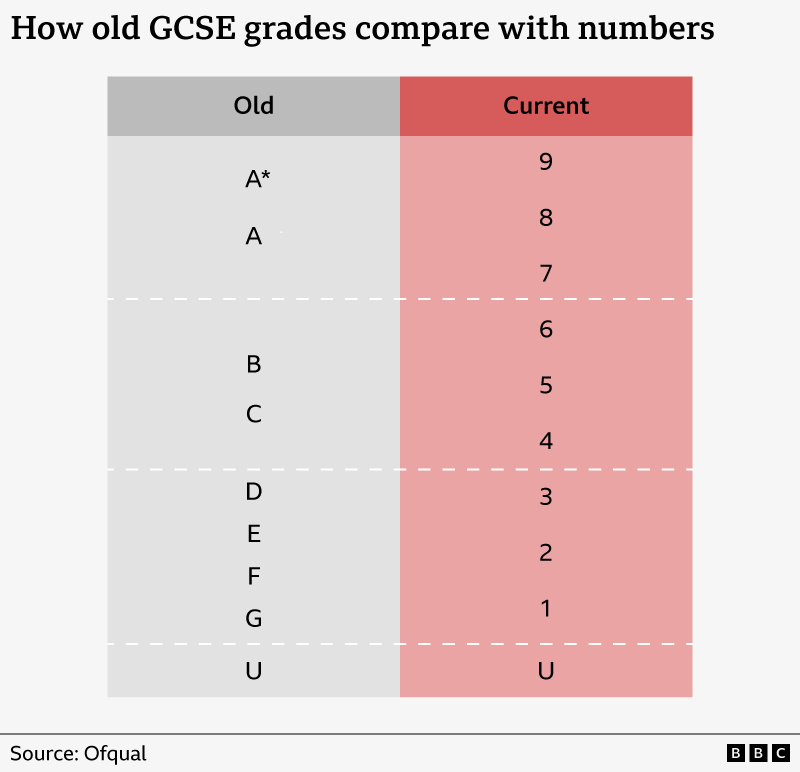
Under the system, 9 represents the highest possible grade and 1 the lowest, with a U still denoting an ungraded result. The number and letter scales are not a direct match, but they are aligned at three key points: the lowest mark within grade 7 lines up with the lowest mark within grade A, the bottom of grade 4 matches the bottom of grade C, and the bottom of grade 1 matches the bottom of grade G. The top three number grades — 9, 8 and 7 — together cover the same span as the old A* and A grades.
In practice, this means a grade 9 broadly equates to a high A*, a grade 8 to a low A* or high A, and a grade 7 to a low A. A grade 6 corresponds to a high B, a grade 5 to a low B or high C, and a grade 4 to a low C. Lower down the scale, a grade 3 aligns with a D or high E, a grade 2 with a low E or high F, and a grade 1 with a low F or a G.
How are grade boundaries set each year?
Grade boundaries mark the lowest score a student can achieve and still be awarded a particular grade, and examiners fix these boundaries only after students have completed their exams, according to Ofqual's guide for schools and colleges. Exam boards then release these boundaries on results day itself, and AQA has said its GCSE boundaries will be published at 8am on the day results are issued, the same time from which students can access their marks, according to AQA's results day information.
Ofqual has said the standard required to achieve a given grade in 2026 will be comparable to that applied in summer 2025, and that boundaries are calibrated so it is no easier or harder to reach a particular grade from one year to the next or between different exam boards, according to the regulator's student guide for 2026. However, an updated explainer from a national broadcaster published on 14 August 2026 has noted that boundaries can still differ between exam boards and subjects, according to a broadcaster's education guide.
For GCSEs that are tiered, such as combined science and maths, the structure differs further. AQA has said foundation tier entries are graded from 5 down to 1, while higher tier entries run from 9 down to 4, with a narrow grade 3 acting as a safety net for some higher-tier candidates and for combined science, according to Ofqual's 2026 guide.
What counts as a pass?
Grades 1 to 3 are technically classed as a pass, though many sixth forms set a minimum entry requirement of grade 5 or 6 for further study. The government's own school league tables measure performance by the proportion of pupils achieving grade 5 or above in English and maths.

Students who score a grade 3 or below in English language or maths are required to keep studying that subject the following year. Guidance on navigating this outcome, including how to appeal a result or arrange a resit, is set out in our earlier coverage of how to appeal, resit or plan your next move on GCSE results day 2026.

Why did England move away from letter grades?
The switch to numerical grading formed part of a 2014 curriculum reform led by then-Education Secretary Michael Gove, which reduced the weight given to coursework so that almost all subjects are now assessed through final exams. The redesigned qualifications were intended to be more demanding, with pupils examined after a full two years of study rather than through the modular assessments used previously.
At the time, the government argued that the additional grades allowed for sharper distinctions between high-performing students. It stated:
the new scale "recognises more clearly the achievements of high-attaining students, as the additional grades allow for greater differentiation".
Ministers also said the shift from letters to numbers would help employers and colleges identify which syllabus a candidate had followed, stating:
the change would make it clear "whether a student has taken a new, more challenging GCSE, or an old reformed GCSE".
How do Northern Ireland and Wales grade GCSEs differently?
Northern Ireland has also revised its grading structure. In summer 2019, the CCEA brought in a nine-category scale spanning A* to G, which includes an additional C* grade, though students entered for exams set by English boards may still receive results on the 9-to-1 scale.
This year's results follow a strong set of A-level outcomes in the region, with more than 26,000 Northern Ireland students receiving record A-level results on 13 August 2026, when provisional figures showed 44% of entries achieved A*–A grades.
Wales introduced new and revised GCSE courses in September 2015, with the most substantial changes affecting English language, Welsh language and mathematics. Unlike England, Wales has kept its letter-based grading structure running from A* to G.
What happens next?
GCSE results across England, Wales and Northern Ireland are due on Thursday 20 August 2026, following the A-level results issued a week earlier. Students awaiting A-level outcomes and information on clearing can consult our guide to grade boundaries, appeals, resits and Ucas clearing for 2026, which covers this year's priority review deadlines. AQA has confirmed its GCSE grade boundaries will be released at 8am on results day, according to AQA's grade boundaries page. Students weighing up alternatives to traditional post-16 study may also want to review our explainer on how T-levels are graded and which courses are available.
Key Facts
- England's GCSEs use a 9-to-1 numerical scale, phased in from 2017 and fully adopted by 2020.
- Grades 9, 8 and 7 together correspond to the old A* and A grades; the bottom of grade 4 aligns with the bottom of grade C.
- GCSE results in England, Wales and Northern Ireland are due on Thursday 20 August 2026.
- AQA will publish its 2026 grade boundaries at 8am on results day.
- Wales retains an A*-to-G letter system, while Northern Ireland uses a nine-category A*-to-G scale including C*.


