

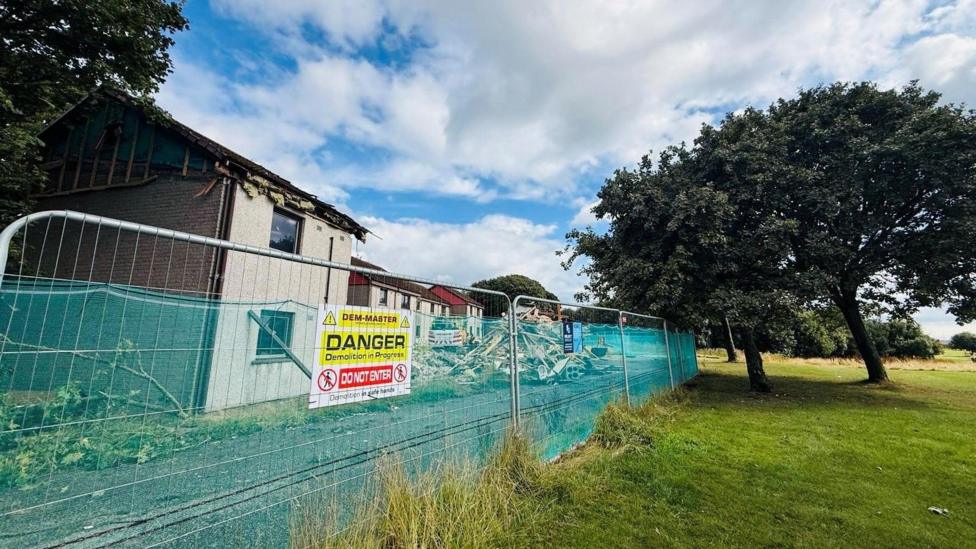
Demolition work has started on homes in Aberdeen found to contain reinforced autoclaved aerated concrete (Raac), with fencing and warning signs now erected around properties and some buildings already knocked down. More than 500 properties—the majority council-owned—were discovered to contain the potentially unstable material in 2023, and residents say it has been difficult to watch their community disappear.
Local resident Hannah Corr, who left one of the affected homes nearly two years ago, described the emotional toll of the demolitions.
"Of course, that's the one thing we have here is a community and it being slowly chipped away at is, of course, upsetting."
Fellow resident Nat Jankowska voiced similar concerns about the disruption ahead, while acknowledging the properties could not remain standing indefinitely.
"I think it's going to be a lot of mess and a lot of noise and it's going to affect not only people who live here but also the wildlife. I mean they've been sitting empty for so long, something has to be done with them. But it is sad to see everything getting demolished."
Not everyone shares that sense of loss. Wayne Youngson argued that the demolitions were a necessary step forward.
"If they're faulty and they're falling apart then get rid of them and put new ones up. It would be more upsetting if it falls on somebody. Houses go down and houses go up, that's just life. The community's still going to be here after it."
How many homes are involved and what will it cost?
Of the properties affected, 366 are council homes and 138 are privately owned, all found to have Raac in their roof panels. The overall demolition-and-rebuild programme has previously been estimated at more than £150m, though more recent reporting has broken that figure down further. According to the Herald Scotland, the council set a demolition cost of roughly £5.8m specifically for 277 Raac-affected homes in the Torry area, representing one phase within the wider scheme. Separately, a March 2025 report from the national broadcaster put the rebuilding cost at around £130m, with the full demolition-and-reconstruction project expected to take up to four years.
How is the phased demolition being carried out?
Aberdeen City Council's Communities, Housing and Public Protection Committee approved a phased demolition plan on 11 March 2025, splitting the work and subsequent landscaping into four stages, according to details published on the council's housing service page. The first stage has focused on terraces that are fully council-owned, using a top-down demolition method, before later stages move on to streets where private ownership is more mixed. The council has said it aims to acquire privately owned Raac-affected homes through voluntary agreement so that later demolition phases in areas such as Balnagask, which includes both council and private housing, can proceed safely.

Why has buying out private owners taken so long?
Progress on acquiring privately owned homes has been slow. A February 2025 report from the national broadcaster noted that only four of the 138 private homeowners had accepted purchase offers at that point. Some residents are still negotiating the sale of their properties, while others are searching for a new home to move into, and the Scottish government and the council previously agreed a £10m funding package last year to support affected residents.
This mirrors ongoing tension elsewhere in the city, where private homeowners have sought more time to respond after the council gave them just 14 days to decide how to proceed with their properties. Reporting from July 2026 by Aberdeen Business News similarly described continued pressure on remaining owners to state their intentions within a tight timeframe.
What is Raac and why is it a safety concern?
Reinforced autoclaved aerated concrete, or Raac, is a lightweight material used mainly in flat roofing but also in some floors and walls between the 1950s and 1990s. It was a cheaper, quicker alternative to standard concrete, aerated in a way similar to a chocolate bar with air bubbles, but it is far less durable, with a typical lifespan of around 30 years and structural behaviour quite different from traditional reinforced concrete.
Because the material is porous, it is vulnerable to structural failure when moisture penetrates the bubbles inside it. Roofing panels are often coated with a protective layer such as bitumen, but this coating can itself degrade over time. The Health and Safety Executive has warned that Raac is now beyond its expected lifespan and can collapse with little or no warning.
When did the problem first come to light, and what happens next?
The council first identified the Raac problem in Aberdeen in February 2024, when it said it was examining long-term options ranging from remedial repairs to full demolition, according to earlier reporting from the national broadcaster. Councillors continued to weigh planning and preparatory work at a meeting on 21 August 2024, and the programme has since moved into active demolition.
Looking ahead, the council's phased approach means further demolition stages will depend on continued property acquisitions and the availability of vacant terraces, per the council's published housing plan. Recent reporting suggests that deadline-driven engagement with remaining private homeowners, along with the demolition work itself, is expected to continue through the rest of the year.
Key Facts
- More than 500 Aberdeen properties were found to contain Raac in 2023, including 366 council homes and 138 privately owned homes.
- The full demolition-and-rebuild programme has been estimated at over £150m, with rebuilding alone put at around £130m and one phase in Torry costed at approximately £5.8m for 277 homes.
- The phased demolition plan, approved in March 2025, is split into four stages and could take up to four years to complete.
- As of February 2025, only four of 138 private homeowners had accepted council purchase offers.
- A £10m Scottish government and council funding package was agreed last year to support affected residents.


