

Students collecting their GCSE results this week are weighing up next steps, and for many that includes T-levels, the vocational qualification for 16 to 19-year-olds in England that blends classroom study with an extended work placement. According to a national broadcaster's report, more than 19,600 students received T-level grades across 21 subjects in 2026, up from 11,900 students across 18 subjects the year before, showing the qualification's rapid expansion since it launched.
The programme sits alongside A-levels and apprenticeships as one of three main routes for post-16 study, but it is structured differently from both, with a heavier practical component than academic courses and less employer time than apprenticeships.
What are T-levels, how are they marked, and what are they worth?
T-levels are technical qualifications built around practical skills rather than purely academic content, and they were rolled out in September 2020 as two-year courses. The Department for Education says they were developed jointly with employers and education providers, and each course requires students to complete at least 315 hours - roughly nine weeks - on an industry placement, making up about a fifth of the total programme, according to government guidance.
The qualification is pitched at students who want something more hands-on than A-levels but do not want to commit as much time to an employer as an apprenticeship demands, since apprenticeships can involve up to 80% of a student's time in the workplace.
Grades are calculated from a mix of written exams, coursework and successful completion of the placement, and students are awarded one of four outcomes, from a pass up to a distinction*. Their final certificate records both the overall grade and a breakdown of what they studied and experienced.
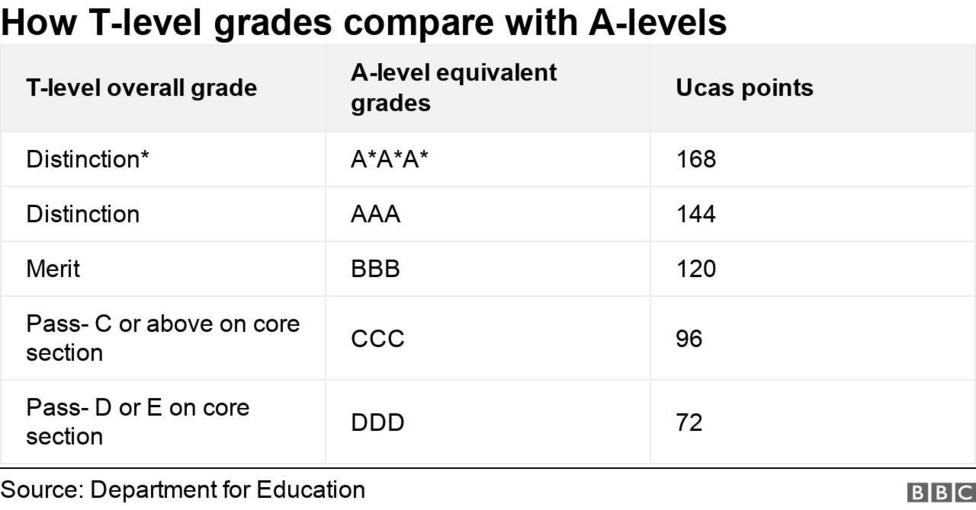
In terms of Ucas points, a distinction* carries the same weight as three A*s at A-level - 168 points - while a merit is treated as equivalent to three Bs. The government's own T-levels website confirms this scoring system and notes that the qualifications are accepted as an entry route by more than 150 universities and colleges across the UK.
What T-level courses are available?
There are now more than 20 T-level subjects on offer, spanning fields such as accounting, craft and design, engineering and media production. The Department for Education states that the total has reached 21 subjects, and that the window for new providers to register to deliver T-levels for the 2026 to 2027 academic year closed in March 2025.
Onsite construction has been dropped as a starting option, with the department saying take-up had been too low and arguing that \"the needs of learners and the economy are best met through apprenticeships and other classroom provision.\"
Some subjects, including catering, have been delayed in reaching classrooms, while others - hairdressing among them - were scrapped before ever launching.

How successful are T-levels and what problems have there been?
Enrolment has risen every year since the qualification began, but a significant share of students do not finish their course. Most A-levels and comparable qualifications retain more than 90% of students to completion, whereas only 77% of those who began a T-level in 2024 went on to complete the two-year programme by 2026 - an improvement on the 73% completion rate recorded the year before.
Quality concerns have also surfaced. In July 2024 the exams regulator Ofqual fined the NCFE awarding body £300,000 over what it described as \"major failings\" in papers taken by 1,200 health and science T-level students in 2022.
Separately, figures from the engineering sector show the scale of uptake in technical subjects specifically: 8,307 students received results in engineering and technology-related T-levels in 2026, according to EngineeringUK's analysis of the 2026 results.
How do T-levels compare to other vocational qualifications?
When the previous Conservative government introduced T-levels in 2020, the vocational landscape in England included more than 12,000 separate qualifications offered by upwards of 150 awarding bodies. T-levels were intended to simplify that system and give students and employers clearer choices after age 16.
As part of that shift, funding was withdrawn from a number of other vocational qualifications, including some BTecs, on the grounds that they duplicated what T-levels now covered. Since then, a government review has restored funding to some overlapping courses while others remain defunded.
The Department for Education has said the two systems can \"coexist\" while T-levels are refined, though its stated ambition is for T-levels to eventually become \"the large technical qualification of choice.\" Other vocational routes still available across the UK include BTecs, National Vocational Qualifications (NVQs) in England, Wales and Northern Ireland, and Scottish Vocational Qualifications (SVQs).
What happens next?
Funding rules for T-levels are due to change from 2027, and the Department for Education has confirmed there will be no separate registration process for providers wanting to introduce the qualification from the 2027 to 2028 academic year onward. For now, colleges and other institutions can still deliver T-levels in 2026 to 2027 provided they hold a 16 to 19 funding agreement and have approval from the relevant awarding organisation.
Funding levels for 2026 to 2027 have already been published, with the national rate set at £14,772 for Band 9 courses and £10,266 for Band 5 courses, according to the government's funding guide. Provisional results for the current 2025 to 2026 academic year were published on 13 August 2026, and provisional outcomes for the following 2026 to 2027 cohort - those who began their courses in September 2025 - have already been scheduled for release once that group finishes the programme.
Anyone who has taken a T-level and wants to share their experience of the course, the placement or the grading system is encouraged to get in touch with their story.

Key Facts
- T-levels launched in September 2020 as two-year courses combining classroom study with a minimum 315-hour industry placement.
- More than 19,600 students received T-level grades across 21 subjects in 2026, up from 11,900 across 18 subjects in 2025.
- Course completion stood at 77% for students starting in 2024, up from 73% the previous year, still below the 90%-plus retention typical of A-levels.
- A distinction* equals 168 Ucas points, matching three A*s at A-level, and is recognised by more than 150 universities and colleges.
- Funding methodology changes from 2027, with no new provider registration process planned from the 2027 to 2028 academic year.


