The construction industry in Wales faces a critical shortage of young workers, with housing leaders and employers calling for sustained government funding and coordinated planning to expand training opportunities and apprenticeships.
Iwan Trefor Jones, chief executive at Adra, a housing association, emphasised that organisations must collaborate to ensure young people have genuine pathways into the sector.
"It's really important that organisations like Adra work in partnership with other organisations to make sure that there are opportunities for young people."
Demand for training places far outpaces supply. Adra's academy scheme has experienced a surge in applications, with one recent intake attracting 108 candidates competing for just six positions. Since the scheme's launch in 2021, it has supported 230 participants through construction courses.
The shortage reflects a broader workforce crisis. Analysis by the Federation of Master Builders revealed that the construction sector requires an additional 2,200 workers annually to meet current demand. The sector's workforce is ageing significantly, with one-third of workers over 45 and only 20% aged 16–24.
What is the Welsh government doing?
The Welsh government confirmed that work is already underway to expand construction skills provision. New Level 2 apprenticeships in bricklaying, site carpentry, scaffolding and building maintenance are set to launch later this year, with construction also included in new vocational qualifications from September 2027. A skills audit is currently in progress to assess current and future workforce needs across Wales, and a Skills Summit is scheduled for October to bring together employers, educators, training providers and policymakers to shape reforms to vocational training.

Why is additional funding essential?
Jones stressed that planning alone is insufficient without financial backing.
"There's a need for a long-term plan, but also a plan is nothing without the funding behind it. We need some kind of assurance that there is a long-term plan to support the funding of placements in work, to support young people into employment and to support employers."
Elin Williams, who oversees Academi Adra, highlighted the scheme's reliance on external grants to operate.
"We've been very lucky to be able to have some external grant funding to allow us to run some courses and pay for placement opportunities. We're calling for more funding for opportunities and projects like Academi Adra... We want to carry on to develop and expand to meet the rising demand that we're seeing."
Academi Adra's construction skills course for those over 16 offers a week of classroom training, a week of unpaid work experience, and the opportunity to apply for a paid 16-week placement at the National Minimum Wage. This model has proven effective but requires sustained investment to expand capacity.
How are employers responding?
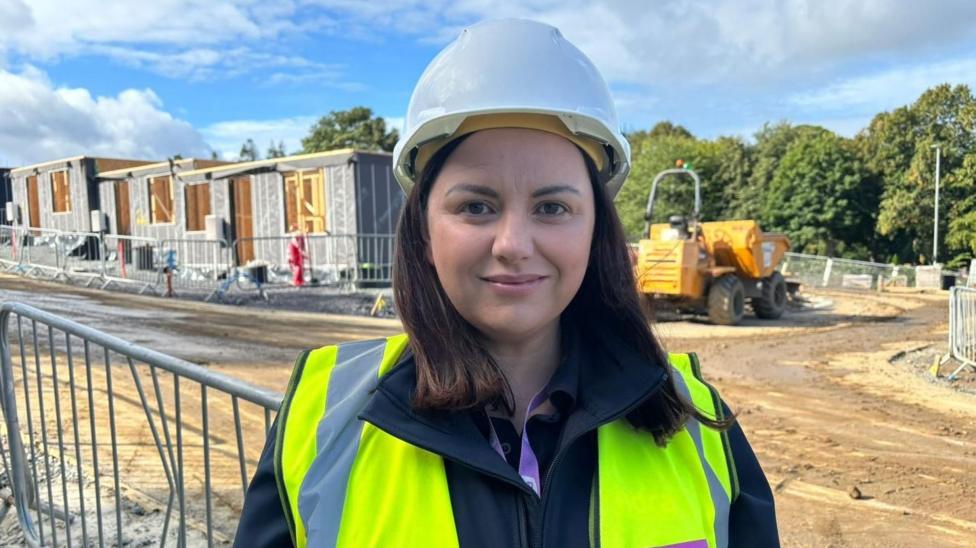
Steven Walker, a construction manager with Williams Homes, emphasised the sector's capacity to absorb more young workers.
"We have an ageing workforce across the country. It's really important that young people are being pushed through to be work ready to be the next generation of construction workers."
Walker outlined how his company supports newcomers to the industry.
"We can always create the space for young people to come and work on our construction sites. We buddy them up with an experienced worker, we show them the ropes, we give them the training, we look after them, we interview them regularly to see that they're OK and that they're looked after."
He highlighted the value of schemes like Academi Adra in preparing workers.
"The classroom-based teaching is really important. It prepares them for the work... and then when they come to us, they'll actually put into practice what they've seen in the classroom."

What impact are colleges seeing?
Local further education institutions are experiencing unprecedented demand. Aled Jones-Griffith, chief executive of Grŵp Llandrillo Menai, reported significant growth in construction enrolments.
"Our enrolment has increased by 28% since 2025-26 to a record 461 learners this year."
To accommodate this surge, the college has invested substantially in workshop redevelopment, staff recruitment and course resources. However, Jones-Griffith warned that continued provision depends on additional funding.
"To meet this demand, we have invested significantly in redeveloping our workshops, recruiting additional staff and buying additional course resources. However moving forwards, we need additional funding to maintain this high level of provision and effectively minimise Neets in our community."
How does this connect to Wales' housing goals?
The construction skills shortage directly impacts Wales' housing ambitions. The Construction Housing Council (CHC) has linked workforce development to the nation's housing emergency. Clarissa Corbisiero, deputy chief executive at CHC, argued that investment in construction skills is essential to delivering new homes.
"Investing in our homes is the best investment we can make in Wales' economic health. In building 20,000 new social homes over the next four years, housing associations can deliver over 14,000 jobs per year during construction. By aligning our housing goals with a bold construction skills strategy, we can turn a national emergency into a wave of opportunity for every community. Ending the housing emergency is more than bricks and mortar - it's about health, jobs, and opportunity."
This ambition aligns with earlier calls from developers and housing associations for planning reforms and increased funding to meet the government's 20,000 social homes target by 2030.
What do young people say about the opportunities?
Cian Halliday, 26, a carpenter from Llanrug, experienced the transformative potential of such schemes. Made redundant during the Covid-19 pandemic, he described the period as difficult.
"It was difficult, and a struggle to find work, so I decided, the minute this opportunity came up, to start a new job."
Halliday joined Academi Adra and progressed through its pathway.
"Academi Adra were offering courses, and almost 16 weeks of work experience and at the end they decided to keep me on as a labourer. I did that for a year. Then they offered me an apprenticeship and I chose to be a carpenter."He reflected on his career change positively.
"I was happy enough to change careers. I jumped at the opportunity and never looked back."
Daniella Williams, 35, similarly benefited from retraining through Academi Adra after leaving the NHS due to health issues and family responsibilities. She pursued an administrative role within the construction sector.
"It's changed mine and my children's lives... I've been able to save, I've bought my own car, and it's given me so much more confidence. I've been able to achieve so much that I wasn't able to achieve before, and it's inspired my children as well to go on and do bigger and better than myself as well."
Williams is now passionate about encouraging young women into construction careers.
"I work with schools... especially to get girls into construction. It's not just bricks and building, there are all kinds of different things. We work a lot with local companies, and it's a great sector to get into, I really enjoy it."

What is the current youth employment situation?
The need for construction training opportunities is underscored by rising youth unemployment. Recent Welsh government figures show that the proportion of young people not in education, employment or training (Neet) has risen sharply to 17%, returning to levels last seen around 2013. This trend reflects broader challenges in the education and employment system, with hundreds of Welsh teenagers facing waiting lists for college courses due to funding shortfalls amid record applications.
What new apprenticeship routes are available?
New Level 2 construction apprenticeship routes are now available in Wales, including bricklaying and site carpentry, with existing Level 3 frameworks set to be withdrawn on 31 October 2026. Skills for Wales confirmed that new construction qualifications will be fully approved by September 2026 and available for registration, with live assessments planned from 1 March 2027.
The Welsh Government and Medr developed these new pathways following engagement with employers, stakeholders, training providers and learners, reflecting the sector's urgent need for skilled workers across multiple specialisms.
What happens next?
Several key milestones lie ahead. Medr has scheduled an information event for potential apprenticeship providers on 8 September 2026, with Stage 1 applications due by 30 September 2026. The Welsh government's Skills Summit in October will convene key stakeholders to shape the future of vocational training. Additionally, the government is conducting a comprehensive skills audit to provide a cross-government assessment of current and future workforce needs across Wales.
Key Facts
- Adra's academy scheme received 108 applications for six positions in its most recent intake, demonstrating overwhelming demand for construction training
- The Federation of Master Builders estimates the construction sector needs 2,200 additional workers annually to meet demand, with only 20% of the current workforce aged 16–24
- Grŵp Llandrillo Menai reported a 28% increase in construction enrolments to a record 461 learners, requiring significant investment in facilities and staffing
- Welsh youth not in education, employment or training (Neet) has risen to 17%, matching levels from around 2013
- New Level 2 apprenticeships in bricklaying, site carpentry, scaffolding and building maintenance are launching in 2026, with live assessments available from March 2027