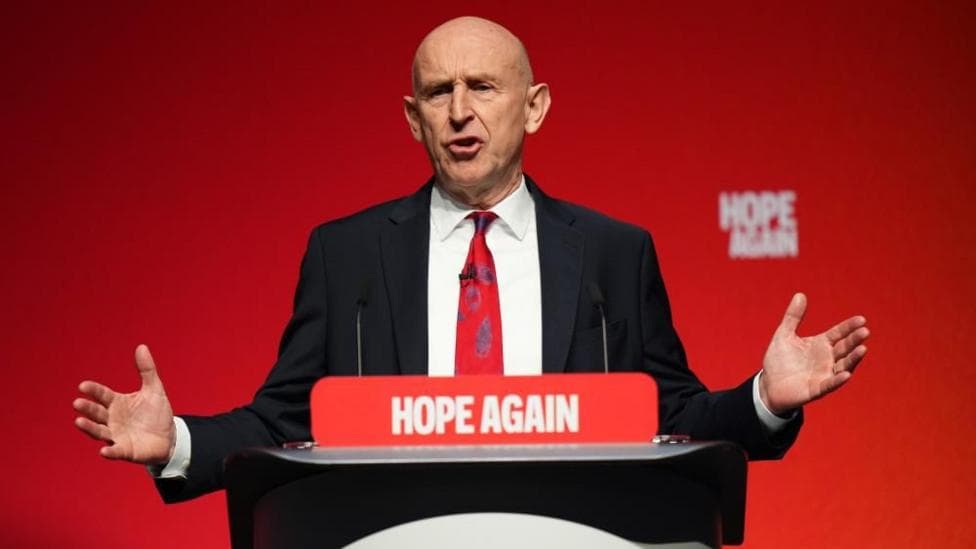
John Healey, the chancellor, has declared that employment with training represents a superior alternative to welfare payments for young people, as he announced an expansion of apprenticeship schemes at Labour's annual conference in Liverpool on Monday. His remarks come amid pressure to reduce public spending or increase taxation before next month's Budget, aimed at lowering government borrowing costs. The chancellor framed the policy as part of a broader commitment to fiscal discipline and economic growth.
Speaking to delegates, Healey stated that providing young people with work opportunities was
"more than an economic must - it's a moral duty"and emphasised that
"the best thing we can offer a young person is not a benefit payment - it's a first job with training and a wage."
The government faces a significant challenge: according to recent figures, more than 750,000 people aged 16 to 24 are unemployed in the UK, while nearly a million young people are not in education, employment or training—a group known as Neets. Healey pointed to this cohort as evidence that the welfare system required fundamental reform, stating that
"it is not progressive to allow a bigger and bigger benefits bill, and a system which offers an income but doesn't offer a future."
What is the Local Apprenticeships Service?
The chancellor announced the expansion of the Local Apprenticeships Service, a scheme that will now be available to any English mayor who requests it, moving beyond its original pilot phase in a limited number of areas. According to reporting on the announcement, the apprenticeship scheme will use teams compared to "football scouts" to match young people with employers, including firms that have never offered apprenticeships before.
The Treasury is allocating an additional £100 million to the scheme, which will be
"fully funded"by savings from the Department for Work and Pensions. Healey justified placing implementation powers with mayors, explaining that
"they know which firms are hiring, which colleges are delivering, which estates have been left behind."The rollout across England is scheduled to begin from March 2027.
Healey described the new Local Apprenticeship Service as a
"down payment"on work being led by former Cabinet minister Alan Milburn, whose final report on tackling youth inactivity is expected to set out recommendations in the coming weeks.
How does this fit into Labour's wider welfare reform agenda?
The apprenticeship expansion forms part of a comprehensive welfare reform strategy unveiled at the conference. According to Labour's policy announcements, Work and Pensions Secretary Pat McFadden separately announced a Youth Guarantee that includes £2.5 billion for opportunity measures, £3,000 payments to businesses hiring a young person for their first job, 50,000 additional youth apprenticeship starts, and 300,000 work-experience places.
The government has also pledged to expand a jobs guarantee for young people with disabilities and health conditions from April 2027, reflecting a commitment to ensure no young person is left behind. McFadden highlighted the scale of the welfare challenge, citing figures showing that the government currently spends £25 on inactivity for every £1 spent on getting people into work.

On Sunday, McFadden told the conference that the current welfare system was flawed because it could leave people on benefits when they would be better off working, setting the stage for Healey's remarks about reframing benefits as a bridge into employment rather than a permanent trap.
What fiscal pressures is the government facing?
Healey sought to reassure financial markets by emphasising that all government promises would be
"built on the rock of fiscal discipline"and that he and Prime Minister Andy Burnham remained
"united on meeting the fiscal rules."Fiscal rules are the government's self-imposed constraints designed to manage decisions on spending and taxation.
The chancellor acknowledged the constraints on public finances, stating that
"the money New Labour had in the '90s is simply not there now."He blamed the Conservative Party's previous time in government for leaving Britain in a position where it spends more on debt servicing than on the Home Office, Ministry of Defence and Ministry of Justice combined.
Helen Miller, director of the Institute for Fiscal Studies think tank, cautioned that adhering to fiscal rules alone would be insufficient to reduce debt, as such rules amount to
"basically a promise to get down debt tomorrow."She suggested that reducing the benefits bill, potentially by removing support from some recipients, could be one approach to cutting national debt more rapidly.
What other economic commitments did Healey make?
Beyond welfare reform, Healey reiterated government promises to reindustrialise the country. He announced that Rolls Royce would invest an additional £300 million into its British factories located in Derby, Bristol, Glasgow and Rotherham, signalling continued private sector engagement with the government's growth agenda.
The chancellor also confirmed plans to restore the Union Learning Fund in England, a scheme originally established in 1998 and abolished by the previous Conservative government. The fund is intended to help working people develop additional skills in an era of artificial intelligence, though details regarding its funding mechanism remained unclear at the time of the announcement.
How did the opposition respond?
Conservative shadow chancellor Andrew Griffith rejected the government's approach, claiming that
"Labour MPs will never support cutting the out-of-control welfare bill"and asserting that
"with Labour, it's always more taxes if you work and more benefits if you don't."
What happens next?
The government has set clear timelines for implementation of its youth employment strategy. The Local Apprenticeships Service rollout across England is due to begin from March 2027, while the expansion of the jobs guarantee for young people with disabilities and health conditions is scheduled to start from April 2027. The final recommendations from Alan Milburn's review on tackling youth inactivity are expected in the coming weeks and will likely inform further policy refinements.
Healey characterised young people as
"digital natives, whip-smart, questioning, ambitious, brave"who could transition from what he termed
"generation jeopardy to generation hope."The government's welfare and employment strategy will be tested when the Budget is unveiled next month, which Healey said would
"give families and businesses a bit of breathing space."
Key Facts
- The Local Apprenticeships Service will expand from a pilot scheme to become available to any English mayor, with rollout beginning March 2027
- The government is allocating £100 million to the apprenticeship scheme, funded by Department for Work and Pensions savings
- More than 750,000 people aged 16-24 are currently unemployed in the UK, with nearly a million young people classified as Neets
- A Youth Guarantee announced separately includes £2.5 billion for opportunity measures and 50,000 additional apprenticeship starts
- The jobs guarantee for young people with disabilities and health conditions is scheduled to expand from April 2027