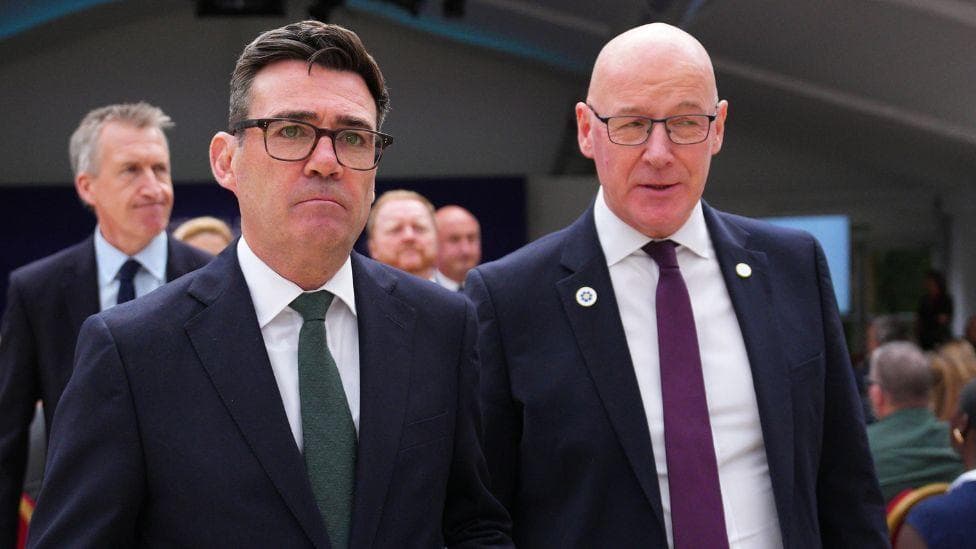
Prime Minister Andy Burnham is travelling to Scotland during the Scottish National Party's annual conference this week, where he will outline his vision for devolving greater authority to local communities across the country. The visit comes as John Swinney prepares to use his keynote address to renew calls for Scottish independence, setting up a direct clash over the constitutional future of the United Kingdom.
Burnham's trip to the central belt will take place on Friday, 16 October, while the SNP holds its 92nd annual conference at P&J Live in Aberdeen from 15–17 October 2026. During his visit, the Prime Minister is expected to call for Holyrood to transfer more powers to local authorities, according to reporting on the visit. Swinney's keynote speech is scheduled for Saturday, 17 October.
The timing underscores the deepening divide between the two leaders on Scotland's constitutional direction. Burnham has made clear his position that a second independence referendum is not on the table, having told Swinney during a summer meeting in Glasgow that such a vote is
"off limits". In a September interview, Burnham stated there was "no clear consensus" for another independence referendum and argued the 2014 vote had settled the issue
"for a generation".
What is Swinney's position on independence?
The First Minister remains committed to holding a second independence referendum by 2031, viewing it as essential to Scotland's future. However, his ambitions face a significant legal obstacle: the Supreme Court has ruled that the Scottish government cannot hold such a vote without the consent of Westminster, making Burnham's backing essential to any referendum proceeding.
Why is Burnham focusing on devolution instead?
Rather than engaging with independence discussions, Burnham is prioritising a model of deeper devolution that he believes can drive economic growth across all parts of the country. During a House of Commons debate this week, he told MPs he was
"looking forward to visiting Scotland later this week". When pressed by SNP MP Chris Law on whether the UK government would discuss a legal route to a second independence referendum, Burnham responded:
"The discussions that I am having with the Scottish government and will have later this month are on a model of deeper devolution for Scotland that can get growth going in all parts of the country. That is where my priority lies and that is what I will do."
Addressing concerns about Scotland's economic performance, Burnham told the Commons that the current
"status quo" was "not good enough for Scotland or for Britain"when asked about the impact of Brexit on Scotland's economy.
How are the SNP responding to Burnham's visit?
The SNP has extended an invitation to Burnham to attend its conference, viewing the event as an opportunity for him to set out a path forward on Scotland's constitutional future. Keith Brown, the party's deputy leader, suggested that Burnham's time in Downing Street is becoming
"defined by the UK's constitutional future - it is the central question on these islands". Brown argued that the conference was the
"perfect and natural place"for the Labour leader to outline Scotland's route to a second referendum.
The SNP's invitation reflects broader frustration within the party that Burnham has made Scottish independence a central focus of his premiership, yet remains unwilling to engage with the mechanisms through which Scotland might pursue it. The party views Burnham's emphasis on devolution as insufficient to address Scotland's aspirations for self-determination.
What happened at the Labour conference?
Burnham's visit to Scotland comes less than three weeks after he used the Labour Party conference to directly challenge Swinney's assertion that he would be the UK's last prime minister. The remark was interpreted as Burnham signalling his confidence in Labour's long-term political dominance and his rejection of the SNP's independence narrative.
Key Facts
- Burnham will visit Scotland on Friday, 16 October, during the SNP's annual conference at P&J Live in Aberdeen (15–17 October 2026)
- The Prime Minister has told Swinney that a second independence referendum is "off limits" without Westminster consent, which the Supreme Court has ruled is necessary
- Burnham's focus is on a devolution model designed to boost economic growth, rather than engaging with independence discussions
- Swinney plans to use his Saturday keynote speech to renew his push for a referendum by 2031
- The constitutional question has become a defining feature of Burnham's early premiership