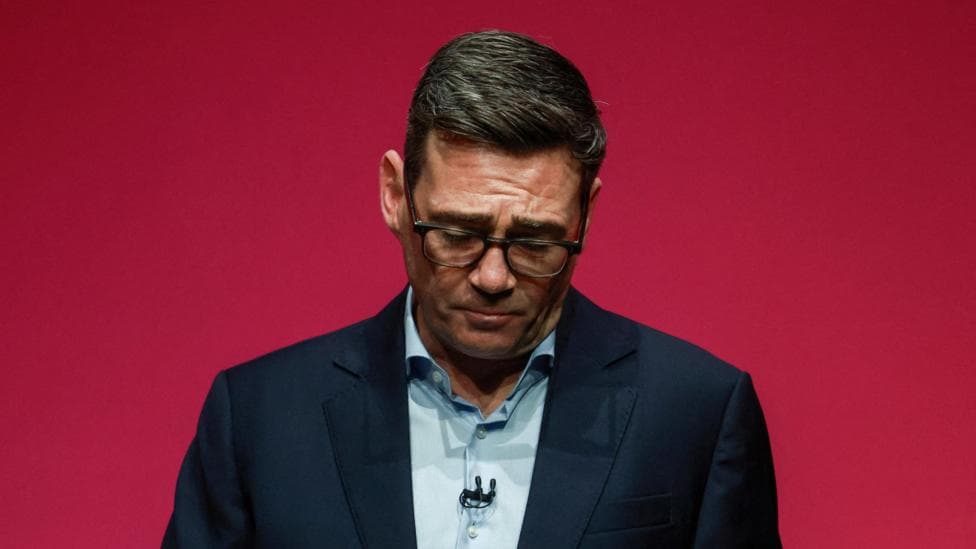
Andy Burnham's address to the Labour conference represented a convergence of two profound personal circumstances: his recent elevation to prime minister and his simultaneous struggle with the impending loss of his father, Roy. The funeral is scheduled to take place within days. This dual reality shaped both the substance and emotional resonance of what emerged as a sweeping political manifesto, grounded in reflections on his father's life and influence.
The prime minister is navigating two life-altering moments concurrently—adjusting to his new role while preparing remarks amid active grief. Senior Labour figures have expressed enthusiasm about leading a party with what they characterise as a leader possessing a clearly defined sense of direction, easily communicated to the public. The implicit, unflattering contrast with his predecessor, Sir Keir Starmer, requires little elaboration.
What distinguished Burnham's speech was its scope and ambition. His vision divided into two temporal horizons: immediate priorities he hopes to accomplish before the next general election, and longer-term proposals he intends to present to voters when polling day arrives within the next three years.
What are Burnham's plans for social care?
The centrepiece of his agenda involves overhauling England's social care system, an issue that has defeated both Labour and Conservative attempts at reform when announced close to election campaigns. Burnham's strategy aims to begin building consensus now, betting that winning the intellectual argument in advance will insulate the proposal from electoral turbulence. Whether this approach succeeds remains uncertain, as the debate has only recently commenced.
According to reporting from international news sources, Burnham said the proposed National Care Service would be free at the point of use, with no care charges taken from people's basic state pension. The service would be introduced in the next parliament, following the next general election, which must occur by mid-2029.
How would the pension changes work?
Funding this expansion requires difficult choices about state pensions. Burnham announced that from April 2030, if Labour wins the next election, the annual earnings link within the triple lock will be removed. The triple lock currently ensures the state pension increases annually by whichever is highest: inflation, average wage growth, or 2.5%. Under the revised arrangement, the pension would still be increased further if necessary to maintain its value at above 30% of the full-time average wage.
Labour estimates that altering the pension uprating rules could save £15 billion annually by 2040. This represents a significant departure from Labour's 2024 manifesto, which pledged to retain the triple lock throughout the current parliament; Burnham's proposed change would begin only after the next election.

Anticipating fierce criticism—which has already materialised from the Unite union and political opponents—Burnham provided more granular detail than observers expected at this stage, apparently seeking to offer reassurance to pensioners and their families about the sustainability of the system.
What other major reforms has Burnham outlined?
Beyond social care and pensions, Burnham's agenda encompasses substantial structural changes to British governance and infrastructure. He committed to launching a National Commission on Electoral Reform to examine how to make votes count more fairly, signalling Labour's intention to campaign for a more proportional voting system to replace first-past-the-post.
On utilities, Burnham pledged to repeal the prohibition on public ownership of water companies and to establish a publicly owned Great British Grid to invest in electricity infrastructure and compete with private operators. These measures represent a significant expansion of state involvement in sectors previously dominated by private enterprise.
Regarding Britain's international relationships, Burnham signalled his intention to pursue a closer relationship with the European Union, though the specifics—including what trade-offs might be involved and what reaction such moves might provoke—remain undefined pending a forthcoming review.
How has the party responded?
Burnham's cabinet colleagues and numerous party members are energised by the intellectual battle he has initiated and is actively pursuing. The speech generated a series of clear dividing lines with Labour's political opponents that are likely to dominate forthcoming debate. Notably, in remarks lasting more than an hour, Burnham made only a broad reference to Labour's opponents on the Right, declining to name specific rivals—a strategic choice that kept focus on his own vision rather than reactive criticism.
What challenges lie ahead?
The central question now facing Burnham and his government concerns execution: do they possess the institutional capacity to deliver on these ambitious commitments? Can they persuade voters that their vision is coherent, appealing, and financially sustainable? These questions arise against a backdrop of persistent economic stagnation and international instability—neither of which will simplify the task of translating policy into reality. The economic headwinds and geopolitical turbulence that have frustrated many of his recent predecessors show no sign of abating, making the realisation of this agenda a formidable undertaking.

For regular updates on Westminster politics and beyond, to receive daily political analysis and insight delivered to your inbox.