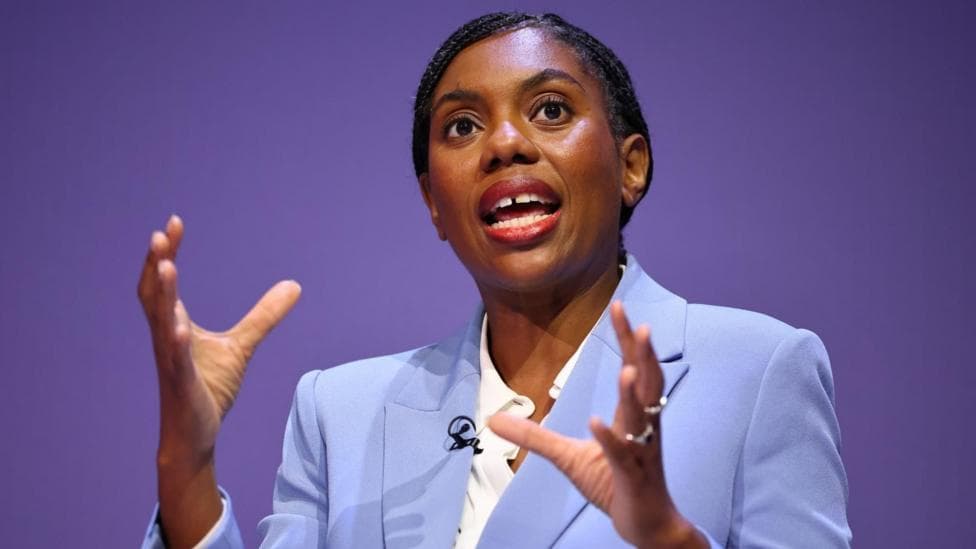
Kemi Badenoch is set to unveil cuts to inheritance tax (IHT) during her keynote conference address, framing the forthcoming election as a fundamental
battle for the soul of this nationbetween a government committed to ever-rising expenditure and a Conservative party determined to constrain state spending. The party has neither officially confirmed nor moved to dispel speculation surrounding the inheritance tax announcement, creating an expectation so pronounced that observers suggest any speech omitting the measure would disappoint her supporters.
The inheritance tax currently generates £15bn annually for the Treasury and is projected to raise that figure further by the decade's end. Rather than abolishing the levy entirely, Badenoch is expected to propose a reduction. According to reporting from multiple outlets, the proposal concerns the 40% rate that applies to estates valued above £325,000—or £500,000 when a home passes to a direct descendant. However, Conservative officials have indicated the party will not commit to specific inheritance tax measures until Andrew Griffith and the economic team assess what remains fiscally affordable.
The tax announcement is likely to dominate headlines, yet the Conservatives plan to release a broader
savings planoutlining how they will fund tax reductions, including the £2.3bn cut to employer national insurance aimed at younger workers. The party previously identified £70bn in potential savings, with £23bn derived from welfare reform. Yesterday, Helen Whately, the shadow work and pensions secretary, announced she had identified additional savings beyond those already proposed.
Badenoch's strategy at this conference represents a significant shift in Conservative messaging. Two weeks earlier, Ed Davey, the Liberal Democrat leader, delivered his conference speech clearly targeting moderate Conservatives who either defected to his party two years ago or might do so at the next election. Since 2024, Badenoch has increasingly adopted rhetoric resembling that of Nigel Farage on migration and Europe, making her party unappealing to one-nation Conservatives. Now, belatedly but substantially, she is attempting to reclaim these voters.
What policies target different voter groups?
The headline policies announced at this conference or in its run-up fall into three distinct categories, revealing a deliberate electoral strategy. The first comprises proposals that, while not benefiting any particular demographic, arguably serve the nation as a whole—though they appeal primarily to those holding rightwing views. These include commitments on net zero policy and broader economic philosophy.
A second category includes measures ostensibly designed to appeal to younger voters. The £2.3bn cut to employer national insurance is presented as boosting employment prospects for young people, though employers rather than workers directly receive the benefit. Similarly, cutting regulations relating to building is framed as addressing intergenerational fairness, yet primarily benefits construction businesses. Younger voters may remain sceptical about whether builders will pass savings to homebuyers rather than retaining them as profit.
The welfare proposal, which penalises young people by restricting benefits access, is justified by Conservatives as ultimately beneficial—preventing a lifetime reliance on state support. However, the party has provided no clear costings, making it difficult to assess the true fiscal impact on younger citizens.
The third category comprises measures with potentially enormous impact on a smaller group: older, wealthy people. These include the £100,000 childcare allowance, worth as much as £20,000 per child for some families, and the promised repeal of Labour's Family Homes Tax (officially termed the High Value Council Tax Surcharge). The Family Homes Tax, announced by Rachel Reeves in her 2025 budget and due to commence in April 2028, will add between £2,500 and £7,500 annually to council tax bills for affected homes in England. The surcharge alone will exceed the average Band D council tax bill in England, currently standing at £2,392.
Conservatives have issued a statement explaining their position:
A Conservative government will abolish the Family Homes Tax outright, and if Labour legislates before the election a Conservative government will repeal it. The Family Homes Tax is an unfair tax raid on the homes people have worked hard for. It is a purely political and spiteful tax raid by Labour. The tax is expected to raise just £400 million a year compared to the over £50 billion a year raised by the council tax system. It adds huge complexity for very little gain in terms of overall revenue.
Notably, when asked about the pensions triple lock yesterday, Badenoch stated it would be unaffordable if it becomes law because resources would be diverted elsewhere. She has not applied this same logic to the inheritance tax cut or Family Homes Tax repeal.

Which constituencies benefit most from these policies?
The electoral geography underlying these announcements is unmistakable. Financial Times columnist Stephen Bush observed on social media that while the £100,000 childcare allowance affects relatively few people, those affected are concentrated in approximately 100 constituencies—40 of which the Conservatives must win from the Liberal Democrats, and 20 they must prevent the Liberal Democrats from gaining. A further 40 are Labour-held seats where socially liberal high earners feel trapped between Labour and the Greens.
Politics professor Rob Ford reinforced this analysis, noting that
Cons do best with pensioners who have paid off their mortgages but next group to target after that is high income families who feel, not without reason, that they are taxed more heavily than ever. They have noticed and aren't happy about it. That's a political opportunity!
When ITV's Robert Peston put it to Badenoch that she was clearly attempting to win back older voters in southern England leaning towards the Liberal Democrats or Labour, she responded:
Robert, I'm very sad, very sad, that you're looking at this in crude electoral terms.Viewers interpreted her response as confirmation that Peston's assessment was correct.
Has the Conservative party genuinely changed under Badenoch?
Badenoch claims the Conservative party has undergone considerable transformation under her leadership and therefore should not be tainted by the reputation of the previous Conservative government. In one interview, she stated:
We are under new management. Your viewers will know that sometimes you have a football team that's disappointing. There's a new captain, there's a new coach, there's a new owner, effectively, which is all me.
This assertion is partially accurate. The Conservatives are now committed to leaving the European Convention on Human Rights, a treaty backed by every previous Tory leader since its creation in the 1950s. On net zero and migration, the party has shifted sharply rightward.
In other respects, continuity prevails. Badenoch presents herself as revolutionary, yet her
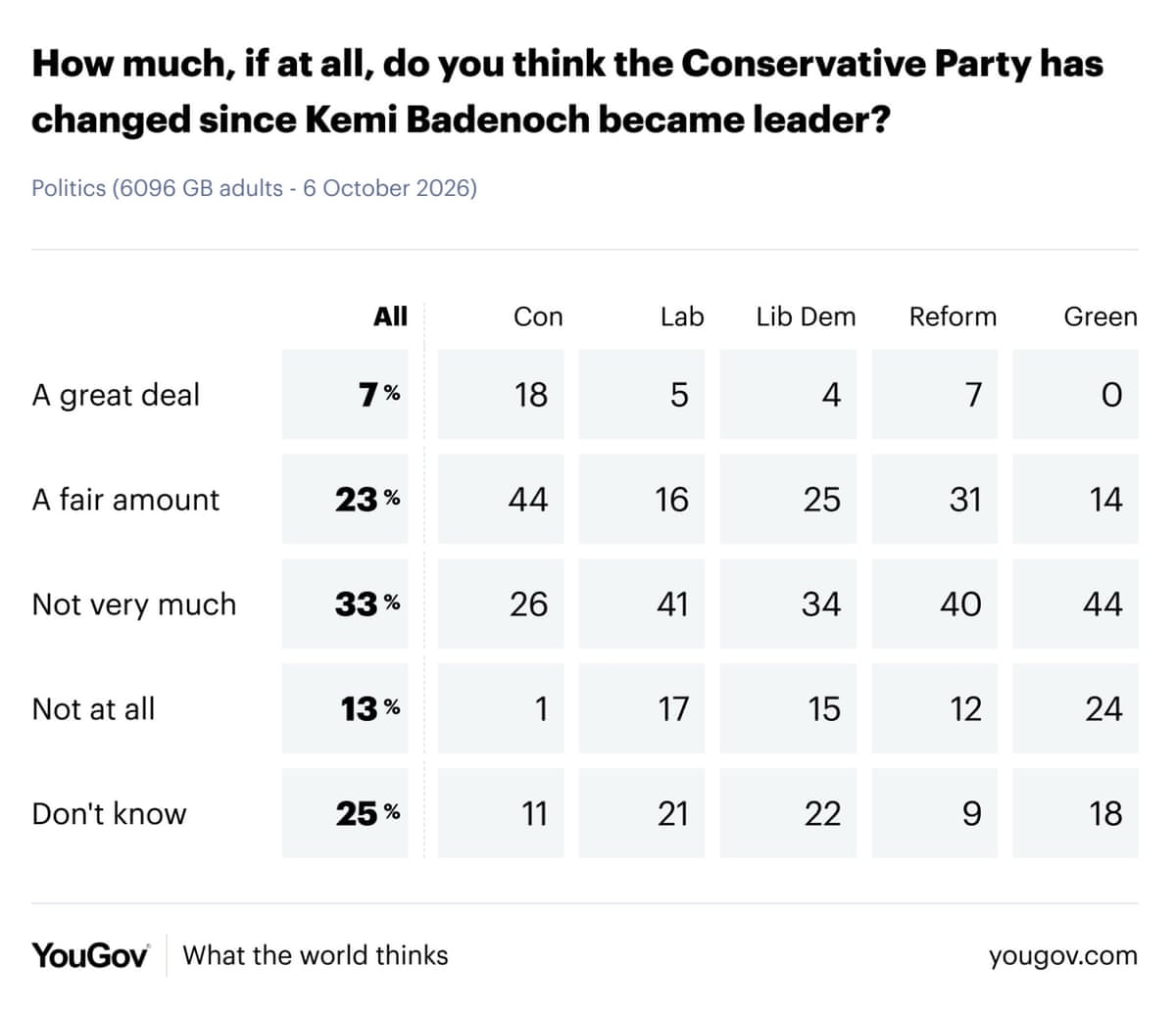
battle of ideasframing represents mainstream Conservatism. According to polling by YouGov, voters are more likely to believe the Conservative party has not changed under Badenoch (46%) than to think it has (30%).
How would an inheritance tax cut work?
Inheritance tax represents one of the Treasury's most paradoxical levies. It ranks among the most unpopular taxes administered by HM Revenue and Customs, with polling demonstrating widespread opposition—despite the fact that most people never pay it. This contradiction stems partly from a visceral belief, widely held, that parents should be able to transfer assets to their children without state intervention.
Helen Miller, director of the Institute for Fiscal Studies thinktank, explained on the Today programme:
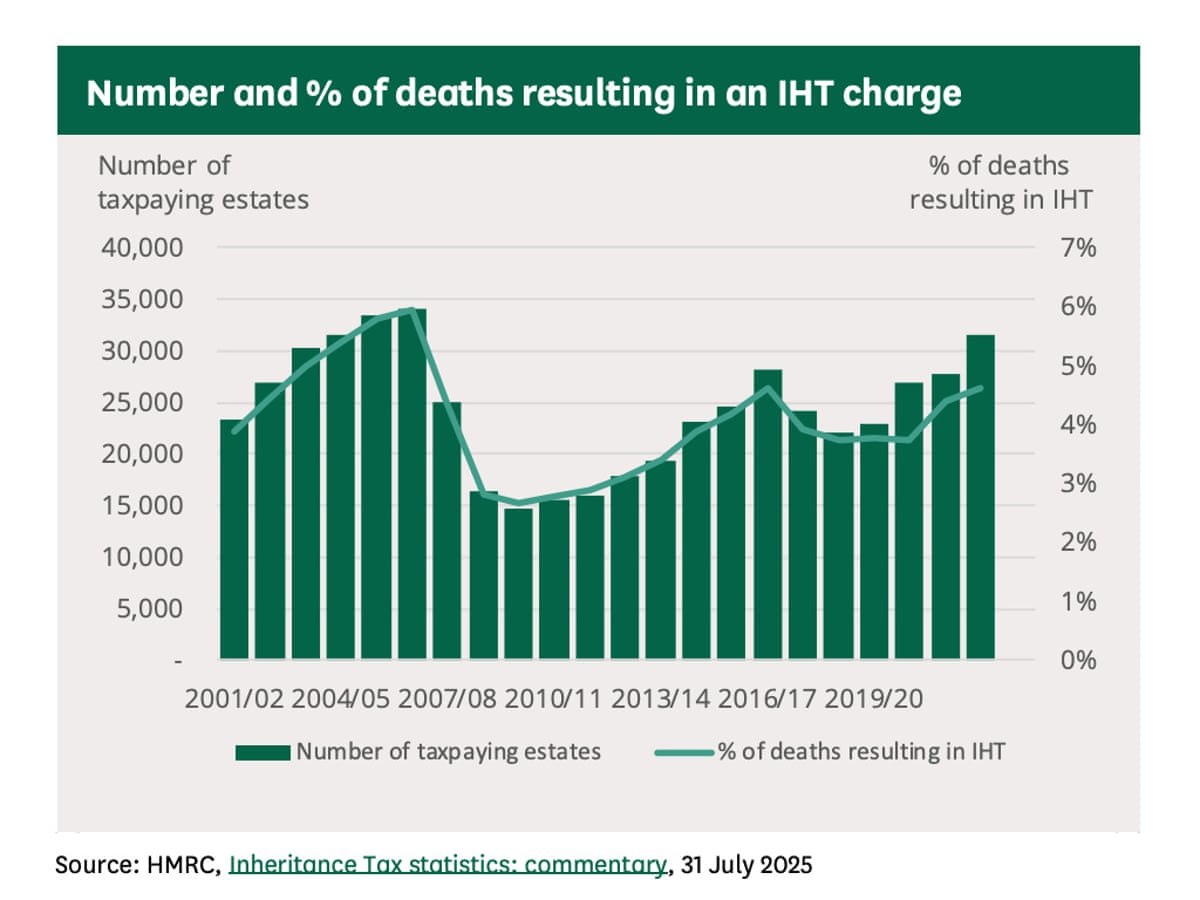
It's a tax that is charged on estates when people die, but only around one in 20 estates will actually end up paying it.The threshold stands at £325,000, meaning estates below that figure incur no charge. When a home passes to children, the threshold rises to £500,000, and for couples it reaches £1m. As Miller noted,
most people don't go anywhere near the tax.
Two broad options exist if Badenoch wishes to cut inheritance tax without eliminating it entirely. The first involves reducing the 40% rate that applies to estate values exceeding the threshold. Estimates from 2023, the last occasion the Conservatives examined this issue, suggested a 10 percentage point reduction to 30% would cost several billion pounds annually. The second option involves raising the thresholds at which inheritance tax becomes payable. The standard threshold is £325,000, rising to £500,000 when a home is left to a direct descendant.
Badenoch has argued that inheritance taxes are unfair and
morallywrong because people are taxed again on wealth they have already earned. She has also insisted that any tax cuts must be fiscally responsible. The inheritance tax threshold has been frozen for almost a decade, bringing more estates above the threshold.
The fiscal cost of scrapping inheritance tax entirely would be substantial—equivalent to building a
Britannia Shielddefence programme annually. Inheritance tax is projected to raise more than £10bn yearly from next year onwards, making any significant reduction an expensive proposition.
What is Badenoch's broader economic philosophy?
Badenoch's keynote speech will articulate a fundamental divide between Labour and the Conservatives on public spending. She will argue:
There is a fight coming in British politics. A fight that we have not seen in this country for more than half a century. It will be a battle for the soul of this nation. A battle that goes to the very core of who we are and what kind of country we want to be.
She will characterise Labour's approach as rooted in failed ideology:
On one side we have a government that wants to wind back the clock to failed ideas of the past. They believe economic growth is created by politicians. They think government knows best. They think that your income, your pension and your savings are theirs to take and then hand out as they see fit. They claim that what they are doing is compassionate but we know that these ideas will make every single person in this country poorer. Your taxes will be higher. Your bills will go up. You will find it harder and harder to make ends meet. Just because these ideas are delivered on TikTok doesn't make them any less dangerous than they have always been.
By contrast, she will position the Conservatives as champions of individual liberty:
On the other side of the battle is us. A renewed Conservative party fighting again for the belief that what people earn belongs to them, not government. That the collective wisdom of people in our country is greater than the central planning of bureaucrats and politicians. That spending money we don't have on things we can't afford is not kind, it is reckless.
Badenoch's economic framework includes a golden economic rule
stipulating that half of savings identified through policy changes would be directed towards reducing the budget deficit, rather than funding additional tax cuts.
What happens next?
Badenoch was scheduled to deliver her closing conference speech on Wednesday, 7 October, at noon. The morning session begins at 10am with Kevin Hollinrake, the Conservative chair, opening proceedings. Speeches from Chris Philp, the shadow home secretary, and Nick Timothy, the shadow justice secretary, are also scheduled before Badenoch takes the podium at approximately 11.15am.