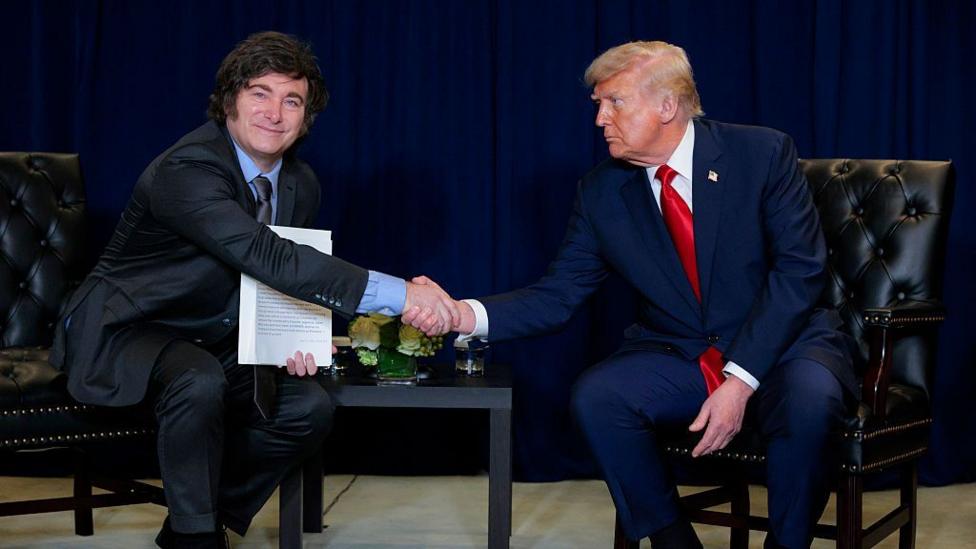
Argentine President Javier Milei has cultivated a notably close relationship with President Trump, and that alliance now sits at the centre of a renewed and intensifying dispute over the Falkland Islands. The temperature of this territorial disagreement has been rising steadily in Argentina well before Milei delivered a late-night national address focused on sanctions earlier this week, but his speech has crystallised the stakes and signalled where Buenos Aires believes its leverage now lies.
The friction over the islands became visibly apparent during the Fifa World Cup this summer, when Argentine players celebrated their victory over England by holding aloft a banner reading "Las Malvinas son Argentinas" – the Falklands are Argentine – before jubilant supporters. Yet this public display merely reflected tensions that had been building beneath the surface for considerably longer.
During his Thursday address, Milei opened with a historical account of the Falklands dispute presented entirely from Argentina's viewpoint. He reiterated the core of Argentina's argument: that the islands "rightfully belong" to the nation. According to his version of events, the British invaded and established colonial rule over the territory in 1833, forcibly seizing it from Argentine control.
What does Britain say about Argentina's historical claims?
The UK Government contests this narrative by pointing to details it says Milei omitted. The islands, which had changed hands between European powers throughout the 17th and 18th centuries, were uninhabited when Britain reoccupied them. The Argentine settlement had been expelled two years before the British reoccupation – not by British forces, but by the United States. In December 1831, the American warship USS Lexington destroyed a fort that Argentina had established there, an action taken amid disputes over local fishing and sealing rights.
Paradoxically, if American intervention two centuries ago contributed to Argentina's loss of the islands, American policy today may now strengthen Argentina's hand. Milei clearly believes this to be the case. He told the Argentine people that "winds of change" were blowing, citing remarks from President Trump indicating he was "re-evaluating" the American position on the Falklands. According to reporting from , Trump stated, "I always review every position. That's just one of many," when asked about the Falklands in the Oval Office.
How has the United States traditionally approached the Falklands dispute?
Historically, American policy has maintained a position of neutrality on the sovereignty question, while formally recognising British administration of the territory. This stance was shaped significantly by the 1982 Falklands War, during which President Ronald Reagan provided material support to Margaret Thatcher – a decision that reinforced the long-standing alliance between London and Washington during times of conflict. According to , the U.S. has generally avoided taking sides on sovereignty since that conflict, though it has recognised British administration.
For Trump, however, the traditional "Special Relationship" between the United States and Britain has been damaged by what he views as insufficient British support. He expressed frustration with Prime Minister Sir Keir Starmer's decision not to join the American military action against Iran. "You weren't there to help me," Trump said in an interview with a national broadcaster this week. He added that the Falklands were "a long way away" – a geographical argument that islanders have contested by noting that the distance from London to the Falklands is actually shorter than the distance from Washington DC to the American territory of Guam in the western Pacific.
Why has Milei escalated the Falklands issue now?
Trump's comments have clearly energised Milei, but domestic political pressures also play a significant role. Milei faces a presidential election next year in which one of his challengers, his former vice-president Victoria Villarruel, has positioned herself as a tougher defender of national sovereignty and has criticised Milei's diplomatic approach to the Falklands as ineffective. Beyond electoral calculations, however, Buenos Aires contends that the matter has become genuinely urgent. Milei described it as "a clear and urgent danger."
The urgency stems from planned offshore oil exploration. Two energy companies – the Israeli-owned Navitas Petroleum and Rockhopper Exploration from the UK – are scheduled to undertake exploration work on the Sea Lion oilfield off the Falklands coast within two years. In his address, Milei declared that Argentina "cannot allow" these companies to "appropriate the oil reserves under our sea" and vowed, "We will not stand by with our arms folded." According to reporting from UPI, Milei used his national address to announce sanctions targeting oil companies operating near the islands, escalating pressure beyond rhetoric alone. The same source noted that Milei argued the islands are Argentina's "historically and legally" and rejected self-determination for the islanders.

How does the "Don-roe Doctrine" reshape the geopolitical picture?
In his speech, Milei presented Argentina as a reliable and "trustworthy partner" to Washington, and he benefits from Trump's support both ideologically and personally. The two leaders are close allies within what Trump calls the "Don-roe Doctrine" – a play on the 19th-century Monroe Doctrine – which envisions American dominance over the Western Hemisphere. Under this framework, both presidents seek to ensure that only ideologically aligned leaders hold power in the Americas.
Within such a reordering of hemispheric influence, it becomes plausible that Trump might favour the Argentine leader over the British Prime Minister, even though the underlying issues transcend personal relationships and party affiliation. The central question for the coming months is whether the strength of this emerging "Don-roe Doctrine" will outweigh the historical weight of the "Special Relationship" between the United States and Britain.
What are the next steps in this dispute?
Britain has already responded to Argentina's renewed claims. UK officials reaffirmed their support for Falkland Islanders after Argentina renewed its claim, saying London's position remained "unwavering". The Falkland Islanders themselves voted almost unanimously in 2013 to remain a British overseas territory, a democratic expression that Argentina's government rejects as illegitimate.
The immediate focus now rests on whether Trump will follow through on his suggestion of re-evaluating American policy, and how Britain will respond to both Argentina's escalating rhetoric and any shift in Washington's stance. The sanctions threat against offshore oil firms suggests that enforcement or legal action may occur in the near term. A broader U.S. review of policy toward the Falklands had already been under consideration in the context of wider NATO-alliance policy discussions, according to reporting from April, though no specific scheduled hearing, summit, or announced decision date has been identified.
Key Facts:
- President Milei cited Trump's "re-evaluation" of U.S. Falklands policy as evidence of "winds of change" favouring Argentina's claim
- Argentina announced sanctions against oil companies planning exploration work on the Sea Lion oilfield within two years
- The dispute reflects both long-standing territorial claims and immediate concerns over offshore energy resources
- Milei faces domestic political pressure from rivals who claim he has been insufficiently assertive on the sovereignty question
- Britain has reaffirmed its "unwavering" support for the Falkland Islanders, who voted overwhelmingly in 2013 to remain a British overseas territory