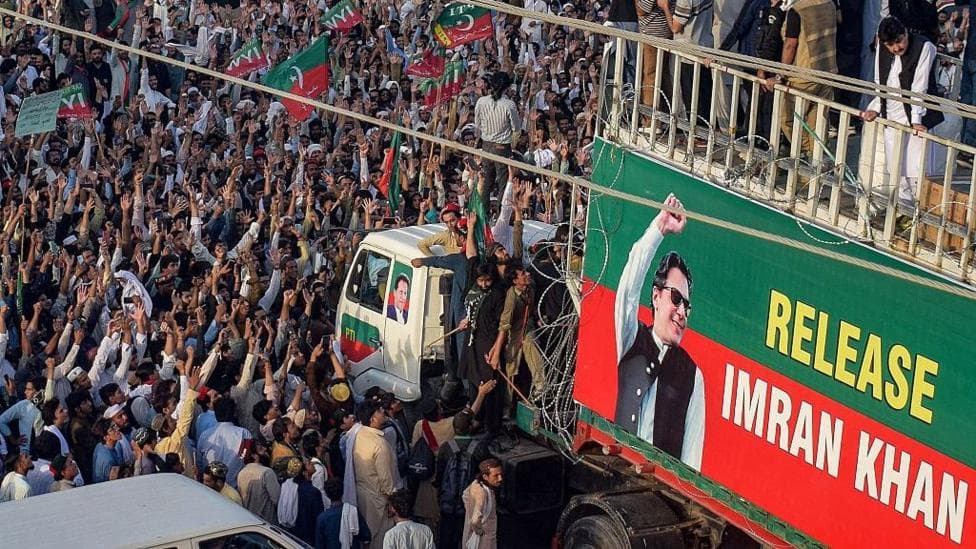
Thousands of supporters of Pakistan's jailed former prime minister Imran Khan launched a march toward the capital Islamabad on Sunday, October 4, demanding his freedom and calling attention to deteriorating health conditions he has experienced while imprisoned. The demonstration, which began in Lakki Marwat—a city located 275 kilometres from Islamabad—came after two rounds of weekend negotiations between the government and Khan's Pakistan Tehreek-e-Insaf (PTI) party ended without agreement.
Approximately 5,000 people participated in the initial stages of the march, carrying the red-and-green flags of Khan's party. According to reports from the region, the federal government announced that protesters would not be permitted to enter Islamabad, with authorities erecting shipping containers to block key access routes into the city.
The 73-year-old Khan, who was imprisoned in August 2023 on corruption charges carrying a 14-year sentence, has consistently maintained that all cases against him—numbering more than 100—are politically motivated. His family and party representatives have raised serious concerns about his physical condition, particularly claiming that he has lost most of his vision in his right eye due to what they characterise as negligence by prison authorities.
Why was the march postponed and what triggered it now?
The demonstration was originally scheduled for September 27 but was postponed to October 4 to permit negotiations between government officials and PTI leadership. The planned route included overnight stops near Karak on October 4 and Kohat on October 5, before continuing toward Peshawar. However, the talks collapsed over fundamental disagreements between the two sides.
The PTI stated that negotiations failed because authorities rejected the party's request for access to Khan, which would have allowed party leaders to consult him on national and political matters. The party also demanded that Khan receive an immediate medical examination and treatment. According to party statements, the march was intended not only to secure Khan's release but also to seek the supremacy of law and the Constitution.
Interior Minister Mohsin Naqvi countered by accusing Sohail Afridi, the chief minister for Khyber Pakhtunkhwa province, of sabotaging the negotiations. According to Pakistan's local media reports, Naqvi claimed that the provincial government had reneged on earlier commitments regarding counter-terrorism issues.
What is Khan's current health situation?
Concerns about Khan's wellbeing have intensified over recent months, with his family asserting that prison authorities have failed to provide adequate medical care. In August, Khan was briefly transferred from jail to a state-run hospital for medical examination and treatment following complaints about his deteriorating health. However, doctors subsequently declared him medically fit, a conclusion that Khan's family and the PTI disputed.
The family and party representatives criticised authorities for disregarding a court order requiring that Khan be examined by physicians at a specific private hospital. On August 18, the Supreme Court had issued an order for Khan to be shifted to a private Islamabad hospital for examination and treatment, but this directive was not fully honoured according to party claims.
Former international cricket captains have made multiple public appeals to Prime Minister Shehbaz Sharif, urging that Khan receive proper medical care befitting his status and health requirements.
What is the scale and trajectory of the march?
Sohail Afridi, the chief minister of Khyber Pakhtunkhwa province, predicted that the march would reach a town approximately 80 kilometres west of Islamabad by Thursday, October 8.
[By then] this movement will have reached every corner of the country and every square will have become a centre of activity, Afridi stated on Sunday, urging citizens to
play an active role in the political process.
Afridi indicated that he would announce the march's next phase when the convoy reaches Khairabad on Thursday, October 8. The march paused overnight and was expected to resume around midday local time on Monday, October 5, continuing its advance toward the capital.
What is Khan's political background and significance?
Khan, who previously captained the Pakistan national cricket team, served as the country's prime minister from 2018 to 2022. Despite his imprisonment, he remains a potent force in Pakistani politics. His jailing triggered large-scale protests by supporters, which were met with forceful crackdowns by authorities, and demonstrations in support of him have previously led to deadly violence.
The charges against Khan span a wide range of allegations, from leaking state secrets to selling state gifts. He has rejected all accusations as politically motivated persecution. His conviction on corruption charges resulted in a 14-year prison sentence, though he continues to contest the legitimacy of the legal proceedings against him.
What other recent developments have affected Khan's supporters?
On September 20, Khan's sister Aleema Khanum was arrested in the eastern city of Lahore. The arrest order alleged that Khanum had been mobilising people to create law and order situations and was raising objectionable slogans against the government among the general public. Her detention added another dimension to the family's grievances and further energised the movement calling for Khan's release.
What happens next?
The march is expected to continue its advance toward Islamabad over the coming days, with the convoy scheduled to reach Khairabad on Thursday, October 8, where Afridi will announce the movement's subsequent phase. The federal government has made clear that protesters will not be allowed to enter the capital, setting the stage for a potential confrontation between demonstrators and security forces. The outcome of these developments will likely shape the political landscape in Pakistan over the coming weeks.
Key Facts:
- Approximately 5,000 supporters began the march on Sunday, October 4, from Lakki Marwat, 275 kilometres from Islamabad
- Khan, imprisoned since August 2023, faces charges in more than 100 cases and maintains all are politically motivated
- The march was postponed from September 27 to October 4 to allow government negotiations, which ultimately failed
- Khan's family claims he has lost most vision in his right eye due to prison authorities' negligence
- Federal authorities have blocked key access routes to Islamabad using shipping containers to prevent the march from entering the capital