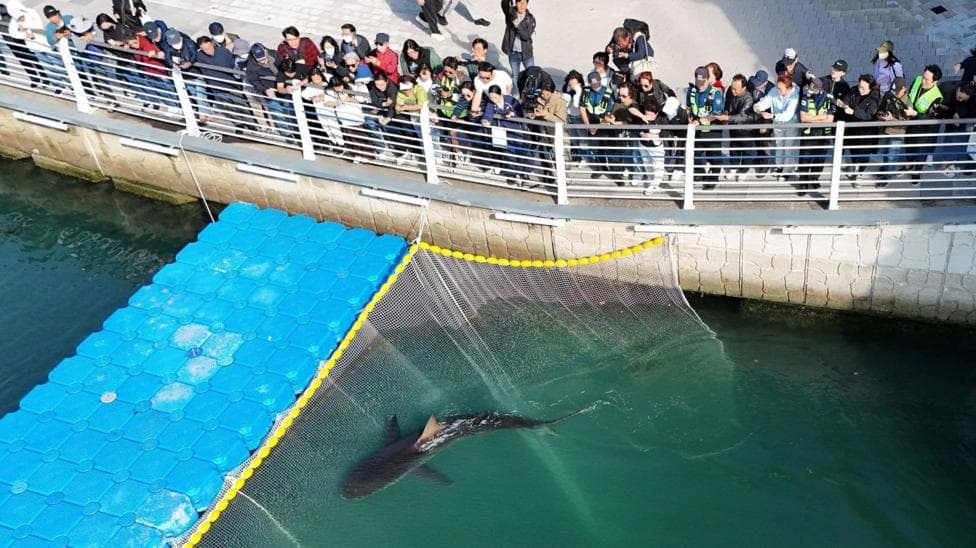
A dusky shark that has captured public attention in South Korea continues to defy rescue efforts, swimming back into a Busan canal just hours after being guided to open water. According to BBC News, the three-metre-long shark, nicknamed Bukangi, broke through a barrier installed by authorities on Thursday morning after a lengthy rescue operation the previous day.
Bukangi first appeared in the south-eastern port city's canal in mid-September and has since become an unlikely celebrity, attracting more than 1.6 million visitors to the waterway. The shark's presence has boosted Busan's tourism profile, with the city embracing it as an unofficial mascot, though authorities have grown increasingly concerned about its health and well-being.
On Wednesday, rescue workers conducted a livestreamed operation lasting more than eight hours, carefully using nets to guide the shark toward the harbour's open water. Hundreds of spectators gathered at an overlooking park, cheering as the animal was directed seaward. However, the effort proved short-lived when Bukangi returned through the reinforced barrier the following morning.
Why is the shark struggling to leave?
Experts believe Bukangi was initially drawn to the canal by unusually warm water temperatures and an abundant food supply. The Star reported that the shark was first spotted in the canal on 18 September, with footage showing damage to its right pectoral fin and evidence of the animal striking the canal wall. As sea temperatures continue to rise annually, marine scientists warn that Busan may expect more shark visits in coming years.
The shark's apparent injuries have raised health concerns among rescuers. Social media videos circulating online show Bukangi swimming with what appears to be a bloodied snout, and observers have noted that the animal does not appear to be eating. Authorities worried that declining water temperatures could further weaken the already-stressed shark.
How many rescue attempts have been made?
The Wednesday operation marked the third attempt to free Bukangi from the canal. The New York Times reported that earlier efforts on 29 September and 2 October both failed, with the second attempt halted after a net became snagged on the canal bottom. A joint team from South Korea's Ministry of Oceans and Fisheries, Busan city authorities, and other organizations has coordinated the successive rescue efforts.
During the most recent attempt, rescuers found Bukangi trapped in a confined space between two layers of nets. They freed the shark by removing the outer net layer, then reinforced the remaining barrier to prevent re-entry. A government official told BBC News on Thursday afternoon that the rescue team had concluded its immediate operations.
What happens next?
Officials are not giving up. Chosun Ilbo reported that Busan authorities and South Korea's Oceans and Fisheries Ministry were developing a new strategy after Bukangi slipped back through the pontoon barrier, with the shark confined between the pontoon and a second net approximately 50 metres into the canal mouth. The revised rescue plan involves deploying underwater drones to inspect the seabed, removing the pontoon net to allow Bukangi greater freedom of movement, then installing a longer net to guide it toward open water. Authorities planned to resume rescue work at 9:30 a.m. on 22 October, beginning with the underwater-drone seabed inspection.
Key Facts
- Bukangi has been in the Busan canal since 18 September, attracting over 1.6 million visitors and becoming a tourism draw for the city
- The shark shows signs of injury, including damage to its right pectoral fin and a bloodied snout, and appears not to be eating
- Three separate rescue attempts have been made, with the most recent occurring on 21 October lasting more than eight hours
- Warming sea temperatures are believed to be drawing sharks toward the canal, a trend experts expect to continue in future years