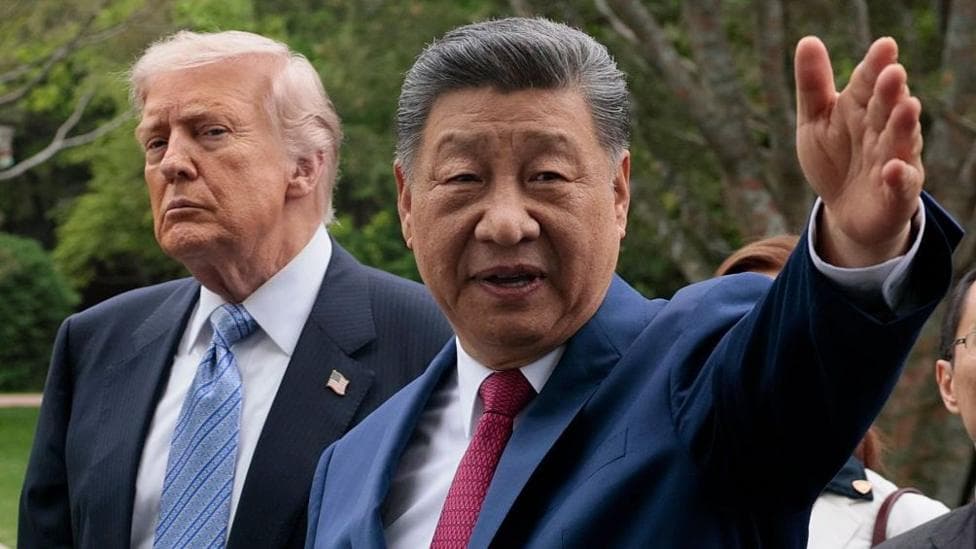
The United States and China are engaged in an intensifying competition to establish technological supremacy in artificial intelligence, with the two nations' leaders preparing to address the stakes during their upcoming meeting. President Donald Trump has made his position unambiguous, declaring AI development a cornerstone of American power and naming China as the principal competitor. While Xi Jinping has been less vocal in public statements, his government's decade-long focus on AI as a strategic priority reveals comparable ambitions.
"China very much sees it as a race, they very much think China should be the leading force in AI - they see AI as a power maximiser,"according to Rebecca Arcesati, a researcher at the Mercator Institute for China Studies. China's technological strategy has consistently prioritised AI development, regardless of how prominently Xi discusses it externally. For Trump, the pursuit of AI leadership takes precedence over potential risks posed by the technology itself—he has previously characterised such concerns as
"a hoax".
China's foreign ministry has cautioned against what it terms
"narratives of threat"and confrontational framing, advocating instead for collaborative approaches to global AI governance. When the two presidents convene this week, few subjects will rival AI in importance, and their statements and decisions will reverberate across the global technology landscape.
Which nation currently leads in AI capability?
Determining leadership in artificial intelligence depends significantly on the metrics used to measure success. The United States maintains a commanding position in frontier models—the most advanced systems evaluated against standard performance benchmarks. Leading American companies including Anthropic, Google, and OpenAI have developed systems that consistently rank at the top of these assessments.
The competitive gap has narrowed considerably. In February 2025, an AI model developed by China's DeepSeek temporarily matched the performance of the leading American system, and according to researchers at Stanford University, as of March 2026, Anthropic's leading model held only a marginal advantage of
"2.7%"over Chinese competitors. The substantial financial investments flowing into American frontier AI laboratories have contributed to this advantage, as these companies expend enormous resources constructing the computational infrastructure required to train next-generation models.

The American economy's expansion increasingly depends on the explosive growth and anticipated profitability of the AI sector, which partly explains Trump's emphasis on AI as fundamental to national prosperity. A significant constraint on China's development capacity stems from comprehensive restrictions imposed by the American government, which prohibit the sale of advanced microchips to Chinese enterprises—components essential for developing state-of-the-art AI systems.
Where does China hold advantages?
Despite semiconductor restrictions, both nations are releasing innovative AI models at a rapid cadence, and the definition of "winning" an AI competition remains ambiguous. Whether a finish line exists at all is uncertain. Numerous organisations are pursuing artificial general intelligence (AGI), a hypothetical form of AI capable of learning, reasoning, and executing diverse tasks at or exceeding human-level performance.
China's AI sector has pursued a distinct strategy, concentrating not on frontier model development but on releasing open weight models—systems that can be downloaded and modified similarly to open-source software. This approach contrasts sharply with the predominant American strategy, where major firms typically restrict access to proprietary models through paid subscription services or proprietary platforms. Chinese developers are releasing open weight models at an accelerating pace, with performance metrics indicating that leading Chinese systems lag American counterparts by only several months.

Models such as Moonshot AI's Kimi K3 have achieved substantial adoption within China and internationally, delivering performance approaching frontier systems while remaining freely available and adaptable. According to Lizzi Lee, an analyst at the Asia Society Policy Institute,
"AI isn't the moon landing. The US may lead at the frontier, while China could still gain enormous economic and geopolitical leverage by making capable AI cheap, open and ubiquitous."Beijing's strategic focus emphasises deploying AI technology across its entire economic structure rather than competing solely on frontier capabilities.
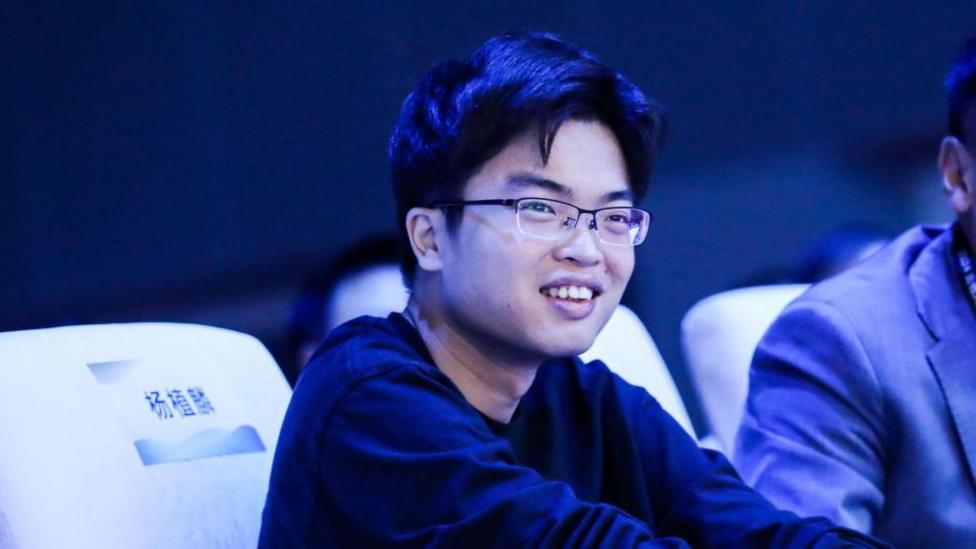
Energy availability represents another significant advantage for Chinese AI development. Rebecca Arcesati explained that
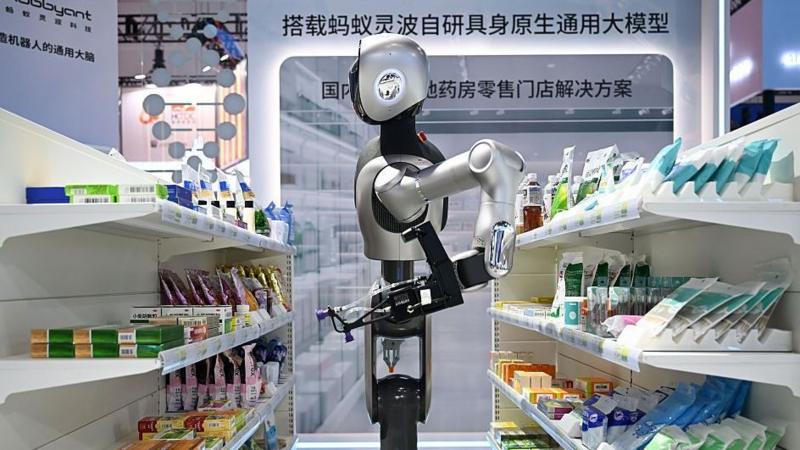
"Chinese AI companies are able to access the electricity they need for a much lower cost and that really is an advantage."In robotics—a field many analysts believe will fundamentally reshape global economies—China has emerged as the world's dominant manufacturer. The International Federation of Robotics estimates that more than two million robots currently operate in Chinese factories. China also leads global production of humanoid robots, accounting for over ninety percent of worldwide shipments during the first half of the year, according to Chatham House, an independent policy institute.
Chinese AI developers have demonstrated
"remarkable resilience and innovation"despite the shortage of advanced American semiconductors, according to Lian Jye Su, an analyst at technology research firm Omdia. However, American officials and technology companies have contended that Chinese developers narrowed the performance gap through distillation—a technique permitting models to acquire knowledge from more sophisticated systems. China's foreign ministry responded by asserting that AI development was
"fuelled"by the nation's
"vision of extensive consultation and joint contribution for shared benefit."
How do the two nations approach AI safety differently?
Although the United States and China engage in vigorous competition, their governmental approaches to safety considerations diverge markedly. Some industry figures have recently warned that AI development could pose existential dangers to humanity, yet Chinese researchers appear less preoccupied with such scenarios and instead focus on potential misuse and cyber warfare threats. Trump has stated that existing American regulations are adequate and that the sole guardrails AI requires are a
"high IQ"president, adding that
"We're leading now over China by a lot, and everyone else, and we're going to keep it that way."He further asserted that the United States would not
"stifle the growth of something that will be bigger than the industrial revolution."
Washington has prioritised innovation and attempted to minimise regulatory burdens to
"keep American labs ahead,"according to Jayant Dave, an information security officer at cybersecurity firm Check Point Software Technologies. Beijing has adopted a contrasting approach to American deregulation. Xi has directed national leaders to monitor AI risks vigilantly and maintain the technology
"under human control."
"China has taken a relatively cautious and centrally-coordinated approach,"Dave noted,
"introducing guides on data usage and algorithms before many other countries, helping to address many underlying concerns."Jonathan Sim, an AI ethics lecturer at the National University of Singapore, observed that these guidelines, though not legally enforceable, establish expectations while permitting developer innovation.
Will the two superpowers cooperate on AI governance?
International cooperation on AI remains uncertain despite repeated calls for collaborative frameworks. The two nations have previously worked together on existential threats such as nuclear weapons, but that cooperation rested on mutual recognition of the danger—a consensus currently absent regarding AI. Jayant Dave explained that
"Washington worries about capability escaping control. Beijing worries about capability threatening domestic stability."Trump has rejected proposals for an industry-wide development slowdown, contending that such measures could permit Chinese developers to reduce the performance gap.
Significant progress has emerged in recent discussions. According to reporting from a major international news agency, U.S. Treasury Secretary Scott Bessent and Chinese Vice Premier He Lifeng discussed establishing a notification mechanism for serious AI incidents during New York talks preceding the Trump-Xi summit. The proposed system was described as a direct communications line or "incident line" for AI safety events, addressing concerns about uncontrollable AI agents and cyber threats from non-state actors.
The future discussions are expected to encompass weaponization of AI, protection of critical infrastructure, and cyber-attack prevention. These represent the first official bilateral discussions devoted exclusively to AI between the United States and China since Trump returned to office. While Trump's recent messaging regarding China has grown
"more antagonistic,"according to policy analyst Leia Wang from the Carnegie Endowment for International Peace, the inclusion of AI on the summit agenda represents
"a good start."Wang cautioned against allowing
"an unhealthy version of the race narrative to perpetuate,"warning that such framing could intensify an already intense rivalry.
What comes next in the U.S.-China AI dialogue?
The momentum toward formal engagement has accelerated. Senior officials from both nations are scheduled to reconvene in Shenzhen in approximately two months to continue substantive discussions on AI safety and governance. The notification mechanism and broader AI governance framework are anticipated to feature prominently during the Trump-Xi summit this week, with potential formalisation of the arrangement expected at or shortly after that meeting. These developments signal a tentative shift toward structured dialogue, though the underlying competitive pressures and strategic divergences between the two superpowers remain formidable obstacles to comprehensive cooperation.
Key Facts
- American companies lead in frontier AI models, though China's top systems now trail by only 2.7% as of March 2026
- China emphasises open-weight models and robotics manufacturing, where it produces over 90% of global humanoid robot shipments
- The U.S. maintains semiconductor export restrictions that constrain China's AI development capacity
- U.S. and Chinese officials have agreed to establish a formal AI notification mechanism and plan further talks in Shenzhen within two months
- The two nations diverge significantly on AI safety priorities, with Washington focused on capability control and Beijing emphasising domestic stability