You are hungry. Or perhaps you are not. The distinction proves irrelevant.
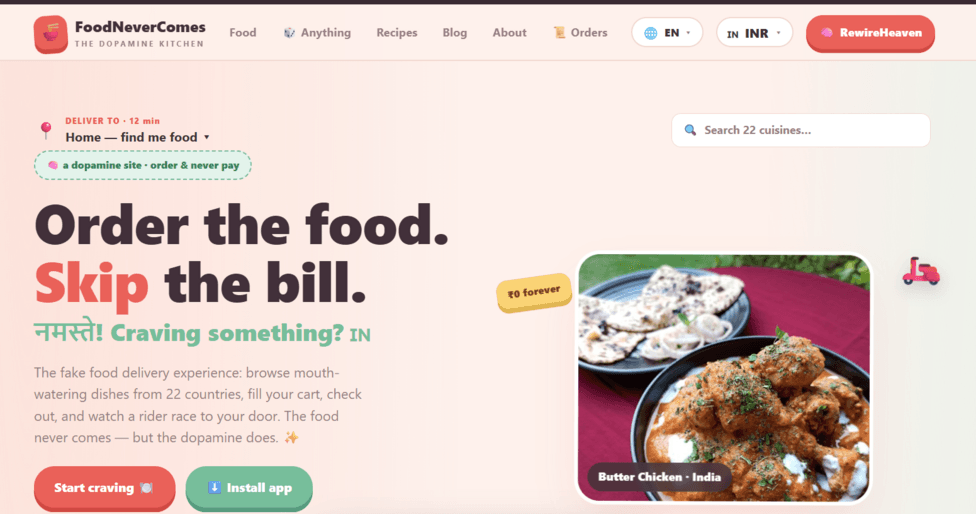
Open FoodNeverComes, select from 22 cuisines and begin browsing. Butter chicken catches your eye. So does bibimbap. You add several dishes, observe the total accumulate and proceed to checkout. A tracker indicates a rider is en route.
Then a simulated AI-generated call arrives from within the platform. The caller claims to be outside your building but cannot locate your street or entrance. Yet no food ever existed. The entire transaction remains confined to the screen.
"Order the food. Skip the bill,"the site declares. Its tagline cuts deeper:
"The food never comes - but the dopamine does."
Two 26-year-old software engineers—Purvansh Parmar and Anshul Sharma—from Udaipur in Rajasthan created FoodNeverComes. Since launching in June, the platform has drawn more than 2.7 million visitors. It now features 22 kitchens, 327 dishes and 319 authentic recipes, each accompanied by fabricated prices, a mock checkout process and a fictional delivery sequence.
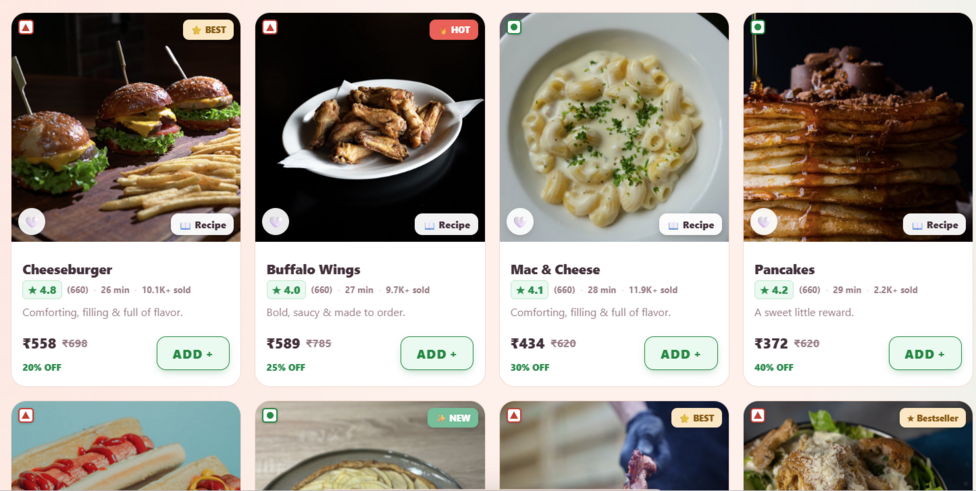
FoodNeverComes exemplifies an emerging internet category: "dopamine sites," which simulate consumption rituals without actual purchasing. Fake shopping platforms, counterfeit delivery services and even simulated vacations populate this expanding ecosystem. The trend originated in South Korea and has since proliferated globally, generating platforms such as Dopamine Shop and Fakehaul that replicate everything from food ordering and retail to travel experiences.
The founders discovered the concept through their own behaviour patterns. Parmar and Sharma met during a computer science diploma programme and subsequently established NeuroX AI, a company developing software, artificial intelligence products and social media content. They recognised a recurring pattern in their lives: digital shopping carts accumulating items they desired but never purchased.
Sharma would examine electronics, populate an online basket and abandon it. Parmar's mother exhibited identical behaviour.
"She would add things to the cart and say, 'I will order this later',"he recalls.
Parmar's own experience culminated at food delivery checkouts. During a two-month assignment in Mumbai, he spent 5,000 to 10,000 rupees weekly on food, frequently ordering items he did not genuinely require: Belgian waffles, ice cream and, on one occasion, a large jar of sour cream he scarcely wanted and subsequently distributed to acquaintances.

He contends that
"perhaps the real craving was not always for the food, but for the ritual of ordering it."
The two developers argue that genuine hunger can evolve into association with the pleasure of ordering. Eventually, boredom, anxiety or habit can activate the impulse even when physical hunger has vanished.
"Sometimes you're not hungry at all. You're bored or busy, and then you realise that ordering food makes you feel good. You start associating the act of ordering with that dopamine hit. Eventually, it's not just the food you want,"Parmar explains.
What drives the appeal of simulated shopping?
Ravi Dhar, director of the Yale Center for Customer Insights, identifies this phenomenon as "anticipatory utility"—the satisfaction derived from contemplating future consumption. This sensation intensifies with items that captivate imagination, such as new footwear, travel experiences or restaurant meals, because anticipation becomes integral to the overall experience.
Dhar observes that anticipation occasionally surpasses actual ownership in pleasure:
"The thrill is in the chase."Once acquisition occurs and tension dissipates, psychological arousal declines.
Neuroscience recognises this distinction between pursuit and attainment, challenging widespread assumptions. Dopamine functions not simply as the brain's pleasure chemical, contrary to popular internet discourse about "dopamine hits."
Kent Berridge, a University of Michigan neuroscientist who formulated the theory distinguishing "wanting" from "liking," characterises them as separate mechanisms. Wanting represents motivational attraction toward something; liking constitutes the pleasure of possessing it. Though frequently occurring together, they diverge regularly. Dopamine, according to his framework, propels the former, not the latter.
Appealing food or products displayed online probably activate this wanting mechanism, which Berridge designates "incentive salience."
"Some situations can trigger 'wanting' by itself,"he states. Individuals can pursue something vigorously even when ultimate satisfaction proves minimal—or in practical terms, desire something more intensely than they ultimately appreciate it.
Dr Anna Lembke, a Stanford University addiction psychiatrist and author of Dopamine Nation, draws comparable distinctions.

"To call dopamine a chemical of pleasure is an oversimplification,"she explains.
"Dopamine is the molecule that says 'get more of' or 'do more of', but it doesn't necessarily equate to pleasure."
She emphasises ritual's significance. Signals and habits connected to rewards develop reinforcing properties independently, she notes: in addiction, preparatory routines preceding substance use eventually rival the substance itself in importance.
"Anticipation of reward can be as reinforcing as the reward itself,"she asserts.
Can imaginary orders satisfy genuine cravings?
Berridge suggests that repeated fictional ordering might generate a
"dopamine hit and strong 'wanting', and also evoke faint conditioned 'liking'."However, he anticipates
"the novelty to soon wear off"and would be
"surprised" if many people returned to place more than about 10 imaginary orders.
Dhar demonstrates greater openness toward simulated consumption functioning as a pressure-release mechanism.
"While we still need more empirical data to know if simulated shopping can satisfy a consumer urge, evidence from simulated consumption in gaming shows it can be highly effective,"he observes.
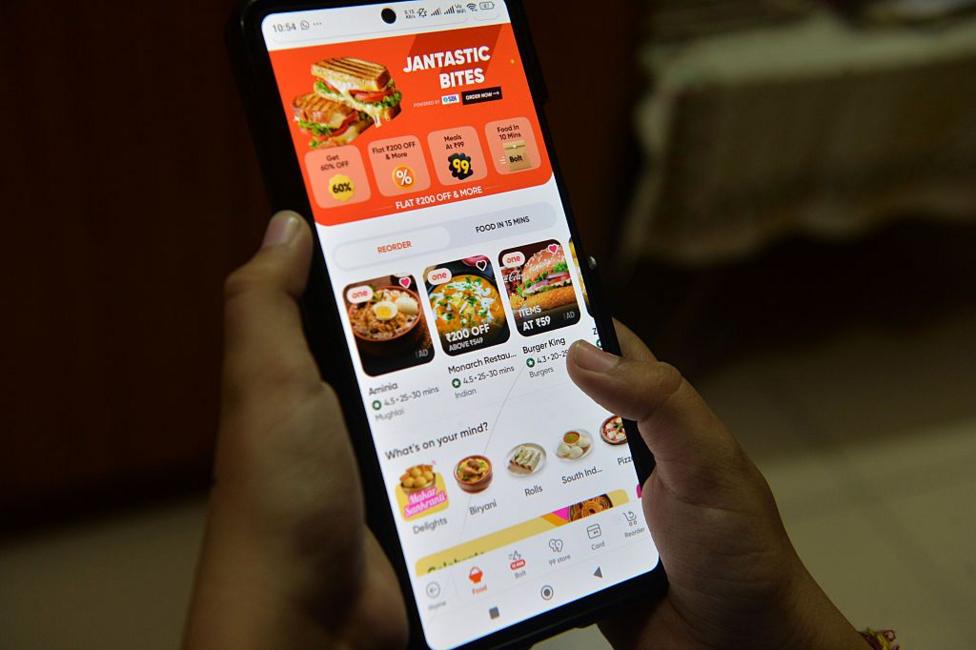
Yet an equally plausible risk exists: the ritual may simply rehearse the behaviour it purports to replace.
Lembke indicates that evidence remains inconclusive, with outcomes potentially varying by individual. Her personal assessment suggests that prolonged engagement could
"reinforce the same addictive neural networks they are trying to simulate."
She does identify one potential advantage:
"The one up side, though, is that people using these sites have on some level already admitted to themselves they have a problem, and that admission is often the first step in recovery."
Sharma conducted an inadvertent investigation himself. When his phone screen fractured, he invested a week on Amazon comparing six or seven replacement models and adding them to his basket. Subsequently, he repaired his original device.
"I enjoyed the process of research and putting the phones in the cart,"he says.
"Eventually I didn't buy a phone."
He now recognises himself engaging in identical behaviour on food delivery platforms, particularly during anxious moments, accumulating items without finalising purchases.
"I realised that I suffer from this problem,"he acknowledges.
Expanding beyond food delivery
The site's blog examines the
"serious side"of the counterfeit takeaway, addressing food-delivery addiction, the psychology underlying fake ordering, cravings, guilt and shopping cart behaviour.
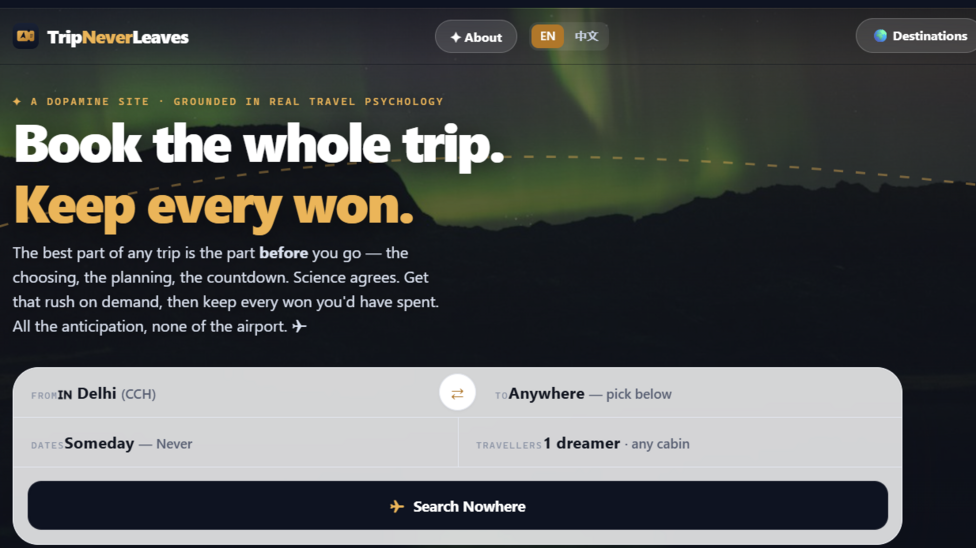
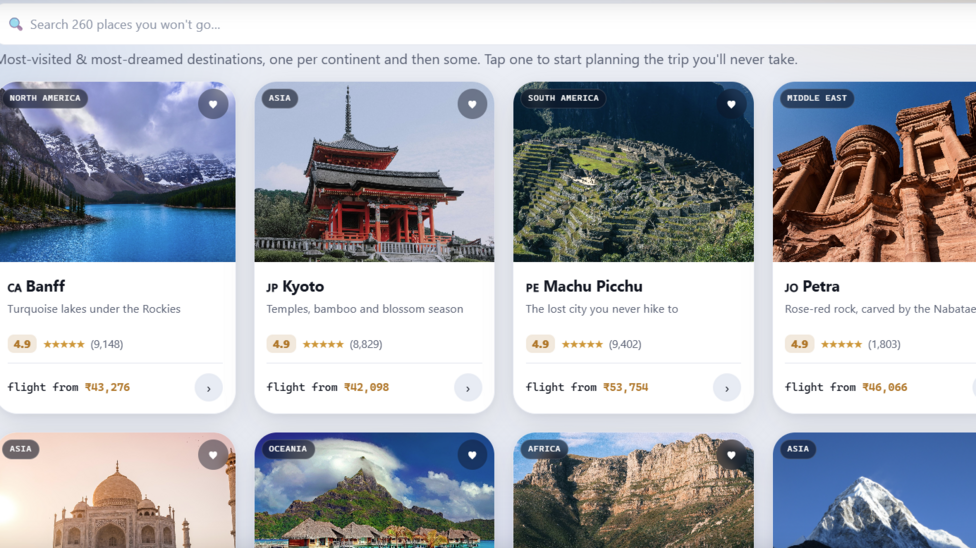
The founders have extended the concept beyond food. A companion platform, TripNeverLeaves, permits users to arrange a vacation—selecting destination, flight, seat, hotel and activities—before embarking on a virtual flight that remains perpetually grounded at the runway. This site has attracted more than 100,000 visitors.
According to the platform's official blog updated on 15 September 2026, FoodNeverComes has expanded its offerings to include new country menus from Belize and the Netherlands, incorporating 51 additional dishes and its inaugural African kitchen. The broader ecosystem has evolved considerably, with fictional couriers now including creatures such as turtles, bees and dragons, demonstrating how extensively the concept has developed.
Determining the demographic composition of these visitors proves challenging. However, Lembke suggests younger populations may face heightened vulnerability to reinforcing digital rewards because the
"developing brain is a vulnerable brain."
"In childhood and early adolescence, the front lobe, which acts like the brakes on appetite, is not yet fully connected to the emotion centres of the brain. Hence, teens are more likely to take risks without appreciating the negative consequences, and more likely to get addicted to reinforcing substances and behaviours, once exposed,"she explains.
According to a 2026 profile, approximately 700,000 fake orders have accumulated across the broader FoodNeverComes application and website since its inception.
Currently, the founders maintain that profitability remains secondary. They intend to preserve free access and eventually furnish the accumulated data to neuroscientists and psychologists for research purposes.
What happens next?
The platform's blog indicates that additional country selections are forthcoming, though specific launch dates remain unannounced. The founders continue developing the concept, suggesting further expansion into simulated consumption experiences beyond food and travel.
What initially appeared as satire regarding excessive food ordering has inadvertently raised a fundamental question about contemporary consumption: if substantial pleasure derives from anticipation preceding acquisition, do consumers genuinely require the product itself?