Nearly 600 dental practices across England have withdrawn from NHS treatment over the past decade, according to analysis by the Nuffield Trust, pushing the service towards a two-tier system where access depends increasingly on ability to pay and geographic location. The decline has been sharpest in the South West and East of England, with more than one in 10 practices that once offered NHS care no longer doing so. Meanwhile, NHS dental activity remains 8% below pre-pandemic levels, and six in 10 adults have not visited an NHS dentist in two years.
The shift reflects a fundamental crisis in the economics of NHS dentistry. Many practitioners have handed back their contracts because the work operates at a loss, and the government's response—including new contract reforms introduced in April 2026—aims to address the problem through revised payment structures and mandatory urgent care requirements.
Which regions have been hit hardest?
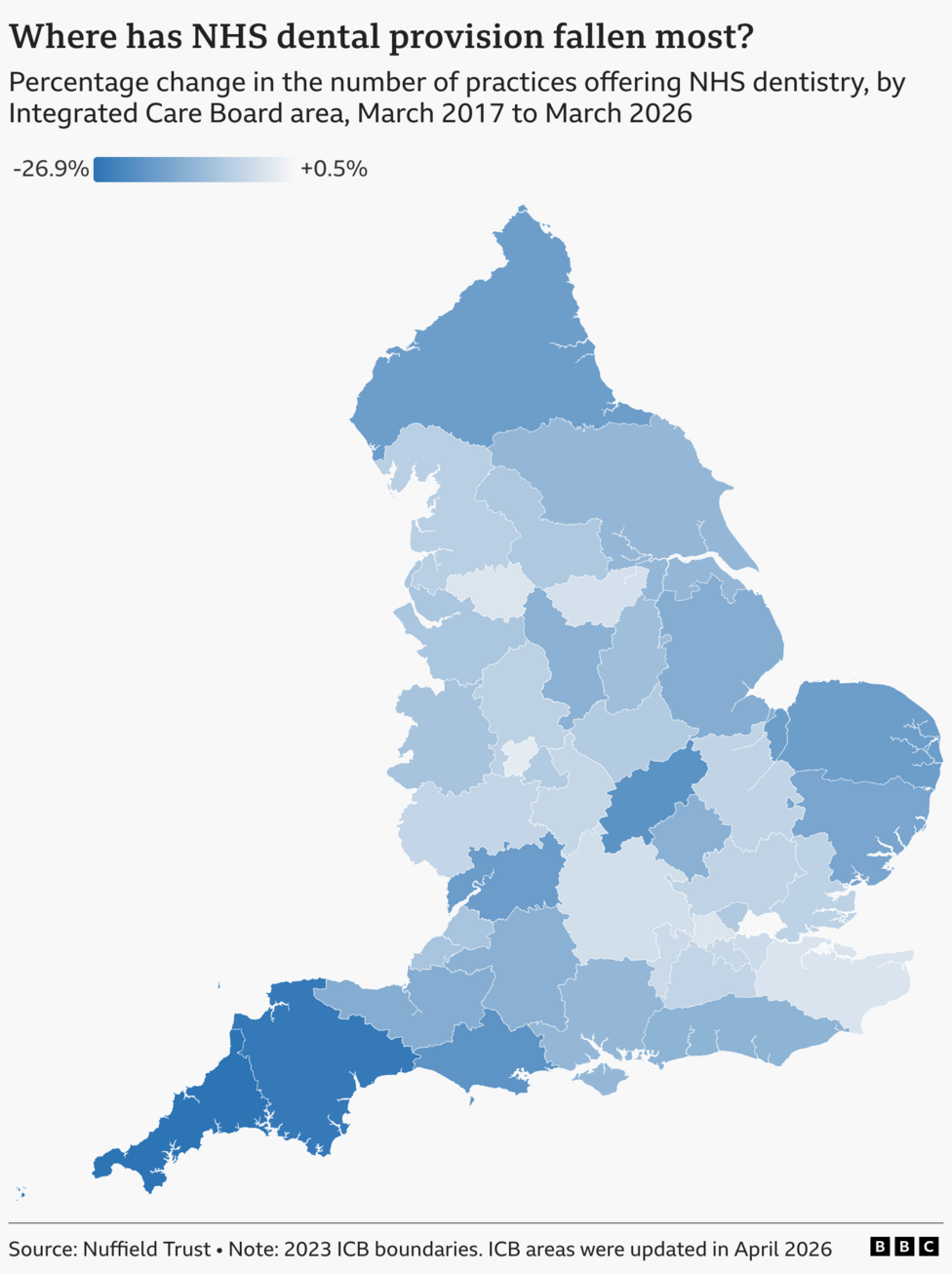
The geographic divide in NHS dentistry access has become stark. Cornwall has seen more than a quarter of its practices withdraw from NHS treatment, making it one of the most severe examples of the shift away from public provision. Devon and Northamptonshire have experienced similarly sharp declines, while Somerset now has fewer than one in five practices offering NHS services.
The pattern is not uniform across England. North West London, the Black Country and North East London recorded the smallest reductions in NHS practices. North East London was the only region to see any increase, gaining one additional practice offering NHS treatment compared with a decade ago. Every other region of England experienced a fall in the number of practices providing NHS dental care.

What does this mean for patients trying to get appointments?
For many people, finding an NHS dentist has become nearly impossible. Of adults who attempted to secure a new NHS appointment in the last two years, just 38% were successful, according to Nuffield Trust research. Alan, 83, who lives in Somerset, has abandoned the search entirely.
"I used to try, but getting a dental appointment anywhere near where I live would be impossible,"he says. With only one tooth remaining after others deteriorated over the years, he has adapted his diet, though he jokes that he has perfected a technique for eating Brazil nuts.
The consequences extend beyond inconvenience. Vivak Shah, who operates three dental practices in Northamptonshire and continues to offer NHS treatment despite losses, warns that when practices stop providing NHS care, patients may be left in pain or forced to seek help through hospital accident and emergency departments.
"Each year we struggle to decide what to do, and there is a limit to how much the private side can cover the NHS losses,"Shah explains. He no longer accepts new NHS patients because the economics no longer permit it.
Why are dentists leaving the NHS?
The decision to abandon NHS work represents a painful choice for many practitioners. Jim Sykes, a dentist in Hexham, handed back his NHS contract in 2024 after the work became unsustainable.
"It was a really hard emotional decision, but the NHS work was running at such a loss. I had to think of my team of staff and make it work,"he says. When he asked whether he could continue treating only children, he was told he had to accept adult patients as well or give up NHS work entirely.
The experience has left Sykes deeply sceptical about returning to NHS dentistry even if conditions improve.
"There has been a real breakdown in trust for me. Even if there was a new government offer, I would still be very nervous about entering a new NHS contract,"he says. His experience is not isolated—none of his friends from his graduating class in dentistry still work in the NHS.
"My friends have gone private, retired or teach - any pathway to avoid NHS dentistry."


What is driving the broader transformation?
Mark Dayan, head of public affairs at the Nuffield Trust, characterises the shift as a quiet but comprehensive transformation.
"A contract handed back in one town attracts little national attention on its own but repeated across the country for a decade it amounts to the quiet transformation of dentistry into a two-tier service. Access to dental care increasingly depends on what people can afford to pay and where they live."
Shiv Pabary, chair of the British Dental Association's General Dental Practice Committee, attributes the crisis directly to government policy.
"The situation is the direct result of choices made by successive governments,"he says, warning that unless ministers
"fix and fund NHS dentistry, more dentists could choose to reduce their NHS work or leave the service altogether."
Dayan emphasises that the problem is not a shortage of dentistry overall—practice numbers have risen in England over the past decade.
"This is not a shortage of dentistry but a shortage of NHS dentistry. Practices will need to be incentivised back into NHS work in the places where the NHS footprint has thinned most."
What reforms are being introduced?
The government has announced changes to the dental contract and committed to training more dentists in areas of greatest need. A requirement for newly qualified dentists to work in the NHS for a minimum of three years has also been introduced. However, these measures represent only the first phase of a broader reform effort.
From April 2026, high street dentists were required to offer a minimum number of urgent or unscheduled appointments, including for some patients new to the practice. NHS England's 2026/27 dental contract reforms now require mandatory services providers to deliver 8.2% of contract value as urgent or unscheduled care, with a new £75 payment for each urgent course of treatment.
The financial incentives have been substantially increased. Urgent and unscheduled care payments are rising by an average of 76%, alongside upfront funding intended to help practices manage capacity. Additionally, NHS England's reform guidance says participating practices can receive £3,400 a year for completing the 2026/27 quality improvement programme, with sign-up closing on 8 May 2026. The reforms also include new payments for complex care pathways and denture modifications, made effective from 23 June 2026.
What comes next?
Further contract changes tied to the 2026/27 reforms are expected later in 2026, with NHS England continuing to issue additional guidance to the sector. The wider dental contract reform programme remains scheduled for implementation across 2026/27, though the success of these measures in reversing the exodus of practices from NHS work remains uncertain.
Campaign group 38 Degrees has called the current dental crisis
"shameful,"with people being
"forced to pay money they can't afford or suffer with the pain, shame, and further complications that come from being denied vital NHS healthcare."Whether the new payment structures and mandatory urgent care requirements will prove sufficient to restore confidence among dentists and rebuild NHS capacity remains to be seen.