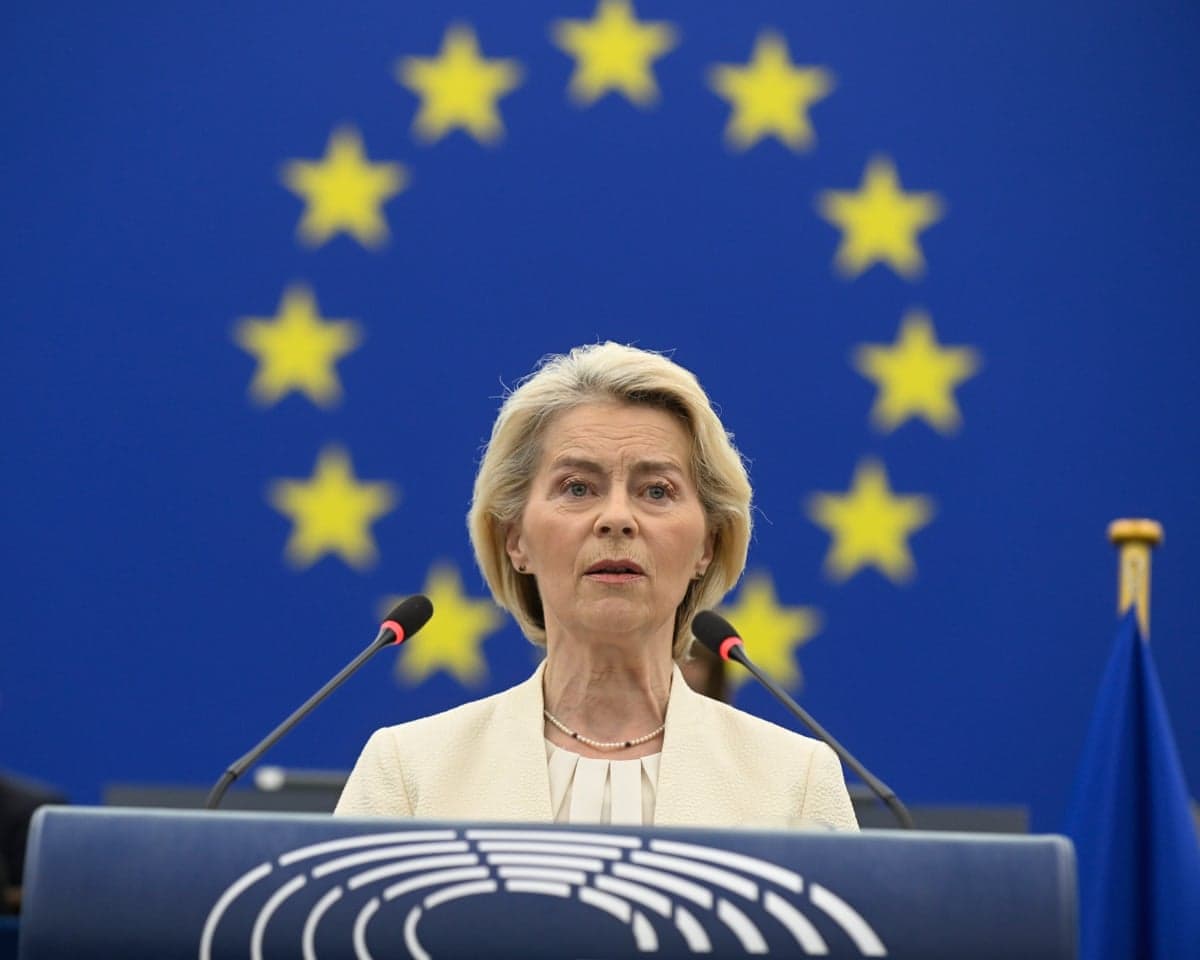
The European Commission is preparing legislation that would restrict access to social media platforms, video-sharing services, artificial intelligence chatbots and online games for children under 15, Commission President Ursula von der Leyen announced on Wednesday during her annual state of the union address in Strasbourg.
Von der Leyen stated that social media applications were "depriving children of their childhood" and that major technology companies must demonstrate the safety of their offerings. She outlined a tiered approach: children under 13 would face a complete ban from social media, while those aged 13 to 15 would be permitted to use restricted "mini accounts" subject to parental oversight and strict time limitations.
According to reporting from international news sources, the leaked draft proposal establishes more granular age categories: children under 3 would have no access whatsoever, those aged 3 to 12 would use parent-controlled child-friendly services, children aged 13 to 14 would receive parent-opened introductory accounts, and full account access would begin at age 15. The proposal is expected to require age-verification mechanisms and mandatory platform design modifications to eliminate addictive features and harmful material.
The Commission will formally unveil its social media and child-safety plan on 17 September 2026, following von der Leyen's speech. The proposal must secure approval from both the European Parliament and all 27 EU member states to become binding law across the bloc.
What prompted this regulatory push?
The initiative reflects growing international concern about children's online safety. In July 2026, an EU expert panel had already recommended restricting social media access for children under 13 unless they were supervised by a parent, caregiver or teacher. The momentum intensified when France's President Emmanuel Macron sent a letter to von der Leyen on 8 September 2026 urging adoption of a stricter EU-wide ban covering children under 15. Several EU member states have independently begun implementing tighter child online-safety regulations, creating pressure for harmonised continent-wide standards.
What else is the Commission proposing?
Von der Leyen also announced that the Commission's Digital Fairness Act, scheduled for submission to the European Parliament in the fourth quarter of 2026, will address problematic platform practices including addictive design patterns, misleading influencer marketing and unfair personalisation algorithms. She characterised addictive design as "harming everyone" and signalled that this legislation would form a complementary pillar to the child-safety initiative.
According to policy analysis reporting, the draft framework would require platforms to be "safe by design" from inception, with minors under 15 unable to create accounts without explicit parental approval. These measures would apply not only to traditional social networks but also to video platforms, AI-powered chatbots and gaming services accessible to young users.

What other major policy announcements did von der Leyen make?
Beyond child safety, von der Leyen's address covered several critical areas of EU governance and security. She committed to developing a European heatwave response plan and announced an emergency mechanism to manage sudden migration flows into the bloc.
In a significant security pivot, von der Leyen made an unprecedented call for the EU to establish its own counter-hybrid defence framework, drawing parallels to NATO Article 4 consultation procedures. She proposed creating a European security council that would include Canada, Norway, Ukraine and the United Kingdom—a notable expansion beyond traditional EU membership. The former German defence minister argued that Europe required an "emergency security protocol" enabling all member states to convene at the request of another in response to hybrid attacks that fall below conventional armed aggression but threaten national security.
"Europe needs its own counter-hybrid playbook," she stated. "We urgently need a consensus on how to respond to certain incidents – those which fall below armed aggression but clearly threaten our national security."
Von der Leyen referenced NATO's Article 4, which permits alliance members to request consultations when they believe their territorial integrity, political independence or security is threatened—distinct from Article 5, the collective defence obligation. European nations have recently experienced multiple hostile actions attributed to Russia, including infrastructure sabotage, unauthorised military aircraft incursions into European airspace and undersea cable damage.
What is the EU's position on Russia and sanctions?
Acknowledging that Ukraine faces a difficult winter ahead, von der Leyen suggested the EU may have exhausted its capacity for additional economic restrictions against Russia. She stated: "What is needed is not necessarily new sanctions, but above all the enforcement of existing sanctions." After 21 rounds of sanctions measures, EU member states have encountered mounting difficulty in reaching consensus on further Kremlin restrictions, with many nations concerned about economic consequences for their own populations.
Where does the EU stand on Israel trade restrictions?
Von der Leyen also addressed European divisions regarding trade restrictions with Israel and its settlements. The Commission has declined to publish a formal proposal banning commerce with illegal Israeli settlements, despite several EU member states and allied nations including France, Canada and the United Kingdom having independently pursued such measures. She observed that "When Europe is divided, it cannot change the course of events," underscoring the bloc's difficulty in achieving unified positions on contentious geopolitical matters.
What happens next?
The European Commission will publish its formal social media and child-safety draft legislation on 17 September 2026. Following publication, the proposal will enter the legislative process, requiring approval from the European Parliament and consensus among all 27 EU member states before becoming EU law. The Digital Fairness Act is scheduled for submission in the fourth quarter of 2026 and is expected to complement the child-safety framework. These measures could establish the foundation for EU-wide discussions on age-verification technologies and platform enforcement mechanisms across the continent.