Cycling is rarely a concern for fertility specialists, though the risk varies significantly between men and women and depends heavily on training intensity.
"Cycling isn't big on the radar of fertility doctors,"says Prof Colin Duncan, a fertility expert at the University of Edinburgh. For most recreational cyclists, the activity poses no meaningful threat to reproductive health. However, elite athletes and those with existing reproductive vulnerabilities face different considerations.
How cycling affects women's fertility
In women, cycling itself is not the primary issue. Rather, the problem emerges when any form of physical training reaches extreme levels.
"Doing huge amounts of physical activity can lower body fat, and that can switch off the ovaries,"Duncan explains.
"Elite athletes may stop having their periods and reduce their fertility."
Research supports this pattern. According to a 2025 review of elite sportswomen, menstrual disorders are common in high-level athletes: 7.1% experience primary amenorrhea (never having menstruated), 16% develop secondary amenorrhea (loss of periods after they had started), and 23.5% experience oligomenorrhea (infrequent periods) among those not using hormonal contraception. However, a 2026 study of former elite athletes found that amenorrhea or being underweight during an athletic career was not associated with later conception or childbirth problems, suggesting that menstrual disruption during intense training does not necessarily cause permanent fertility damage.
The underlying mechanism involves energy availability rather than cycling specifically. Broader sports-medicine research has shifted toward distinguishing low energy availability and menstrual dysfunction from elite training itself as the more important fertility risk in athletes. This distinction matters: the problem is not the sport but the combination of high training volume and insufficient caloric intake.

How cycling affects men's fertility
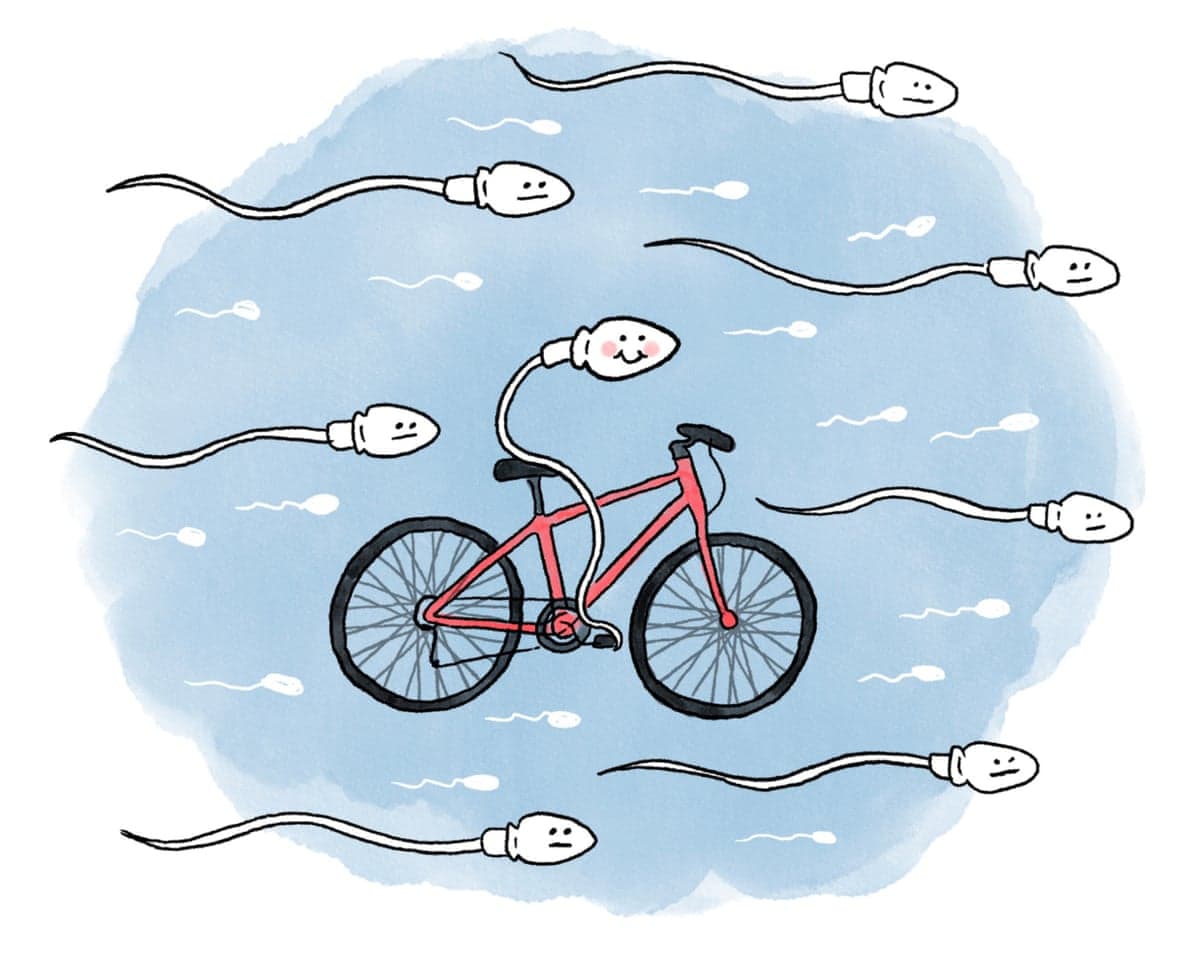
For men, the mechanism is different. Prolonged time on a bicycle saddle can elevate temperature in the scrotal region,
"almost incubating"the testicles. Since sperm develop optimally at cooler temperatures—which is why the testicles are positioned outside the body—heat exposure can theoretically reduce sperm production.
However, Duncan emphasizes that this concern applies mainly to extreme cyclists.
"The testicles produce way more sperm than is actually required for fertility. If you cycle a normal amount, it's still going to make absolutely no difference at all. But if you're doing extreme cycling, it will change your sperm count a little."
Recent research has quantified this threshold. A 2025 cycling study found that more than 5 hours per week of cycling was linked with lower sperm concentration and lower total sperm motility compared with controls. Additionally, a 2025 prospective study reported that bicycling with a soft, comfort seat was associated with reduced fecundability in male participants, while bicycling overall was not consistently associated with fecundability, suggesting that seat design may modulate the effect.
The impact matters most for men whose sperm count is already compromised.
"If you've got a really good sperm count, it probably doesn't make an awful lot of difference. You've still got a lot of sperm there that are swimming."Duncan notes that in fertility clinics, he considers lifestyle factors when abnormalities appear in semen samples.
"If there are abnormalities I'll get a sense of what their lifestyle is like and talk about changes. If you're doing certain things to excess – smoking, drinking, saunas – it's probably worthwhile moderating that."
What does the broader evidence show?
Interestingly, exercise itself is not uniformly harmful to fertility. An August 2026 umbrella review found exercise-based interventions can improve fertility-related outcomes in both women and men, adding newer evidence that structured, moderate physical activity may actually support reproductive health rather than harm it.
Key takeaways
- Recreational cycling poses no meaningful fertility risk for either men or women
- Elite female athletes face menstrual disruption primarily from low energy availability rather than cycling itself, and this does not necessarily cause permanent fertility damage
- Male cyclists who exceed 5 hours per week may experience reduced sperm parameters, particularly if their baseline sperm count is already borderline
- Seat design and overall lifestyle factors (smoking, alcohol, heat exposure) may influence the magnitude of any effect
- Moderate, structured exercise generally supports rather than harms fertility outcomes