

Northern Ireland records the lowest breastfeeding rate anywhere in the United Kingdom, according to the Public Health Agency (PHA), prompting campaigners and health officials to push a sticker-and-certificate scheme designed to make mothers feel welcome to feed in public. Almost 1,500 venues and organisations across the region's 11 council areas have now signed up to the Breastfeeding Welcome Here initiative, though advocates say stigma and inconsistent support still deter many mothers.
Mother-of-three Katy Dillon, who breastfeeds her two children, said feeding in public is simply a matter of necessity rather than choice.
"To me, it is my right. My baby needs fed and if everybody around us is eating why can my baby not feed?"
Health officials have highlighted that uptake varies significantly by area, with the PHA noting that fewer mothers in the Derry and Strabane council area choose to breastfeed compared with the Northern Ireland average.
What barriers do mothers actually face?
For some women, medical circumstances rule out breastfeeding altogether, but others describe a combination of social discomfort and a shortage of practical guidance as the main obstacles. Aimee McIlwaine, a mother of two, said she resorted to feeding her baby in public toilets because of the stigma she encountered and a lack of anyone to turn to for advice.
"I didn't know anyone else who breastfed and I had latch issues - I found going out and about difficult."
McIlwaine said she supports the Breastfeeding Welcome Here scheme as a step toward easing that isolation for other new mothers.
How does the scheme work in practice?
Under the Breastfeeding Welcome Here rules, participating premises are required to permit breastfeeding in every public area of the venue, must not ask a mother to move or stop feeding, and are expected to display both a window sticker and a certificate confirming their membership, according to guidance for parents published by the scheme. Katy Dillon, who lives on a dairy farm outside Hillsborough with her husband and three children, said she has never experienced hostility even in settings she expected to be difficult.
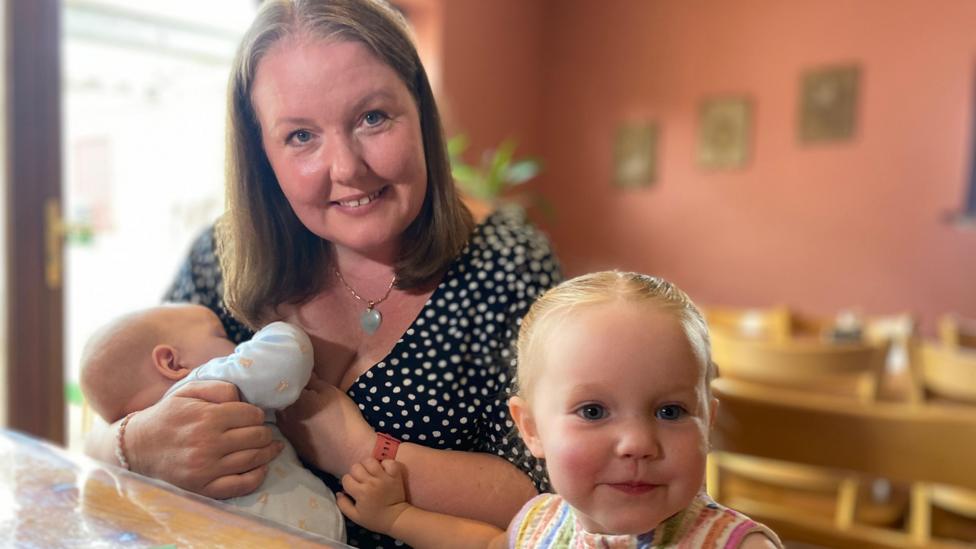
Dillon, who is currently breastfeeding two-year-old Rose and four-month-old Bertie, described feeding her children at the local livestock market in Rathfriland, a venue she said is overwhelmingly male.

"I honestly think that if more people knew what it was like, how easy and hassle free and cheap it is they would do it."
"I go to the local mart in Rathfriland and I breastfeed there and it is quite male-orientated and I have never had any negativity there."
"The mart is literally 99% men and is probably the most daunting place that you are going to feed."
"Generally I have adaptable, specific breast-feeding clothes. They have a small hole or a slit so there is not a lot to see. It is very inconspicuous."
Despite her own confidence, Dillon said many new mothers are not given enough guidance on breastfeeding, particularly during antenatal classes, and acknowledged that the early days can be genuinely tough.
"Don't get me wrong - it is difficult at the start, the first week is pretty hard but if you get past it the sacrifice is worth it."
Why does an event like Breastival matter?
Jennifer Hanratty, who founded Breastival, a festival created to celebrate and support breastfeeding families, said public attitudes have shifted for the better in recent years, though she believes more progress is needed. Breastival's most recent event was staged at Drumglass Park on Saturday, 1 August 2026, continuing its role as a Northern Ireland-based effort to normalise breastfeeding, according to the festival's own event page.
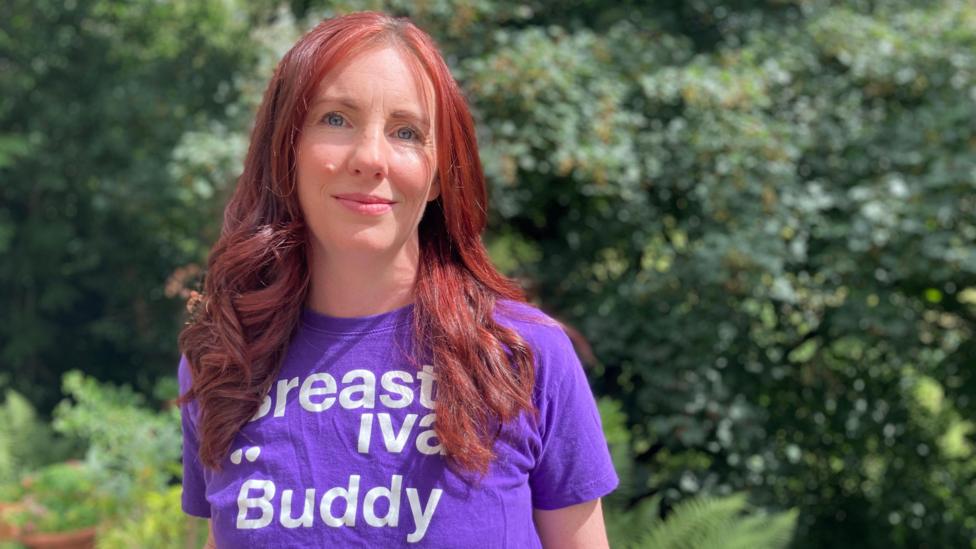
"It is just a part of normal life, it is not a big deal, it is just the same as sitting down and eating a sandwich, sitting down and baby is having a wee feed."
Hanratty also warned that social media has become a double-edged source of information for new parents.
"One of the concerns with social media is that there is an awful lot of misinformation - and so people are looking to social media for information, support and advice when actually the quality of that advice is not guaranteed."
"There are some excellent influencers and accounts out there that will provide good evidence-based information but I would urge people to always go and look at the trusted sources of information from the NHS and the Public Health Agency."
What role do councils and health bodies play?
Orlaith Moley, a senior health improvement officer at the PHA, said the Breastfeeding Welcome Here scheme is intended to build mothers' confidence to feed wherever they need to, whatever the setting.
"The Breastfeeding Welcome Here scheme plays an important role in helping mothers feel confident and supported to breastfeed whenever and wherever they need to."
"Breastfeeding provides significant health benefits for both babies and mothers, helping to give children the best possible start in life while also supporting maternal health and wellbeing."
Belfast City Council area currently has the highest concentration of registered venues, with 352 organisations signed up, followed by Antrim and Newtownabbey Borough Council with 131, figures confirmed in reporting on the scheme's coverage. Antrim and Newtownabbey Borough Council announced in June 2026 that its own council-run facilities would begin displaying Breastfeeding Welcome Here signage after formally joining the scheme, according to a statement from the council.
"Every organisation that signs up helps to normalise breastfeeding and contributes to a culture where mothers feel comfortable, respected and valued when feeding their baby outside the home."
How has policy on this evolved over time?
Northern Ireland's previous breastfeeding strategy, titled "Breastfeeding – A Great Start: A Strategy for Northern Ireland," ran from 2013 and was originally due to conclude in 2023 before being extended by a year to June 2024, according to the Department of Health. The Breastfeeding Welcome Here scheme itself dates back to 2005 and had grown to more than 300 members at one stage, according to figures previously published by the Public Health Agency, a total since expanded to nearly 1,500 venues under the current tally.
What happens next?
The Department of Health launched the Northern Ireland Breastfeeding Action Plan 2026–2029 on 21 July 2026, setting out a three-year programme of measures intended to improve breastfeeding outcomes across the region, according to a Department of Health announcement. That plan now forms the current policy framework guiding efforts over the coming three years, according to a family support information service. Membership of the Breastfeeding Welcome Here scheme remains open, with councils and health bodies continuing to encourage businesses to , and parents are advised to check regularly for newly registered venues in their area, according to guidance for parents.
Key Facts
- Northern Ireland has the lowest breastfeeding rate in the UK, according to the PHA.
- Almost 1,500 venues across 11 council areas are signed up to Breastfeeding Welcome Here.
- Belfast City Council leads with 352 registered venues, followed by Antrim and Newtownabbey with 131.
- The Northern Ireland Breastfeeding Action Plan 2026–2029 launched on 21 July 2026.
- The Breastfeeding Welcome Here scheme began in 2005 and once numbered over 300 members.


