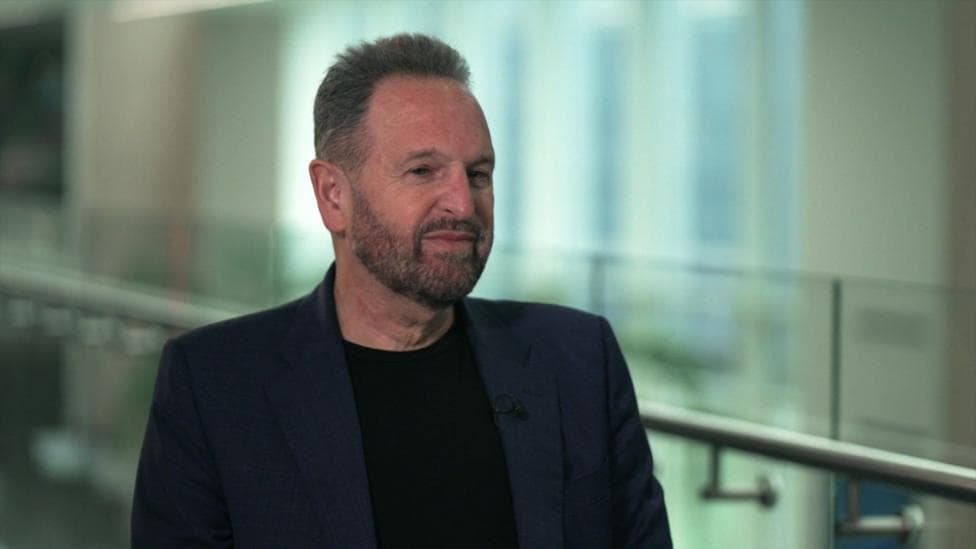
Rene Haas, chief executive of Cambridge-based chip designer Arm Holdings, has declared that artificial intelligence will discover a cancer cure beyond human capability within this generation, though he warns that a global shortage of semiconductors is currently restraining the technology's deployment. Speaking on a major interview programme, Haas outlined both the transformative potential of AI-driven medical breakthroughs and the infrastructure bottlenecks threatening to slow their realisation.
Haas, who previously served on the board of British pharmaceutical company AstraZeneca before stepping down in April, explained that while modelling how DNA markers interact with cancer remains computationally intractable today, advancing machine learning systems will eventually solve this challenge.
AI is going to find a cure for cancer that today you and I, other humans could not in our lifetimes. I believe in our lifetime, AI will help cure cancer. Modelling a cell, modelling a human, modelling how a DNA marker is impacted by cancer—it's too complex a problem, not only for humans today, but the computers that run AI. However, going forward, as we feed more and more of the models into these computers, and the computers get more sophisticated to run the models, they're going to solve it.
According to the full interview published on 7 September 2026, Haas emphasised that the AI-led computer chip boom is being driven by explosive demand from data centres. Yet this same demand is creating severe supply constraints that threaten to undermine progress across multiple sectors.
How is AI expected to transform medicine?
Medical researchers are already harnessing AI's potential in laboratory settings. Prof Chris Bakal from the Institute of Cancer Research, London, and CEO of Sentinal4D, stressed that the critical question is no longer whether to use AI, but what data to feed it.
It is not scraped from the internet. It does not need a giant data centre to run. The future of medical AI will not belong to whoever builds the biggest computer. It will belong to whoever has the right measurements.Bakal noted that his team trains AI systems on data generated directly from patient samples rather than relying on internet-sourced information.
That kind of prediction could cut years from the time it takes to develop new treatments. This is where AI delivers real benefit to patients.
What other applications does Haas foresee for AI?
Beyond medicine, Haas predicted that humanoid robots powered by AI will become widespread within five years, particularly in manufacturing, cleaning, security, construction, and repair work.
With artificial intelligence, these robots can see, learn, and essentially be reprogrammed for new tasks. So, in the service industry, the robot that was programmed to make a bed can also learn how to arrange the towels in a room, or clean the dustbins, or whatever you want to go off and do.Arm designs the processors—the computational brains—that power hundreds of billions of devices globally, from smartphones and automobiles to smartwatches and connected gadgets.

Why is chip supply becoming a critical bottleneck?
The rapid expansion of AI infrastructure is colliding with severe manufacturing constraints. Haas pointed to ambitious plans for massive data centres in France and the United States, as well as proposals to deploy them in space, all of which are being delayed by insufficient chip production capacity.
We are absolutely in a supply-constrained environment. Can you get enough chips? We need more fabs before we can put a data centre in space.The shortage reflects broader supply-chain vulnerabilities that have persisted since the pandemic era; earlier analysis noted that pandemic-related constraints and extended lead times for factory construction have created recurring capacity challenges.
Arm's own business has undergone significant evolution in recent months as it has begun selling its own microchips directly. Meta, the owner of Facebook, commissioned Arm to develop the Arm AGI chip, and
demand has been off the charts, according to Haas, with more than $2 billion in orders since its March launch. Arm's power-efficient technology now powers half of all AI data centres worldwide.
Could chip manufacturing move to the UK?
Despite government discussions about relocating parts of the semiconductor supply chain to Britain, Haas expressed scepticism about the viability of establishing chip fabrication plants domestically.
I don't think it's necessary for the UK to build fabs. Fabs are very expensive. They take a lot of specialised workers. They take a lot of natural resources, and there's a pretty broad ecosystem for those.Manufacturing remains heavily concentrated around Taiwan's TSMC, the world's largest contract chip maker. This geographic concentration underscores the global nature of semiconductor supply constraints.
Will AI-driven automation eliminate jobs?
Addressing widespread concerns about employment displacement, Haas argued that job losses from AI adoption are often overstated relative to the opportunities created.
The estimates of jobs going away and being completely replaced by machines is a bit overstated, he said, while acknowledging that some workforce transitions will occur. He similarly dismissed fears of a market correction in AI company valuations, contending that long-term demand for artificial intelligence will sustain growth.
What is Arm's position in the AI boom?
Arm Holdings reached historic significance earlier this summer when its share price peaked amid the AI surge, making it the most valuable UK-headquartered company by market capitalisation in history. The company designs the central processing units embedded in microchips used across consumer electronics and industrial systems. Despite its sale to Japanese investors in 2016 and subsequent partial listing on New York's Nasdaq rather than the London Stock Exchange—a decision that disappointed some British government officials—Haas noted that approximately half of Arm's workforce remains based in the UK, and the firm remains
by far and away the largest employer in Cambridge.
According to the BBC World Service schedule, the interview with Faisal Islam aired on 7 September 2026 and centred on how the AI-driven computer chip boom is reshaping technology infrastructure and investment priorities globally.
Key Facts
- Haas believes AI will discover cancer cures within this generation, though current computational models remain insufficient for the task
- Global chip shortages are constraining the deployment of data centres needed to support AI infrastructure expansion
- Arm's newly launched AGI chip has generated over $2 billion in orders since March, driven primarily by Meta's demand
- Haas opposes UK-based chip fabrication plants, citing high costs, specialised labour requirements, and existing global supply ecosystems
- Arm remains Cambridge's largest employer despite being majority-owned by Japanese investors and listed on the New York stock exchange