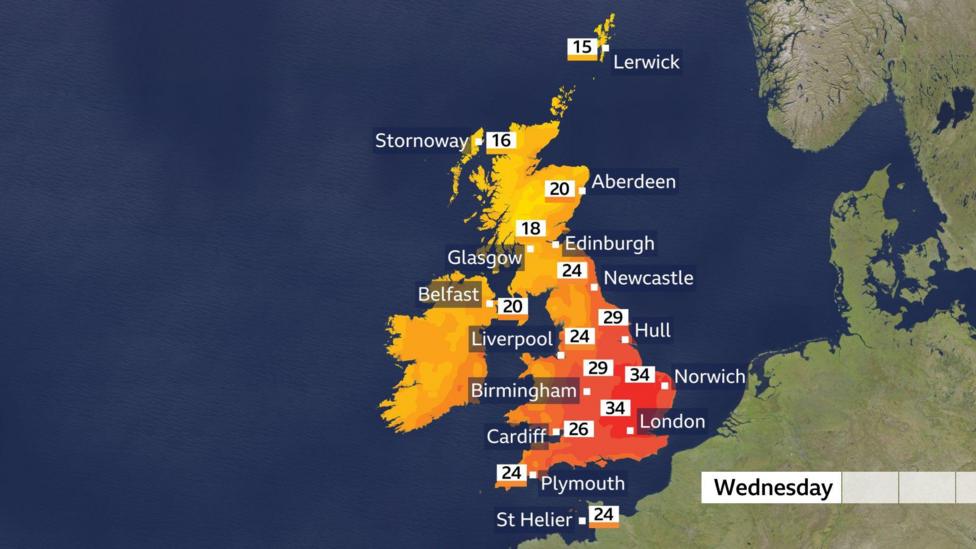
Amber and yellow heat health alerts will come into force on Wednesday as parts of the UK face the fourth widespread heatwave of the year so far. Temperatures are forecast to peak at midweek, with readings as high as 35C (95F) in the hottest places.
Although the heatwave is expected to end quickly for many on Thursday, temperatures well above average in the mid- to high 20s Celsius are likely to continue into the weekend. The hot weather, combined with a significant lack of rainfall, will worsen conditions in many of the driest areas.
How hot will it get where you live?
A plume of intense heat moving north from North Africa, and already bringing exceptionally high temperatures to parts of Iberia and France, will reach the UK on Wednesday.
Temperatures are expected to rise sharply across southern and eastern England and into parts of the Midlands, marking the peak of a short but notable heatwave.
In these areas, temperatures will range from 30-35C at their highest point on Wednesday.
Some eastern areas of Wales could also edge into heatwave criteria.
The UK Health Security Agency has issued amber heat health alerts for the East Midlands, East of England, London and the south-east from 09:00 BST on 29 July until 09:00 BST on 30 July.
The alert warns that significant impacts are likely across health and social care services because of the high temperatures, including a rise in deaths, particularly among those aged 65 and over or with health conditions.
Less severe yellow heat heat alerts have also been issued for the same period for the south-west, West Midlands, and Yorkshire and the Humber.
For much of Wales and Northern England, the three-day run of temperatures of 25C or above required to classify as a heatwave will not be met.
The same is true for Scotland and Northern Ireland, where temperatures will rise closer to 20C at best.
Second half of summer to bring chances for rain but heatwave threat persists
Is there a hosepipe ban in my area? What you need to know
How long will the heat last?
This time around the heat spike looks set to be brief.

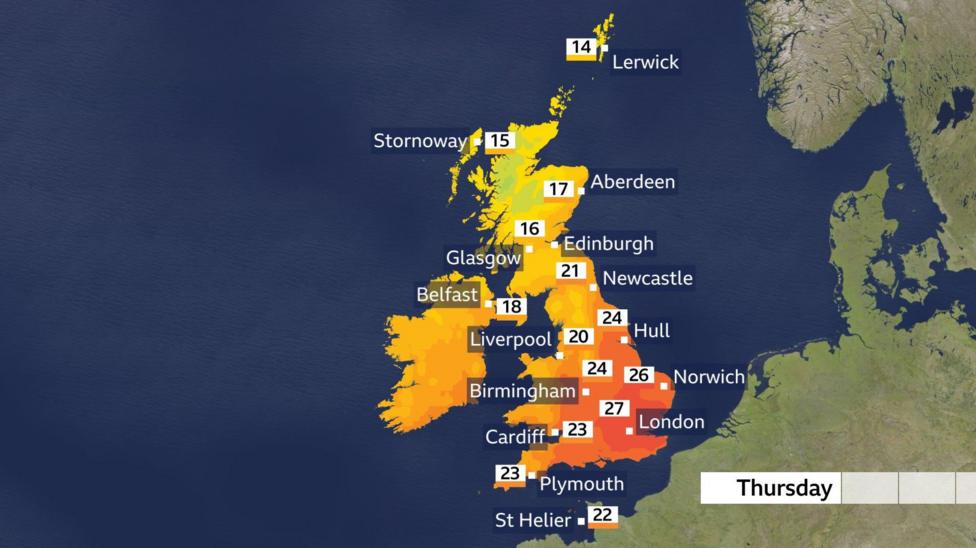
The hottest conditions will be concentrated on Wednesday before a weather front moving through on Thursday will usher in fresher air, bringing a noticeable change in feel.
Temperatures are expected to fall by around 5-8C compared with Wednesday's peak.
Humidity will also ease, making it more comfortable for sleeping.
Even so, it will remain warm, with temperatures still well above average and sitting in the mid- to high 20s Celsius into the weekend.
Heat to exacerbate conditions in driest regions
Alongside the significant heat, the lack of rain means dry ground and low soil moisture levels will continue to be a concern.
While rain and then showers are forecast across Northern Ireland, Scotland and perhaps the far north of England, barely a millimetre is likely to fall.
By Friday and into the weekend, pressure will build across the southern half of the UK, prolonging the dry spell further despite a few showers continuing in the north.
An ongoing lack of rain means hosepipe bans are in force for millions of households, and dry vegetation has provided fuel for wildfires to burn in a number of areas.
According to the Met Office, rainfall in England this month is at 4.4mm, one of the lowest levels on record - tied with June 1925 and behind only February 1891 when 3.3mm were recorded.
Wisley in Surrey has been one of the driest locations in south-east England, clocking up 41 days of no rain as of 28 July.
Rainfall levels in Wales, where drought was triggered in parts last week, are so low that July 2026 is currently the fourth driest of any month since records began.
What is the definition of a heatwave?
Farmers battling 'worst drought in 50 years'
Sunscreen doesn't cause cancer. Why do those claims keep spreading?