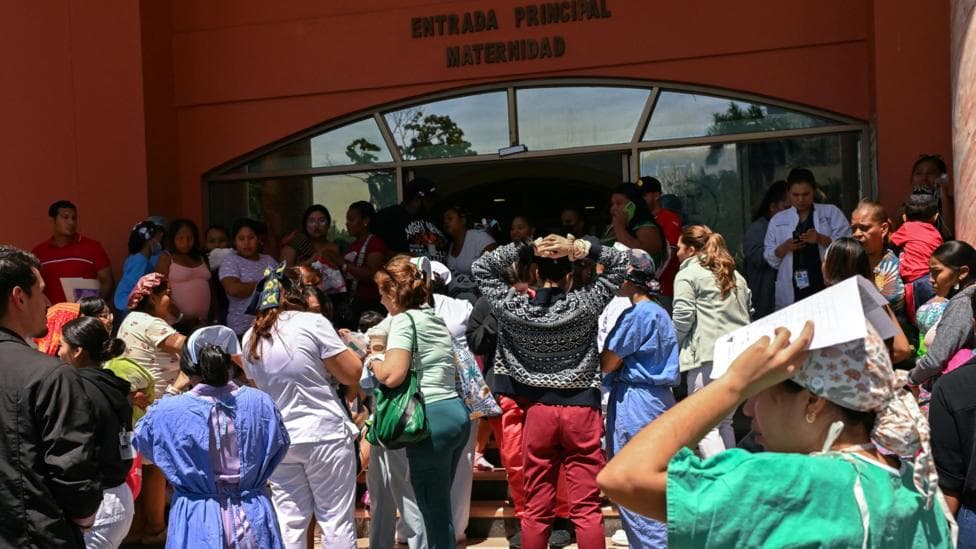
A powerful magnitude 7.7 earthquake shook Panama on Friday afternoon, damaging structures across the country and prompting tsunami alerts across the Pacific. A maternity ward in Panama City was among numerous facilities evacuated as the ground trembled.
The tremor struck just before 15:00 local time (18:00 GMT) with its epicentre approximately 6.2 miles (10km) from Pitaloza Arriba, a small settlement in south-central Panama. According to the US Geological Survey, the quake registered at a depth of 10km, making it shallow enough to cause significant surface damage. The initial assessment from the USGS indicated the magnitude could be as high as 8.0 before being revised downward to 7.6, then further adjusted to 7.7.
The shaking affected a substantial population across the region. Approximately 4.6 million people experienced moderate to severe shaking, with the USGS warning that the disaster's effects were "likely to be widespread". A series of shallow aftershocks followed the main tremor, rattling nerves across the nation.
What damage has been reported?
Unverified footage circulating online appears to show collapsed buildings in the towns of Penonomé and Soná, though the full scope of structural damage remains unclear. Many residents evacuated from buildings in Panama City, located roughly 200km (124 miles) from the epicentre, as a precaution. The exact number of casualties and the complete extent of destruction have not yet been established.
Which areas face tsunami risk?
Multiple nations across the Pacific face potential tsunami hazards from this earthquake. The US Tsunami Warning System identified threats to Colombia, Costa Rica, Chile, Mexico, and Hawaii. According to the US tsunami forecast, waves of 1–3 metres above tide level were possible on some Panamanian coasts, while waves of 0.3–1 metre were predicted for some Ecuadorian coasts.
How has Panama responded?
Panama's education ministry suspended afternoon classes nationwide on Friday as a precautionary measure following the earthquake. Critically, the Panama Canal Authority confirmed the canal was operating normally after the quake, indicating that this vital international waterway sustained no disruption to its operations.
What is the broader context?
The timing of this earthquake is particularly notable given that Panama had scheduled a national evacuation drill for the following Monday—just three days after this actual seismic event—to test the country's preparedness for a major earthquake. This real-world test comes on the heels of devastating earthquakes that struck Colombia and Venezuela earlier this year, underscoring the region's vulnerability to seismic activity.
Key Facts
- The earthquake registered magnitude 7.7 at a depth of 10km near Pitaloza Arriba in south-central Panama
- Approximately 4.6 million people experienced moderate to severe shaking across the region
- Tsunami warnings were issued for Colombia, Costa Rica, Chile, Mexico, Ecuador, and Hawaii, with predicted wave heights of 1–3 metres on some Panamanian coasts
- Panama's education ministry suspended afternoon classes nationwide as a precaution, while the Panama Canal continued normal operations
- The earthquake occurred three days before a scheduled national evacuation drill was set to take place