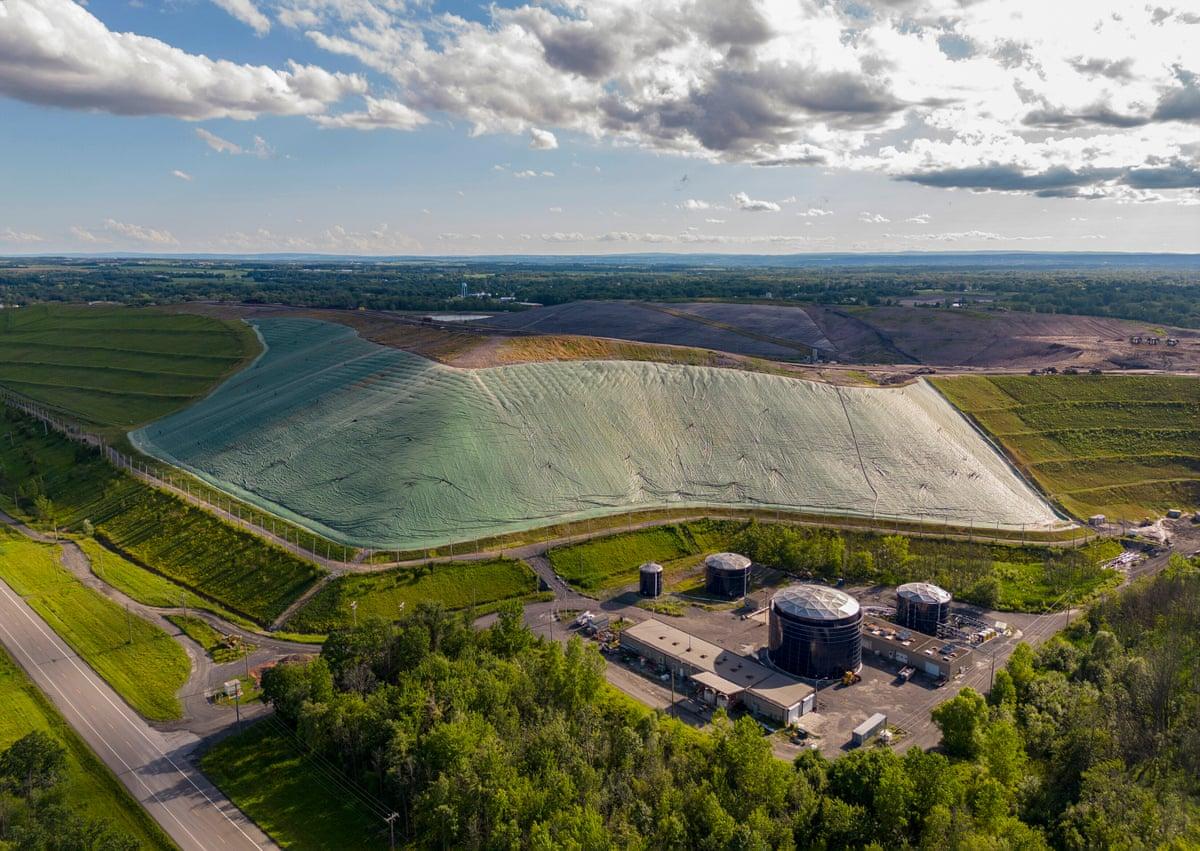
New York's largest active landfill is seeking permission to grow even taller, extending its operational life by several decades despite mounting environmental and health concerns from nearby residents. The Seneca Meadows facility in the Finger Lakes region has already reached the height of the Statue of Liberty at approximately 300 feet, and operator Waste Connections is now proposing to add another 70 feet through 47 acres of newly lined disposal cells. According to The Guardian, the expansion would keep the landfill operational for several more decades, prolonging what residents of Waterloo and Seneca Falls had hoped would close when its permit expired.
The landfill sprawls across 350 acres of deposited waste and has grown continuously since the 1980s. Mark Pitifer, a marketing administrator at Waterloo Containers, a glass packaging company adjacent to the facility, described the visual impact of the towering mound: the landscape around the Finger Lakes remains relatively flat until the landfill appears, creating what he characterized as an incongruous sight—a massive trash heap where one might expect to see a city skyline.
The expansion proposal arrives at a critical moment for New York's waste management infrastructure. According to Inside Climate News, a report filed with state regulators showed only eight months of permitted capacity remained at the end of 2024, underscoring the urgency of the state's waste disposal crisis. Seneca Meadows currently receives approximately 6,000 tons of trash daily from across New York, with roughly 1,500 tons originating from New York City, which has exported its residential waste hundreds of miles away for several decades.
What environmental concerns does the landfill pose?
Seneca Meadows has become the largest source of methane emissions in New York state, a potent greenhouse gas that contributes significantly to climate change. The facility generates persistent odors that have affected the quality of life for residents in surrounding communities. Emily Gallagher, a Democratic member of the New York state assembly who toured the site, described the conditions in stark terms:
There is this huge mountain of trash that is off gassing almost 24 hours a day … contaminating the Finger Lakes, contaminating the groundwater.Residents have reported health impacts severe enough to warrant removing children from nearby schools, and community gatherings have been disrupted by the overpowering stench. Waterloo Containers has implemented workplace measures to help employees cope with the landfill's odors.
Yvonne Taylor, co-founder of the Seneca Lake Guardian environmental group, emphasized that the solutions to reduce landfill waste already exist. She pointed to unnecessary single-use plastics:
We don't need to use plastic grocery bags, we don't need to use plastic toothbrushes, toothpaste, shampoo bottles, and laundry detergent bottles – all of those things can be packaged in other materials that don't wind up in a landfill.Taylor stressed that her organization does not seek to shift the burden to other communities but rather to establish a precedent for waste reduction beginning at Seneca Meadows.
How much waste does New York City generate?
New York City residents produce approximately 12,000 tons of trash daily, and this waste must be transported to disposal sites far from the city. The municipal government has implemented recent initiatives to reduce waste, including the collection and composting of organic matter, which comprises roughly one-third of the city's remaining trash. A spokesman for the city's sanitation department acknowledged that
As capacity continues to shrink in the region, we will likely export trash to further locations.The city's commitment to rail export over trucking makes this long-distance transport logistically feasible, though it raises questions about the sustainability of indefinitely exporting waste to distant communities.
Gallagher estimated that approximately 80 percent of Seneca Meadows' contents could be recycled, yet intense lobbying and donations from interests aligned with the plastics and fossil fuels industries have stymied strict waste-reduction measures and recycling enforcement. She articulated a broader critique of contemporary consumption patterns:
We say throwing away but there is no away. The problem is that it will take a culture change that people won't want to do until it is forced in their faces. We used to have a much more circular economy, where people reused and rewashed everything, but we have been indoctrinated into a convenience culture, even if it then causes us more inconvenience.
What is the regulatory status of the expansion proposal?
On October 29, 2026, a state appeals court upheld the dismissal of residents' and environmental groups' Green Amendment claims, ruling that the amendment did not require specific actions by the regulator or landfill operator. The same ruling found that challenges to the state's ongoing permit review were premature because the Department of Environmental Conservation has not yet made a final decision on either application.
The permit applications seek a 15-year extension for the facility. The operator's draft environmental impact statement was filed in 2024, and the Department of Environmental Conservation requested revisions before deciding whether it is complete for public review. In March 2026, the state appeals court had previously ruled that Seneca Falls' local closure law failed to meet environmental-review requirements, effectively removing that local-law barrier to continued operation. The landfill's 2016 local closure law had originally set December 31, 2025, as the deadline for ending operations, but the town later rescinded it before it was reinstated through litigation.
Waste Connections did not respond to requests for comment from The Guardian. On its website, the company defends its environmental protections and compliance record, stating it is
dedicated to the preservation and advancement of the environmentand maintains an exemplary compliance record. The company describes its environmental safeguards as including a double composite liner and a collection system for rainwater that has contacted waste. Landfill gas is captured and burned to generate electricity, and the operator claims state-of-the-art equipment and practices capture odors, with air monitoring data demonstrating effectiveness. The company notes that the gas composition is 50 percent methane and that the collection and control system is monitored to evaluate its effectiveness.
What happens next in the approval process?
The Department of Environmental Conservation has not yet set a public comment period or hearing; those procedural steps depend on the agency accepting the environmental impact statement for public review. The regulatory timeline remains uncertain as the DEC continues to evaluate the operator's revised submission.
Gallagher acknowledged the difficulty of addressing waste management as a public issue:
Dealing with trash is a gross problem. But we need a much deeper conversation about it rather than continuously pushing it to the side because it's uncomfortable and it confronts our human desire for comfort and our laziness.She has convened a working group focused on the state's waste storage policies and called for immediate action to halt the expansion attempt. The broader challenge, she emphasized, requires a fundamental cultural shift in consumption and disposal practices—a reckoning that extends far beyond the fate of a single landfill in upstate New York.