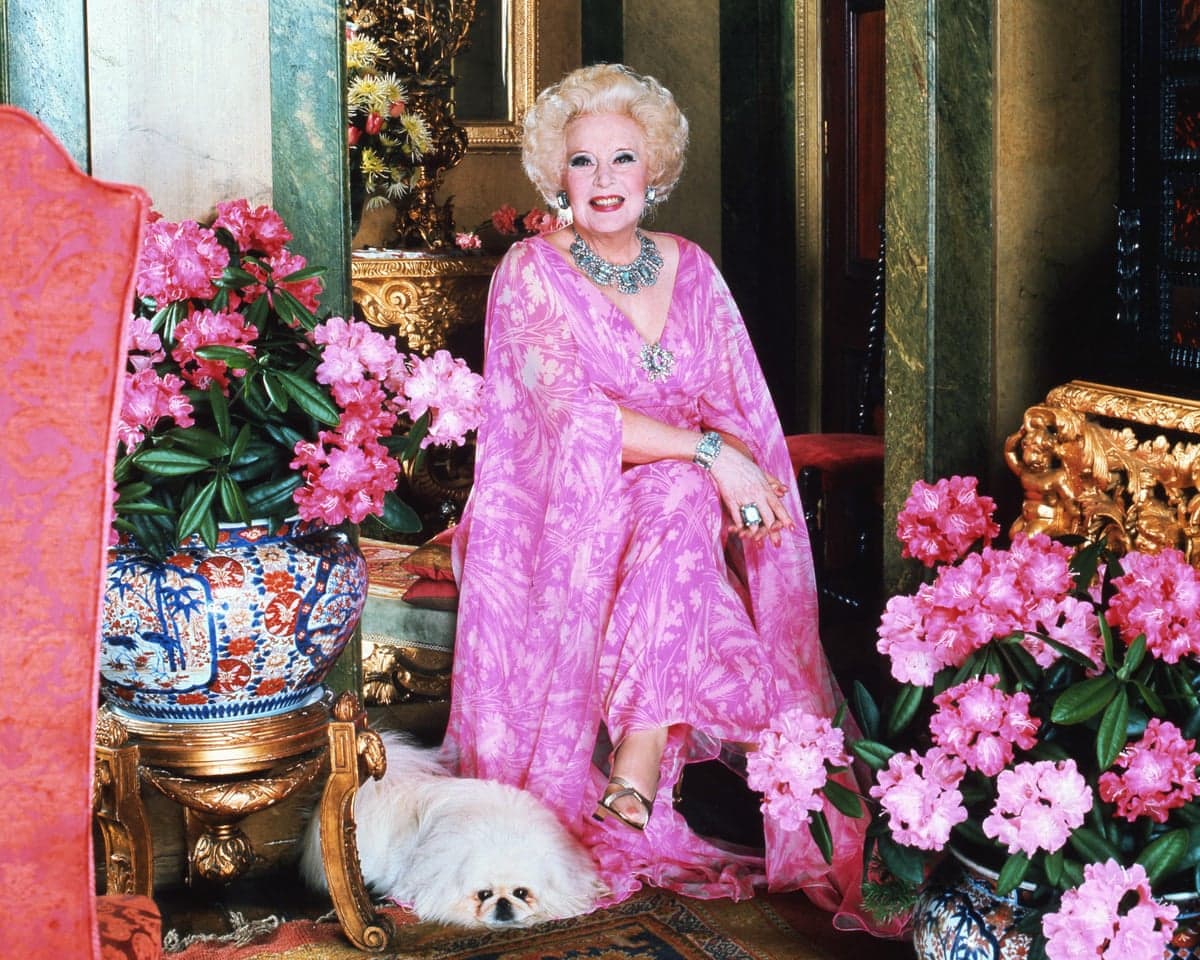
Matthew Sweet's new biography of Barbara Cartland presents a serious, sympathetic portrait of one of the 20th century's most prolific and misunderstood authors. Rather than treating her as a figure of ridicule, Sweet examines how this extraordinary woman—who lived through nearly the entire 1900s and died in 2000 at 98—shaped and transcended the economic, political, social and artistic transformations of her era. The result is a work that restores Cartland to her rightful place as an entirely self-made cultural phenomenon.
Cartland's legendary working method became the stuff of popular mythology. Reclining on a library couch with a pekingese nestled against her hot pink clothing, she would dictate her novels to carefully selected secretaries—women chosen specifically for their steadiness and lack of sneezing fits—who recorded every word in Pitman shorthand. She maintained she could produce 8,000 words daily, meaning a complete 80,000-word manuscript took just two weeks. At her peak, she was completing 23 books annually, accumulating 723 titles across her lifetime. Only Agatha Christie and William Shakespeare surpassed her in total sales, reaching 750 million copies worldwide.
Yet Cartland's dominance extended far beyond her writing desk. She wielded an iron will over husbands, pets, properties and municipal authorities alike. Compliance was expected; defiance was unthinkable. Even the managing director of her printing company suggested she study Nietzsche, claiming they shared philosophical common ground—while simultaneously declaring himself hopelessly in love with her. Beneath the exterior of pink chiffon, candyfloss hair and soft features lay steel of exceptional tensile strength.
Sweet's approach differs markedly from recent biographical takedowns of famous eccentrics. Rather than crafting an amusing demolition in the style of Craig Brown's 2017 treatment of Princess Margaret, Sweet grants Cartland the dignity of serious scholarly attention. Drawing on unrestricted access to the vast archive she left at Camfield Place, her Hertfordshire estate, he has examined her letters, scrapbooks and typescripts to construct an account that is both generous and clear-eyed, rescuing a figure too often dismissed as a lazy cultural joke.
How did Cartland's early life shape her worldview?
Born in 1901 into the lower reaches of the upper class, Cartland inherited a complex social inheritance. Her father's side represented pure commerce: James Cartland and Son manufactured metalwork in Birmingham, producing umbrella stands, crocodile-shaped inkwells, shelf brackets fashioned as sea monsters and "pharaonic letterboxes embossed with meaningless hieroglyphs." Her mother, Polly, descended from Gloucestershire gentry, and the marriage had provoked the predictable family uproar about marrying beneath one's station. Her paternal grandfather took his own life when the business collapsed, and her father subsequently surrendered to alcoholism, leaving Polly to navigate the delicate task of launching a daughter into a lifestyle the family could no longer sustain.
Sweet identifies this constellation of loss and compensation as the emotional foundation for Cartland's entire adult existence. Men emerged as necessary but fundamentally fragile—certainly not figures upon whom one could depend. Having made her debut as a debutante in 1919 into a marriage market flooded with unmarried women, Barbara resolved to achieve financial independence through the only profession for which she possessed any qualification. Throughout the 1920s she supplied gossip columns to the Express, the Mirror and the Daily Mail, chronicling the doings of fashionable London society.
What was the reality behind the Bright Young Things?
The era of the Bright Young Things has been romanticised in retrospect as an epoch of pyjama parties and spontaneous continental adventures. Cartland's own columns reveal a far grimmer reality: a society still reeling from the First World War's devastation. Fathers lay dead in foreign soil—Cartland lost hers in the trenches in 1918. Grand ancestral homes had been liquidated. Divorce had become commonplace. Survival itself seemed to demand constant recourse to alcohol and narcotics. The men Cartland encountered were not the heroic dukes and gallant airmen who would populate her later fiction, but traumatised individuals stripped of the vocabulary to articulate their anguish. In her 1943 memoir The Isthmus Years, she reflected with characteristic acuity: "My contemporaries were ashamed to show emotion. We had all of us a horror of sympathy."

She responded with brittle resolve, determined to extract whatever satisfaction remained possible. Following numerous romantic entanglements with men bearing names like Pingo Langrishe and Nigs Ratendone, she engineered a pragmatic marriage to Alexander McCorquodale, heir to a printing fortune. When he succumbed to drink—echoing her father's trajectory—she executed a calculated manoeuvre: she divorced him, then married his paternal cousin, thereby retaining her surname without the inconvenience of remarriage formalities. She harboured lasting resentment at never securing a title through marriage, a disappointment only remedied when she herself received a damehood in 1991. Her daughter Raine proved far more adept at aristocratic acquisition, securing entry to the peerage through three strategically orchestrated marriages.
Who was the most important man in Cartland's life?
The single male figure who genuinely mattered to Cartland was her cherished younger brother, Ronald. They holidayed together and spent hours debating the pseudo-Eastern philosophies fashionable in the 1920s—Ouspensky and Gurdjieff held particular appeal—and Cartland retained a diffuse mysticism throughout her life encompassing ghosts, spiritual healing, flying saucers and honey's purported curative properties.
The siblings bonded equally over politics, specifically a socially conscious, internationalist strain of Conservatism. Barbara pressured Ronald into parliament, where he became a prominent opponent of appeasement. She herself authored one of the era's rare 1930s British novels addressing Nazi antisemitism directly. Dangerous Experiment (1936) recounts the improbable saga of Lena Carrington, who survives a shipwreck, endures enslavement by a Caucasian thunder-worshipping tribe, and eventually reaches Germany, where a Nazi suitor pursues her. She terminates the relationship upon witnessing his cruelty toward a Jewish refugee.
How did Cartland's work evolve in her later years?
This politically engaged, socially conscious Barbara Cartland bears little resemblance to the figure most people recall from the 1980s onward. During what Sweet terms her "imperial phase," she recycled gossamer-thin plots endlessly while pursuing relentless self-promotion. Bed linens, candles and towels all carried her name, though she demonstrated surprising restraint by declining to attach her brand to scented toilet paper. She orchestrated a partnership with Dewhurst the butcher offering customers one of six previously unpublished Cartland novels for every £12 spent—a promotion that foundered due to the sheer incongruity of "receiving Desire in the Desert alongside a parcel of mince."
The turning point arrived when her daughter Raine became stepmother to Diana Spencer. Cartland recognised the promotional possibilities immediately. She began declaring "I invented virgins" and insinuated that the 1981 royal wedding represented her personal achievement, despite receiving no invitation. Raine, demonstrating her mother's entrepreneurial instincts, ensured that the gift shop at the Spencer family seat, Althorp, stocked a comprehensive selection of Barbara Cartland titles.
According to publisher materials, Sweet's biography also frames Cartland as a "surprising campaigner for Romany rights," a dimension of her activism that extends her political legacy beyond the antisemitism work of the 1930s. This broader context enriches understanding of her as a figure engaged with social justice across multiple decades.
What makes this biography significant?
It would be tempting to dismiss Cartland as an unrepeatable anomaly, a cultural curiosity unlikely to recur. Sweet's achievement lies in embedding her firmly within the 20th century's vast transformations while simultaneously demonstrating how she transcended them. The enduring mystery remains how Barbara Cartland—through sheer determination, commercial acumen and an unshakeable sense of self—became that admirable rarity: a woman entirely self-created, beholden to no inherited advantage or male patronage.
Matthew Sweet will discuss the biography at the British Library on Thursday 10 September 2026 at 19:00, appearing alongside cultural critic Shahidha Bari. The audiobook edition, narrated by Sweet himself, is scheduled for release on 10 September 2026.