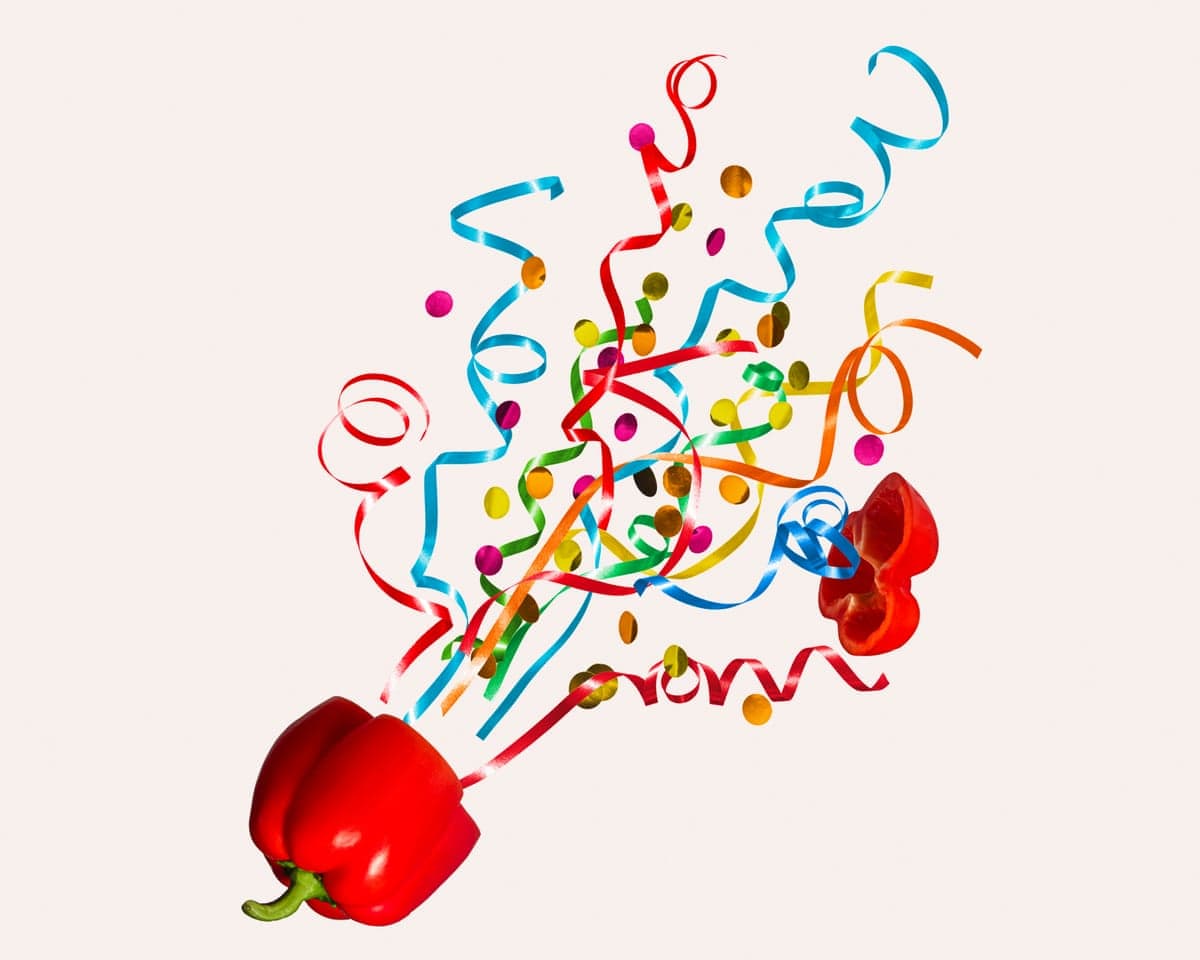
To say the British approach to stuffed peppers represents a culinary tragedy would be hyperbole, yet the evidence is damning. The specimens in question—those traffic-light bell peppers crammed with rice, breadcrumbs, lentils, nuts and miscellaneous vegetables from the 1970s—became the vegetarian's default during an era when plant-based cooking in the UK had not yet discovered pesto. These peppers, with their bulbous, jaunty appearance, resembled nothing so much as cartoon police officers. During my university years, I attempted to recreate them, channelling the vegetarian cookbooks my parents owned from that pre-pesto period. My versions featured buckwheat groats, curly leaf parsley and yeast extract. Decades later, the mere phrase "stuffed vegetables" triggers involuntary recollections of those peppers and their cargo of uninspired filler.
Yet stuffed vegetables need not follow this trajectory. Consider the Mexican poblano: the technique demands not merely filling the pepper, but charring it over flame, peeling away the blackened skin, inserting cheese, securing the seam with a toothpick, coating in flour, dipping in whisked egg, and frying until the batter becomes crisp and puffed. The result bears no resemblance to its British counterpart.
Why did it take decades to reconsider?
My own return to stuffed vegetables came only recently, after years of recovery from my vegetarian phase. Late summer presented the familiar crisis: an allotment tender's dilemma of abundance. The initial courgettes arrive as delights—speckled, tender, accompanied by beautiful flowers. Then the second wave arrives. Then the third. Panic sets in. Grating courgette into unsuitable dishes, smuggling it into cakes, the cook begins to wonder: why not simply stuff these courgettes?
Partly motivated by a desire to honour agricultural abundance, and partly because aubergines bore yellow discount stickers at the market, I committed myself to mastering the stuffed vegetable arts. For guidance, I consulted cookbooks from what might be termed the dolma belt—a region of exceptional stuffed-vegetable tradition spanning from the Balkans across Turkey and Palestine, through West Asia to Iran. In Persian tradition, dolma typically refers to stuffed grape leaves made with ground meat, rice, chopped herbs and seasoning, though the technique extends far beyond this single preparation. The dolma family encompasses a range of stuffed dishes rooted in Ottoman cuisine, spanning time zones, languages and continents. Across this vast territory, a remarkable diversity of stuffed peppers, aubergines, summer squash, courgettes, cabbage and vine leaves has flourished—rendering the British stuffed pepper almost primitive by comparison.

What did studying these traditions teach?
The lessons came swiftly: texture, construction and contrast matter profoundly. I fried onions and minced beef, combining them with spiced maftoul before spooning the mixture into halved, hollowed peppers. Small globe squash, no larger than closed fists, received fillings of lamb, bulgur and handfuls of soft herbs. Palestinian cookbooks—a cuisine that has elevated stuffed vegetables to an art form—revealed the manakra, a long curved blade designed specifically for coring and vastly superior to a conventional knife for preventing mid-preparation disasters. Most crucially, I discovered that despite the seemingly inherent vegetarian character of stuffed vegetables in British tradition, meat represents the superior filling. Had British culinary ancestry drawn from the dolma belt rather than macrobiotic cookbooks, considerable disappointment could have been avoided.
Dolma simply means "stuffed" and represents a cooking technique spanning Middle Eastern and Mediterranean cuisines, where vegetables are filled with rice, herbs, spices and sometimes meat. This linguistic and cultural foundation explains the sophistication evident across the region's interpretations.
Why are these dishes worth the effort?
The principal drawback remains time. Such preparations demand hours of labour. Yet as evenings lengthen and summer urgency fades, autumn and winter offer ideal conditions for extended kitchen projects. Previous years brought attempts at Christmas cakes or ill-advised efforts to reverse-engineer Mr Kipling fondant fancies. This season, the challenge involves the deceptively modest yet genuinely momentous task of constructing stuffed vegetable dishes that, under optimal circumstances, require an entire production line: volunteer peelers, corers, rollers, folders, pot watchers and gossipers working in concert.
The current ambition centres on Kurdish yapraxi silq—the Noah's ark of stuffed vegetables. This elaborate construction layers simmered, translucent onion sheaths; tiger-striped and hollowed courgettes; aubergines and tomatoes with gouged bellies; and rolled Swiss chard leaves. The recipe comes from Pary Baban's work on regional cuisines. I have already completed one of her yaprax recipes: aubergine and cucumber filled with rice and minced lamb, then—gorgeously, surgically—sewn shut with needle and thread. This represents the level of precision and care now demanded.
The author's broader approach to food writing, as described on her own platform, emphasises a "composite and changeable" food culture, with recipes arriving "from all angles." This philosophy underpins the journey from dismissing British stuffed vegetables to embracing the global traditions that have transformed the technique into something worthy of genuine effort and attention. The yapraxi silq awaits construction—a project that may extend into the indefinite future, but one undertaken with considerably more enthusiasm than those 1970s peppers ever inspired.