Former lawyer turned crime writer Steve Cavanagh says the skills needed to persuade a jury are closely related to those used by con artists. He says the idea for his first novel came to him while he was cross-examining a witness, and he has now released his tenth book about conman-turned-lawyer Eddie Flynn.
The Northern Irish author has sold more than five million books globally and has appeared on the Sunday Times bestseller list. He says misdirection, distraction, persuasion and manipulation are transferrable skills between con men and lawyers.
Cavanagh's home near Lisburn is busy, with his daughter stopping in to say hello, Muffin the dog wanting a ball thrown, and the author packing for a UK book tour the next day after returning from a US tour promoting his last book.
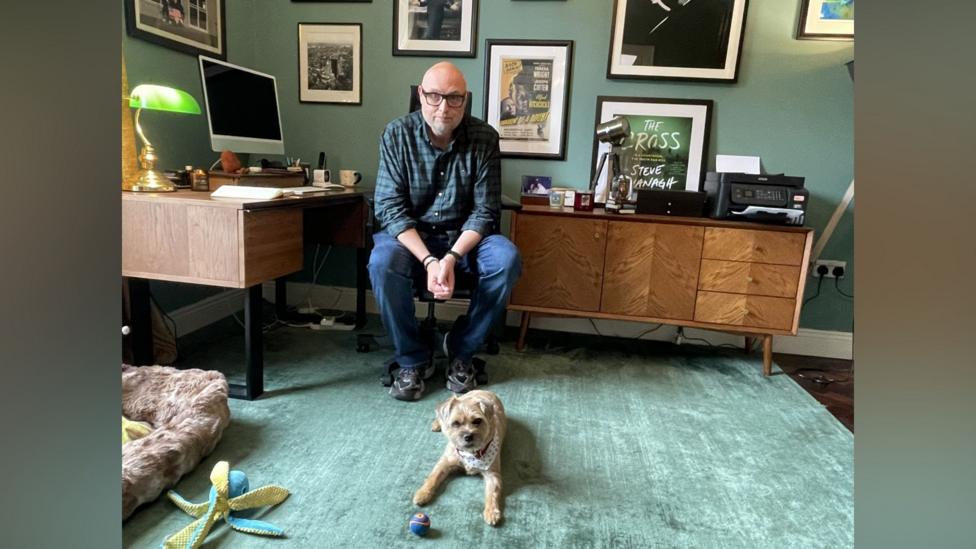
It is a far cry from what he imagined when he was working as a solicitor. He grew up on Palestine Street in south Belfast, went to school in Ballynahinch, then went to Belfast tech before attending university in Dublin.
He only began writing in his mid 30s after his mother died. Cavanagh said she was the only person who ever really encouraged him to write, so he wrote his first book for her. His surname is Mearns, but he chose Cavanagh, his mother’s maiden name, as a tribute to her and because it helped separate the practising solicitor from the author.
Why did he create Eddie Flynn?
Cavanagh says that in a trial, “every word is a weapon in a courtroom”. He believes con artists and trial lawyers share skills that are perfectly allowed: misdirection, distraction, persuasion and manipulation.
“I kind of conned them into revealing that they were lying and it hit me then that con artists and trial lawyers have all the same skills,” he said.
“I thought con artists and trial lawyers all have skills which are perfectly allowed: misdirection, distraction, persuasion, manipulation,” he said.
“I thought that would be a good idea for a character, someone who had all those skills as a conman, who then becomes a lawyer and that's be an interesting character to write about.”
That idea led to Eddie Flynn, a New York lawyer supported by his associates Harry Ford, Melissa Bloch and Gabriel Lake, as well as a dog named after Clarence Darrow, another of Cavanagh’s inspirations.
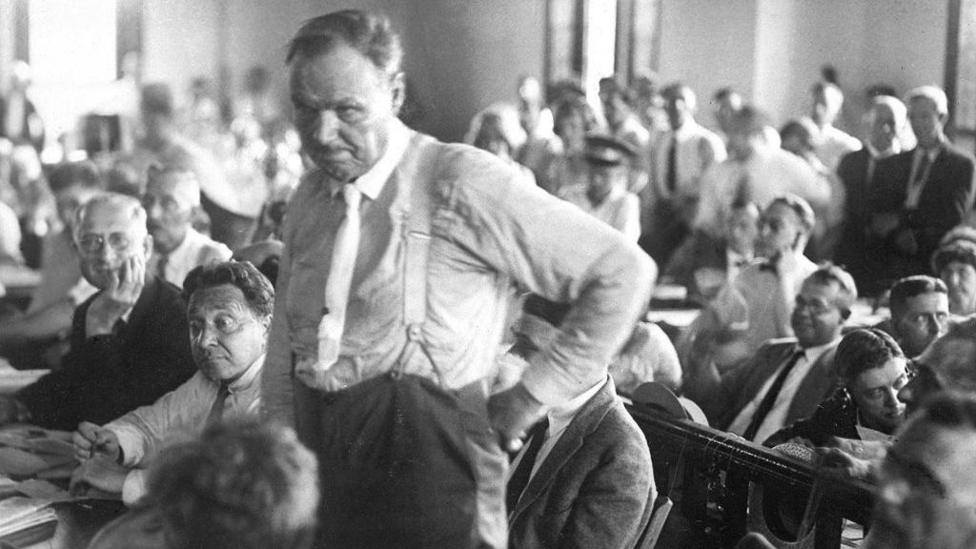
Cavanagh was also inspired by Clarence S Darrow, the famous Chicago trial lawyer, in 1925, who influenced the character Eddie Flynn.
The path to publication was not easy. Cavanagh was rejected by more than 50 agents before getting representation for the Eddie Flynn series and securing his first book deal.
He remembers publication day for his first book, The Defence, when he was representing a client in a police station in County Down. One of the police officers said he had heard Cavanagh had released a book, and the author gave an interview while still working the case.
“I went in and did the interview and by the time I came out the old custody sergeant had been to Eason's and bought it, so I did my first signing in Bangor custody suite.”
The first book won awards but did not sell especially well. Cavanagh says everything changed with Thirteen, the novel he describes as the one that changed his life. Its tagline was “the serial killer isn't on trial, he's on the jury”, and readers responded strongly.

In 2019, he was able to stop working as a solicitor to focus on writing full time. He has since written 10 Eddie Flynn books and several standalone thrillers.
How has his career changed since then?
Cavanagh says the shift from law to writing has allowed him to build a global audience, and he now has more than five million books sold worldwide. His books have been translated into more than 40 languages.
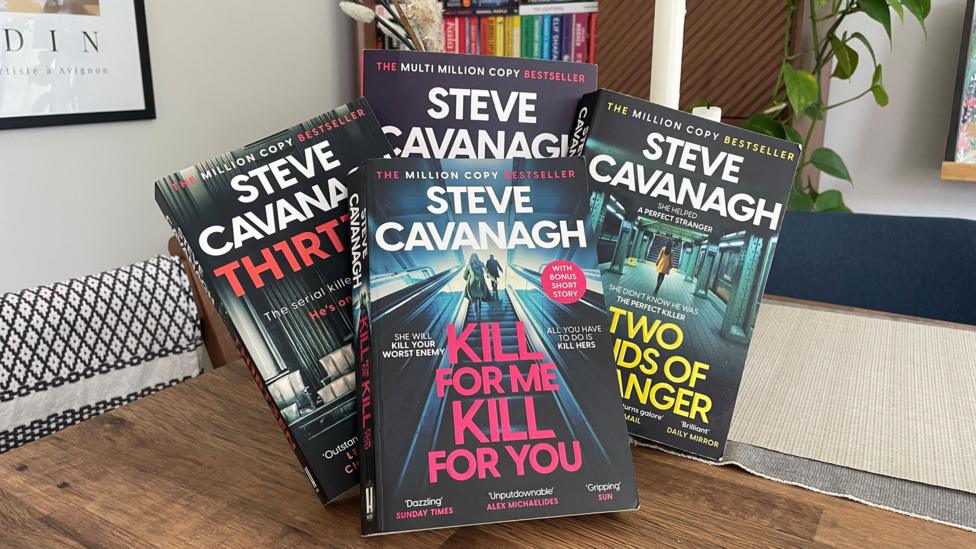
Freida McFadden, author of The Housemaid, recently praised his thriller Kill for Me, Kill for You on Facebook. She said it was “one of the best thrillers I've ever read”.
“It's not often that I read a book where all the twists and turns are perfectly executed, but this is one of them. It's kind of a masterpiece, in my humble opinion,” she said.
Cavanagh said the praise meant a lot and that he also wants to talk about other local authors he thinks people should be reading. He also used a different pen name while still working in his previous career, like Freida McFadden.

What themes is he exploring now?
Cavanagh has tackled a range of subjects across his books. In Two Kinds of Stranger, he explores a TikToker who has shared so much of her life online that she becomes an easy target for a criminal mastermind.
In his latest book, One Of Us is Guilty, readers meet the billionaire Vanderpool family and are immersed in a gruesome murder. Patrick Vanderpool, who is running for governor, and his wife Vanessa are both in the firing line for the murder, but Patrick's father Julian controls half of New York, raising the question of whether anyone will really have to pay.
Cavanagh said he wanted to examine extreme power and wealth in America and the influence of multi billionaires. He said that as a writer about law and a lawyer, he has noticed that increasingly laws do not matter to some people.
“I write about law and a lawyer, and increasingly these days, laws don't matter to some people,” he said.
He is also critical of AI companies.
“That entire technology is almost based entirely on piracy. They have scraped millions of books and the government's doing nothing.
“It's almost the more powerful you are, the more you can get away with.”
For Cavanagh, this is a world away from his working-class upbringing in Belfast. He plans to take a break from Eddie Flynn for now and has a standalone book in mind. He has also been asked by the Conan Doyle estate to write a short Sherlock Holmes story for a collection in the Autumn.
He wants fans to know that Eddie Flynn will return and has not been beaten yet.