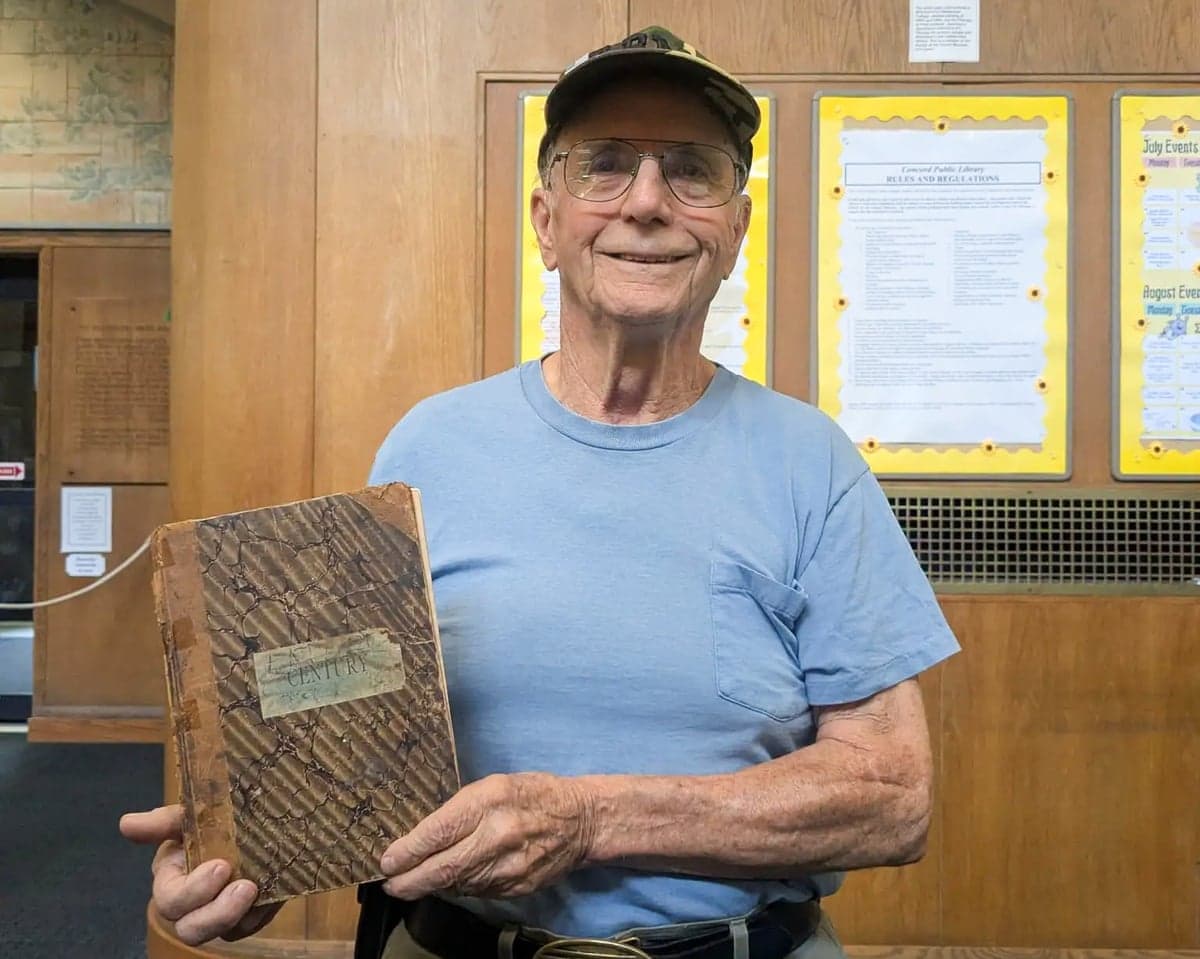
An 84-year-old resident of Barrington walked into Concord Public Library earlier this month carrying a piece of publishing history—a copy of The Century Illustrated Monthly Magazine from September 1894 that had been missing for more than 130 years. John Hanson took advantage of the library's fine amnesty program to return the publication, which would have accumulated theoretical late fees of $12,055 had standard penalties applied to its 48,220-day overdue status.
Staff members at the circulation desk were astonished by the discovery. Jennifer Needham, the library's archivist and outreach coordinator, recalled the moment Hanson presented the magazine.
I honestly thought it was going to be from the 1980s, 90s or 2000s. But then he pulled this out, and I was like: 'Ooo, tell me more!'
Hanson explained that the magazine came into his possession during a house relocation in 1966, where it had remained for decades before he decided to return it. He noted that neither of his parents held a library card, and while his late first wife Carol was a devoted library patron, she would never have permitted an item to become overdue. The original borrower's identity will likely remain a mystery.
Why did the return happen now?
According to NBC News, Hanson decided to bring the magazine back after learning about the library's fine freeze initiative.
Yeah, when I saw that, I said to myself: 'Boy, this would be a good time to bring it back', he remarked. Concord Public Library has been running a one-year fine freeze to study whether eliminating penalties encourages overdue returns, part of a broader effort to assess whether overdue fines discourage returns or simply prevent people from bringing items back.
What makes this magazine historically significant?
The Century Magazine was an illustrated periodical published between 1881 and 1930 that blended history, literature, poetry and current events. Its peak influence occurred during the late 19th century, when it extensively documented the aftermath of the American Civil War. The publication gained renown for introducing readers to emerging literary voices, including Henry James and Mark Twain, whose work appeared in its pages. The magazine carried passages from Twain's Huckleberry Finn, which was first published in the United States in 1885.

The September 1894 edition that Hanson returned bore a Concord Public Library bookplate instructing borrowers that the item
may be kept for one week. The issue contained articles addressing contemporary concerns, including a debate about the necessity of providing outdoor playground space for children at urban public schools—a topic that Needham found particularly revealing about the priorities of that era.
Needham told NBC News that the discussion of school playgrounds struck her as noteworthy.
I didn't know this history, that they were arguing that more city schools should have outdoor spaces for children to play. It sounds like during that time, that just wasn't a priority. It's interesting that they would play inside then.
The magazine's pages also featured period advertisements reflecting consumer culture of the 1890s. One promoted Beeman's Pepsin Gum, marketed as
a delicious remedy for all forms of indigestion. Another advertisement touted Hernan Cortez Cigars, manufactured in Key West, Florida,
under the most favorable climatic conditionsand aimed at
men of brains.
What happens to the magazine now?
The library said the returned magazine will not go back into circulation and is expected to be displayed in the Concord Room instead, where it will join other materials related to the city's history. Rather than being issued to patrons again, the archive item will be preserved for researchers and visitors interested in local heritage.
The return of this long-lost publication fits a pattern observed at libraries implementing similar policy changes. The magazine's return fits a pattern of old library materials surfacing after policy changes that temporarily remove penalties. Concord Public Library continues its one-year fine freeze while evaluating whether the elimination of penalties proves effective in encouraging the return of overdue materials.
Key Facts
- The September 1894 edition of The Century Illustrated Monthly Magazine was 48,220 days overdue when returned to Concord Public Library
- John Hanson, 84, discovered the magazine during a house move in 1966 and kept it for approximately 60 years before returning it
- The library's fine amnesty program and ongoing fine freeze initiative motivated the return, demonstrating how penalty elimination may encourage overdue item recovery
- The magazine will be preserved in the library's Concord Room as a historical archive rather than recirculated to the public
- The Century Magazine (1881–1930) was a prominent publication that featured work by major American authors and documented significant historical events of the late 19th century