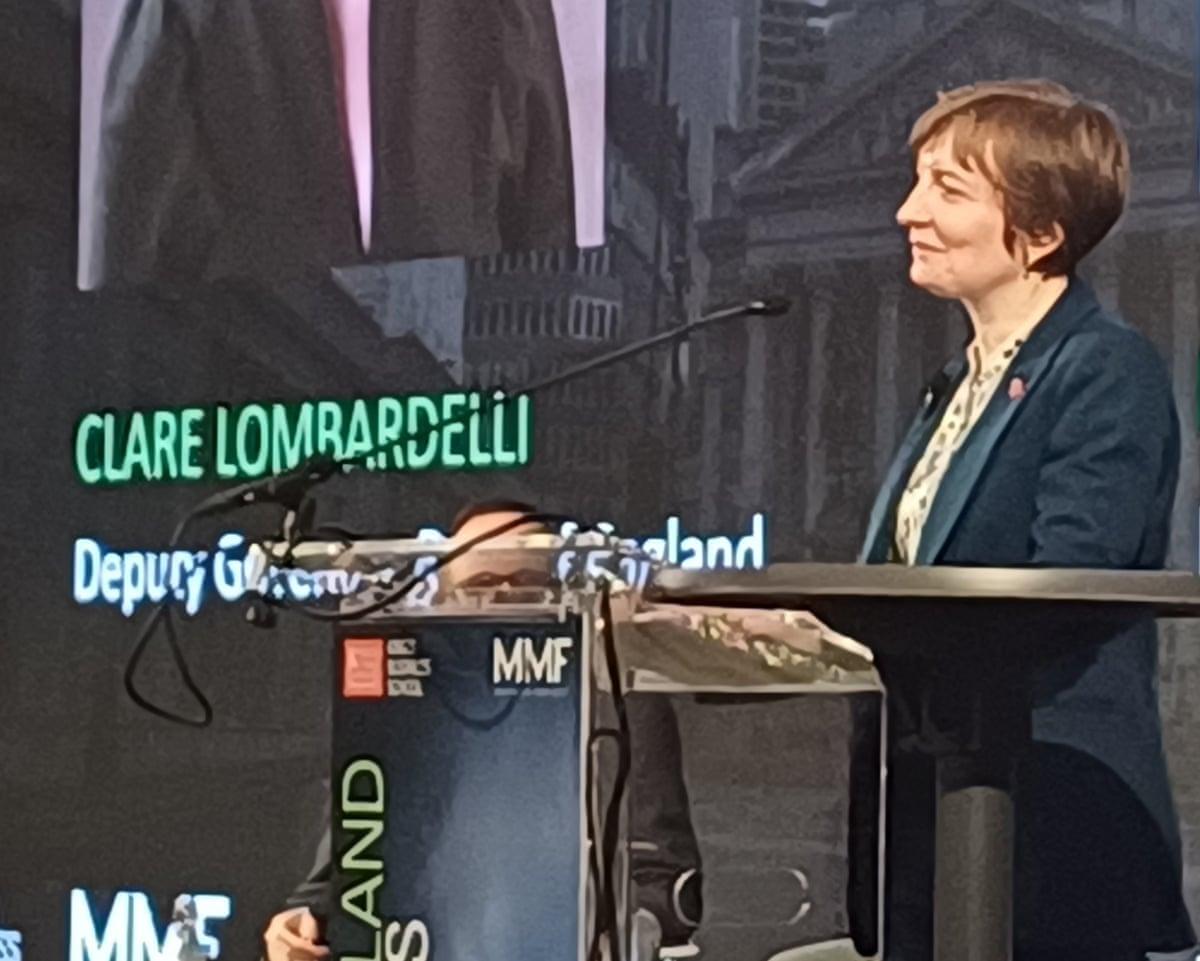
Bank of England deputy governor Clare Lombardelli has warned that the UK's distinctive labour market structure—characterised by reluctance to hire and reluctance to fire—is creating acute problems for young people seeking work, even as the broader economy shows resilience. Speaking at the Bank of England Watchers conference on 10 November 2026, Lombardelli outlined how this pattern protects existing employees while making entry into the workforce substantially harder for those seeking their first role or attempting to change jobs. According to The Guardian, the remarks came as US inflation data released the same day exceeded forecasts, triggering sharp falls in American stock markets and intensifying expectations of further interest rate rises.
The US stock market opened with significant losses following the inflation announcement. The S&P 500 index fell 0.75% while the Nasdaq Composite technology index declined 1%, as traders absorbed the implications of higher-than-expected price growth. According to Reuters, the Consumer Price Index rose 0.4% on a monthly basis in October, exceeding the 0.3% increase that economists had forecast.

How is the UK labour market cooling differently?
The UK economy has demonstrated unexpected resilience to recent shocks, with activity holding up better than anticipated and unemployment rising only gradually. However, this apparent strength masks a troubling dynamic. Lombardelli explained that the labour market is cooling through reduced hiring rather than increased redundancies, a pattern that creates distinct challenges for monetary policymakers and workers alike.
The economy has been more resilient to the recent energy cost shock than expected. Activity has held up better than anticipated, unemployment has risen only gradually, and redundancies remain relatively low. That may sound like good news. In lots of important ways, it is. But a low-hire, low-fire labour market creates its own problems. It protects those already in work while making it much harder for those trying to get in or move on.
This structural feature generates three distinct complications for the Bank of England's inflation-fighting efforts. First, it affects how policymakers interpret rising unemployment. If workers seeking jobs are poorly matched to available positions, higher joblessness may exert less downward pressure on wage growth than historical patterns would suggest. Second, it weakens productivity and economic growth by limiting workers' ability to find suitable opportunities. Third, it reduces the economy's capacity to adapt and reallocate resources efficiently.
Why are young people bearing the heaviest cost?
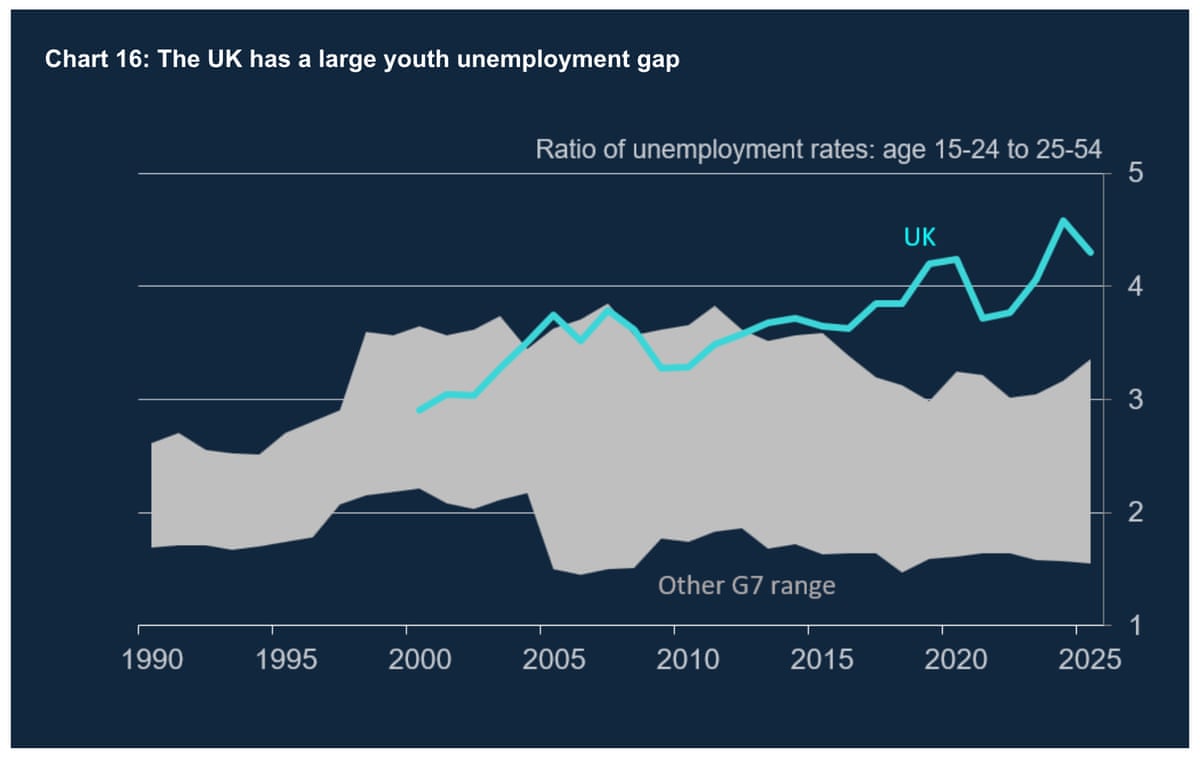
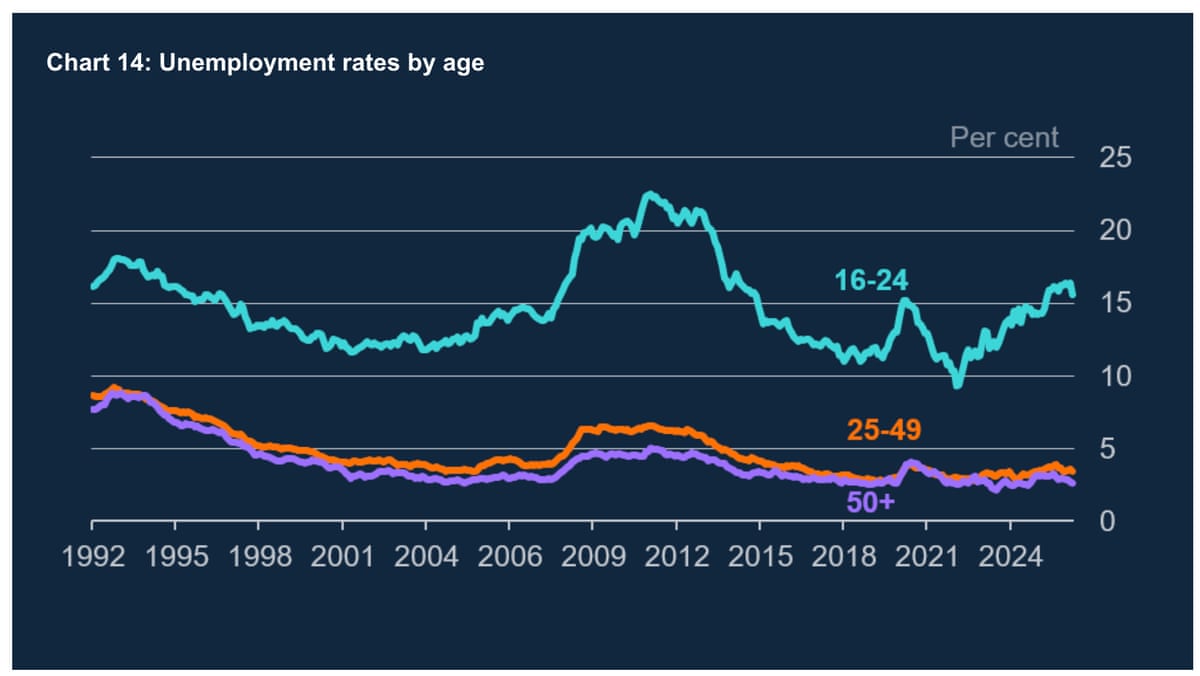
Young people are experiencing a disproportionate deterioration in employment prospects compared to the broader working-age population. Lombardelli presented data showing that the UK's youth unemployment rate—for those aged 16 to 24—now stands at more than three times the aggregate rate, reaching its highest relative level since the early 1990s. Despite comprising only around 12.5% of the labour force, 16 to 24-year-olds account for more than half of the rise in aggregate unemployment since mid-2022.
The costs are falling particularly heavily on young people, for whom the first step into work has become harder.
Four specific factors explain why job opportunities for young people in the UK have deteriorated more sharply than in other advanced economies. The first is the low-hire, low-fire pattern itself. The second involves the concentration of weaker hiring in sectors that traditionally employ many young people. The third concerns deterioration in young people's health. The fourth relates to the rising cost and perceived risk of employing inexperienced workers.
Vacancies have contracted particularly sharply in accommodation, wholesale, and retail sectors—industries that have historically provided entry-level positions through which young people acquire workplace skills and build employment histories.
There is a relative undersupply of jobs in the accommodation, wholesale and retail sectors – the parts of the labour market with the highest concentration of inexperienced job seekers. Those industries matter because they provide many of the starter jobs through which young people acquire workplace skills and start to build an employment history.
What explains the unusual stability in job mobility?
The UK labour market has exhibited striking stability in job-switching behaviour, with workers moving between positions far less frequently than in previous decades. Thirty years ago, more than 3% of employed people changed jobs each quarter. Over the past year, that quarterly rate has fallen to just above 2%—approaching levels last seen during the global financial crisis despite substantially less cyclical weakness in the current economy.
Memories of acute labour shortages following the pandemic lockdowns appear to have shaped employer behaviour. When the economy reopened from the Covid-19 shutdown, widespread worker shortages emerged. Government support through the furlough scheme and broader fiscal and monetary stimulus prevented large-scale unemployment, but the rapid expansion in demand left firms struggling to attract workers with the skills they needed.
As the economy reopened from the pandemic, acute labour shortages were widespread. The furlough scheme and wider fiscal and monetary support prevented large-scale unemployment. The rapid expansion in demand then left firms struggling to attract the skills they needed. Bank Agency intelligence and a range of business surveys repeatedly reported acute recruitment difficulties and skills shortages, leading many firms to place a high value on retaining experienced staff.
This experience has made employers reluctant to shed workers, fearing they will struggle to find replacement skills when activity recovers. That caution on redundancies feeds into reluctance to hire new staff, creating the low-hire, low-fire dynamic that Lombardelli identified as problematic for the broader economy and particularly damaging for young people.
How does this affect the Bank of England's inflation strategy?
The structural features of the labour market complicate the Bank's ability to manage inflation through traditional unemployment-based channels. If higher joblessness fails to moderate wage growth as effectively as in the past, the central bank may need to maintain higher interest rates for longer to achieve its 2% inflation target. Lombardelli signalled that she believes the balance of risks to inflation remains tilted toward the upside, particularly given the energy price shocks stemming from the Iran conflict.
Since our assessment in July the energy price shock has proved larger and more persistent. That has increased the direct pressure on inflation, raised the prospect of greater indirect effects as higher costs pass through supply chains, and increased the risk of second round effects through wages, prices and inflation expectations.
When asked whether she would rule out further rate increases in December or February, Lombardelli declined to commit either way, emphasising that every monetary policy meeting remains live and subject to new data.
I wouldn't rule December in or out, or February in or out. Every meeting is live.She did, however, signal her view that further rate rises may be warranted.
In the absence of evidence of weaker inflation pressures, I continue to think there is likely to be a case for a further increase in rates in the near term.
What is the outlook for US interest rates?
The October inflation data released on 10 November 2026 has intensified expectations of Federal Reserve action at its December meeting. According to Reuters, markets were pricing in a 25-basis-point rate increase following the inflation release, up from 20 basis points of tightening priced in before the data.
Fed policymaker Christopher Waller had signalled earlier on 10 November that stronger action might be necessary if inflation remained elevated.
If the October CPI inflation data out later today are similar to the past two monthly readings—with core CPI inflation around 0.3% or even higher—then a stronger policy move may be needed. In that case, I believe a 50 basis point hike in the policy rate should be considered at the December meeting.
The inflation data confirmed Waller's concern: core inflation—which strips out volatile food and energy components—rose 0.3% for the third consecutive month. According to CNN, shelter accounted for nearly one-third of October's overall price increase, while food prices rose 0.5% and energy prices jumped 0.7% month-on-month. The broader Consumer Price Index increase of 0.4% followed a 0.6% rise in September.
Why is there no annual inflation figure for October?
The Bureau of Labor Statistics was unable to publish an annual inflation rate for October 2026, creating an unusual gap in the data. The absence stems from disruption caused by the US government shutdown that occurred a year earlier. Because the BLS did not collect its standard pricing data in October 2025 due to the lapse in appropriations, it cannot now calculate the 12-month percentage change for October 2026 for many price series.
For most CPI series, BLS could not publish October 2025 indexes. As a result, BLS cannot publish 12-month percent changes for October 2026 for indexes where October 2025 data are unavailable.
The most recent annual inflation figure available before the October report showed inflation at 3.7% in September, well above the Federal Reserve's 2% target.
How might AI reshape economics employment?
When asked whether the Bank of England agrees with US economist Jason Furman's assessment that artificial intelligence could displace at least half of analytical economics jobs, Lombardelli acknowledged the provocative nature of the argument but offered a more nuanced perspective. She suggested that AI will fundamentally transform what economics jobs entail rather than simply eliminating positions.
Junior economists currently spend substantial time on routine tasks such as chart formatting and data manipulation. AI tools will handle these mechanical functions, freeing economists to focus on more substantive analytical work and economic reasoning.
It will mean that junior economists doing a lot less chart formatting, and more time thinking about the economy.
When pressed on whether this transformation will result in fewer total positions or simply better-quality work from existing staff, Lombardelli indicated the outcome remains uncertain.
Does it mean fewer people? Or does it mean people doing much better work? There will be a balance between the two.
What are the risks from AI valuations?
Asked about the possibility of an artificial intelligence investment bubble bursting, Lombardelli acknowledged that significant volatility in AI company valuations is likely. However, she cautioned against assuming that volatility necessarily undermines the transformative potential of the technology itself. The sector may experience substantial repricing without that implying that AI will fail to deliver substantial economic benefits.
Is the current Bank rate restrictive?
The Bank of England's current base rate of 4% sits just above the top of the range for the neutral rate of interest—the level at which monetary policy neither restricts nor stimulates economic growth. Lombardelli indicated that her own estimate of the neutral rate is higher than some other members of the Monetary Policy Committee, suggesting she views current policy as less restrictive than some colleagues believe.
Interestingly, she noted that interest rates have proven less restrictive in practice than the Bank anticipated when setting policy. This may reflect the economy's greater resilience to shocks than policymakers had expected, or it could indicate that companies and households have demonstrated greater capacity to adapt to higher borrowing costs than models had predicted.
Why has the UK economy shown unexpected resilience?
The Bank of England may be systematically underestimating the economy's ability to respond to adverse shocks, according to Lombardelli. Economic models used by the central bank might underestimate the flexibility of both companies and households in adjusting to new circumstances. However, she cautioned that this resilience may not be indefinite. An alternative explanation is that the economy's underlying strength is being eroded through mechanisms that cannot persist indefinitely: companies may be absorbing cost increases by accepting lower profit margins, while households may be drawing down accumulated savings to maintain spending.
What do financial stability experts warn about market corrections?
Sir Jon Cunliffe, a former Bank of England deputy governor who held senior positions at HM Treasury during the 2008 financial crisis, warned that a market correction is inevitable. The critical question is not whether a correction will occur but whether it will transmit through the financial system to create broader economic disruption.
To me it's pretty clear that a correction will happen. The issue isn't whether it's coming, it's whether it transmits though the financial system.
Cunliffe distinguished between two historical precedents: the dotcom bust of 2000, which inflicted substantial losses on asset holders without triggering a financial crisis, and the subprime crisis of 2008, which rippled through interconnected financial institutions and created systemic instability. The critical difference involved the degree of leverage and interconnection in the financial system. Current conditions show concerning signs of both leverage and interconnection, Cunliffe cautioned, raising the risk that a market correction could evolve into a broader credit crunch.
What are the risks from Nvidia's legal challenges?
Niall Hearty, partner and regulatory lawyer at legal firm Weightmans, warned that Nvidia faces a difficult period ahead as it confronts shareholder lawsuits and an independent internal investigation.
Shareholder lawsuits and an independent internal investigation will mean a difficult road ahead for the world's second-largest company, particularly as Nvidia faces wider pressure from investors amid growing concerns around AI investment and the future of the sector. There are also wider questions to be asked about national security and the protection of commercially sensitive information at a time when the US and China are racing to gain technological supremacy.
Would the US exercise leadership in another financial crisis?
Professor Sir David Osmand told the Bank of England Watchers conference that the answer depends on the type of crisis. If a financial crisis involves acute stress—such as a sudden loss of confidence in financial institutions—the US would likely step in with decisive policy action, as it would be in American interests to stabilise global markets. However, Osmand expressed greater concern about what he termed a "slowburn crisis," such as the growth of unregulated tokenisation and digital assets. In such scenarios, the interests of the United States may diverge from those of other countries, particularly in Europe, reducing the likelihood of coordinated global response.
What is the global regulatory gap on artificial intelligence?
Spencer Dale, professor of practice at the London School of Economics, identified the development of artificial intelligence as likely to be the most significant source of systemic risk going forward. The world has failed to establish any coordinated global response to AI or agree on a coherent regulatory framework, he argued. At points of stress, the US has moved in the opposite direction, restricting the flow of information rather than facilitating international cooperation.
Thus far I am not hugely comforted by the way the world has responded to the need to think about and talk about, and then sensibly regulate, AI at a global level.
What opportunities does the UK see in cryptocurrency?
George Osborne, the former chancellor who now serves as an adviser to cryptocurrency exchange Coinbase and has recently joined the board of ChatGPT developer OpenAI, suggested that the UK has an opportunity to establish itself as a leader in crypto innovation. His comments came at the Digital Asset Summit in London and reflected concerns within the cryptocurrency industry about a less favourable regulatory environment in the United States following the midterm election results.
The UK often has opportunity historically when the US system… can be more bureaucratic and fails to take advantage of a financial innovation.
The Trump administration had taken what Osborne characterised as "pretty decisive steps forward on crypto regulation," and Trump himself has been notably bullish on the sector, vowing to make the US the "crypto capital of the world" and pushing for industry deregulation. Trump's personal financial interests in cryptocurrency are substantial: according to financial disclosures made in June 2026, he accumulated at least $1.4 billion in wealth from crypto ventures in the previous year. He also pardoned Changpeng Zhao, founder of the cryptocurrency exchange Binance, who had been imprisoned after pleading guilty to failing to implement adequate anti-money-laundering controls.