The UK unemployment rate has declined to 4.7% in the three months to August, delivering a pre-budget boost to Chancellor John Healey, though the labour market shows troubling signs with job vacancies falling to their lowest level in over a decade. According to The Guardian, the latest Office for National Statistics data released on 20 October 2026 reveals a mixed picture: while employment rose by 102,000 jobs to 34.577 million in the last quarter and unemployment fell by 47,000 to 1.712 million, firms—particularly smaller businesses—are sharply reducing their hiring plans. The jobless rate fell from 4.9% the previous month, beating City economist forecasts which had predicted a rise to 5%.
This report also draws on coverage by The Guardian.
The number of available job vacancies fell by 21,000 in the quarter to reach 691,000 in the period from July to September, marking the largest quarterly drop since the start of 2026 and the first time the total has fallen below 700,000 since February to April 2021. This represents a dramatic shift from the post-pandemic labour market, with vacancies having fallen by 37,000, or 5.1%, over the past year and decreased by 28,000 since January to March 2026. The current level stands in stark contrast to the over 1.2 million vacancies recorded in early 2022, reflecting a fundamental cooling of the jobs market as employers respond to cost pressures and economic uncertainty.
Ben Harrison, director of the Work Foundation thinktank at Lancaster University, cautioned that the fall in unemployment "should not make the government complacent ahead of next week's budget", warning that the UK is still amidst a jobs drought with vacancies at their lowest for over 12 years outside of the pandemic. Suren Thiru, chief economist at the Institute of Chartered Accountants in England and Wales, described the labour market as "running on idle" with employers limiting recruitment and pay awards "in response to surging cost pressures and pre-budget policy uncertainty".
Why are firms cutting vacancies despite falling unemployment?
Smaller businesses are the primary drivers of the vacancy decline, citing increased labour costs as the main reason they are not recruiting. This reflects the impact of higher employer National Insurance contributions introduced by Healey's predecessor, Rachel Reeves, combined with rises in the minimum wage, both of which have made hiring more expensive. Vacancy estimates decreased in 14 of the 18 industry sectors measured in the quarter to September 2026, with construction experiencing the sharpest fall of 7,000 vacancies, suggesting Britain's builders significantly cut back on hiring during the summer months. Businesses with 1 to 9 employees saw the largest decrease across all employment size bands, dropping by 21,000 vacancies, underscoring the particular strain on small firms.
Thiru noted that "the continued fall in vacancies is a flashing red warning light for the labour market, suggesting that a damaging side-effect of this year's AI-fuelled economic growth has been weaker hiring demand, compounded by elevated employment costs".
What does the jobs data reveal about young people?
Young people continue to face a challenging jobs market despite some improvement in headline unemployment figures. The number of unemployed people aged 16 to 24 fell by 28,000 in the quarter to 715,000, yet remains 54,000 higher than 12 months earlier. With vacancies at their lowest level in over a decade, the Work Foundation emphasised that there are simply not enough suitable jobs available for young jobseekers, creating a structural mismatch between the number of positions and the number of people seeking work. Harrison said ministers should focus on the fact that young unemployment remains 54,000 higher than a year ago, while the government's work and pensions secretary Pat McFadden acknowledged that "many young people needed support to enter the labour market", stating the government is "working with industry, to bring young people back into the labour market and prevent them from drifting into the welfare system".
How are employment and payroll numbers moving?
The employment rate for people aged 16 to 64 reached 75.3%, up 0.2 percentage points on the quarter and year-on-year, according to the Office for National Statistics. Economic inactivity fell to 20.9%, down 0.1 percentage points on the quarter. Payroll numbers increased by 13,000 in September to around 30.3 million, though this remains 66,000 lower than a year ago, suggesting that while recent months show stabilisation, the longer-term trend remains subdued.
ONS deputy director of labour market statistics David Freeman noted that while the labour market remained broadly flat through 2026, the latest quarter showed the employment rate edging up and a small drop in unemployment, with payroll data for the most recent month suggesting that the decline might be starting to level off.
What is happening to wage growth?
Regular annual pay growth rose to 3.7% in the June to August quarter, up from 3.6% the previous month. However, when bonuses are included, total pay growth eased to 3.7% in June to August 2026, down from 3.9% in May to July and marking its lowest rate since August to October 2020. This slowdown in bonus-inclusive pay growth suggests that while base wages are rising, the overall compensation picture is cooling, with few bonuses being paid to workers.
Real wage growth—the increase in pay adjusted for inflation—remains weak. Using the CPI inflation measure, annual real regular pay growth stood at 0.8% in June to August, broadly unchanged from the previous month. Annual real total pay growth was 0.9% in the same period, a slight decrease. When adjusted for CPIH inflation, real annual pay growth was 0.6% for regular pay and 0.7% for total pay, indicating that workers' purchasing power is growing only marginally despite nominal wage increases. Wage growth in the UK remains above the 3.1% headline rate of inflation, which is of concern to Bank of England interest rate setters, who fear higher-than-expected inflation will translate into higher pay awards, fuelling future price rises.
How does public sector pay compare to private sector pay?
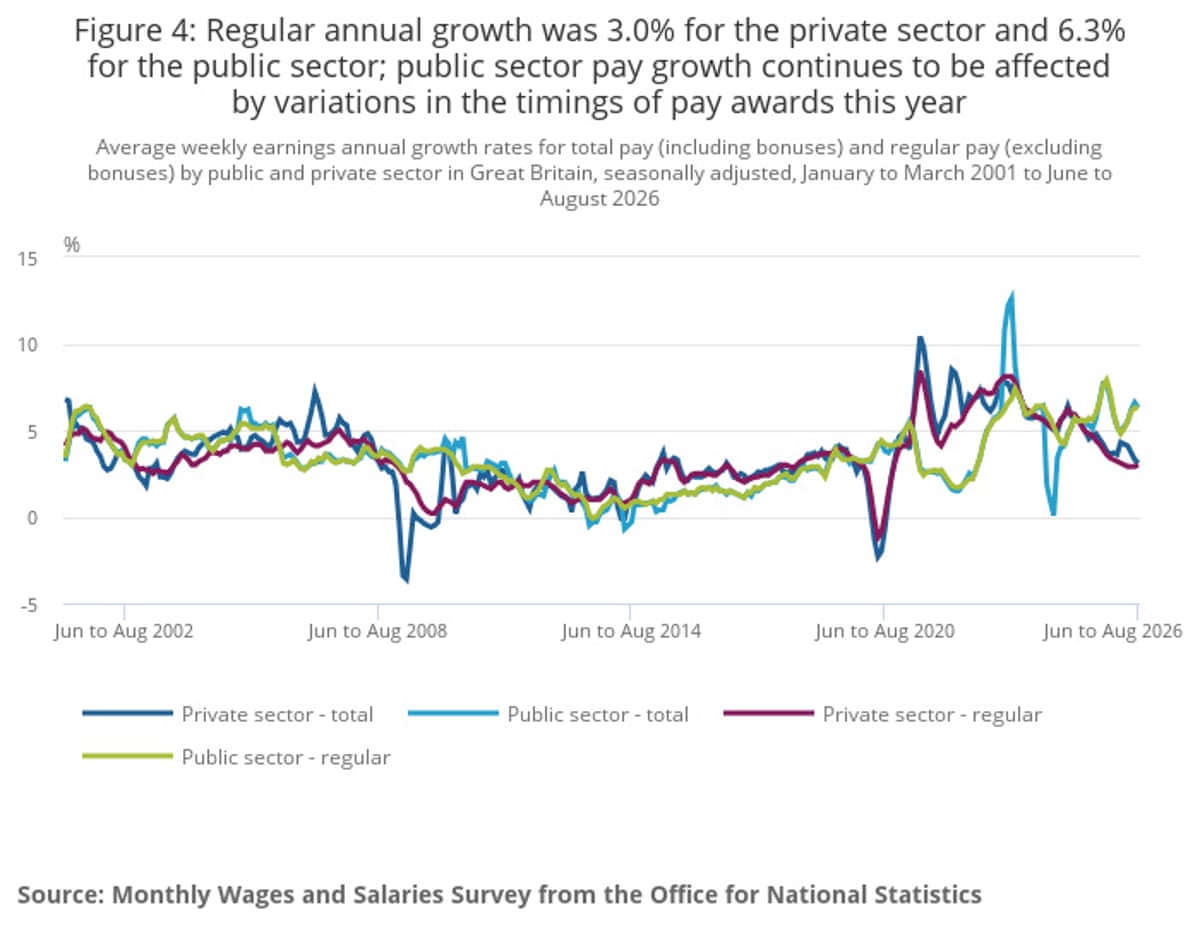
Pay growth continues to diverge sharply between the public and private sectors. Regular annual pay growth reached 6.3% in the public sector compared with 3.0% in the private sector, a significant gap. However, the Office for National Statistics cautioned that public sector pay growth figures are being affected by variations in the timing of pay awards during 2026, largely driven by pay deals in the NHS, meaning the headline figure may not reflect underlying trends as clearly as private sector data.
What happens next?
Chancellor John Healey is scheduled to deliver the Budget on Wednesday 28 October 2026, just one week after these labour market figures were released. The Office for Budget Responsibility is due to publish updated economic and public-finance forecasts alongside the Budget announcement, which will provide the government's assessment of the labour market outlook and any policy responses to the current jobs market challenges. Financial markets expect interest rates to rise to between 4.75% and 5% by the middle of next year, though some analysts believe the Bank of England would probably cap rates at 4.25% given recent labour market developments.
Key Facts
- UK unemployment fell to 4.7% in June to August 2026, beating economist forecasts of a rise to 5%
- Job vacancies dropped by 21,000 to 691,000, the lowest level since February to April 2021 and the largest quarterly fall since the start of 2026
- Small businesses with 1 to 9 employees accounted for the largest decline in vacancies, citing increased labour costs as the main reason for reduced hiring
- Real wage growth remains weak at 0.8% for regular pay and 0.9% for total pay when adjusted for CPI inflation
- Young people aged 16 to 24 remain particularly affected, with 715,000 unemployed despite a quarterly improvement of 28,000