The International Monetary Fund has raised its forecast for UK economic growth this year while warning that rising energy costs and interest rates will slow expansion in 2027, according to its latest assessment released on Tuesday.
The IMF now projects the UK economy will expand by 1.3% in 2026, a significant upgrade from the 1% forecast it issued in July. However, growth is expected to decelerate to 1.2% in 2027 as households and businesses face pressure from elevated energy prices and higher borrowing costs that will dampen consumer spending and capital investment.
The organisation's revised outlook reflects broader global economic resilience in the face of the US-Iran conflict. Economies worldwide have absorbed the energy price shock from the Middle East tensions better than initially feared, though the IMF cautioned that the ultimate economic consequences of the conflict remain "highly uncertain".
What does this mean for UK households?
Households will continue to experience the squeeze of elevated prices over the coming years. The IMF forecasts inflation will average 3.3% in 2026, higher than its previous estimate of 3.2%, and remain above the Bank of England's 2% target at 2.8% in 2027, up from an earlier projection of 2.4%. According to energy market analysis, the Bank of England expects inflation to spike slightly above 4% in early 2027, partly driven by a scheduled rise in the household energy price cap in January.
The IMF said core inflation is expected to return to target by the end of 2027, though later than previously forecast. Chancellor John Healey acknowledged the difficult conditions facing households, stating the government would work to "provide some breathing space" for families in the upcoming Budget announcement on 28 October.
How is the UK's debt position compared to other major economies?
The UK stands out among the world's largest developed economies for its progress in managing national debt. The IMF projects the UK will reduce its annual borrowing by nearly four percentage points of GDP between 2025 and 2031, a significantly steeper reduction than other G7 nations, many of which are actually increasing their deficits during this period.
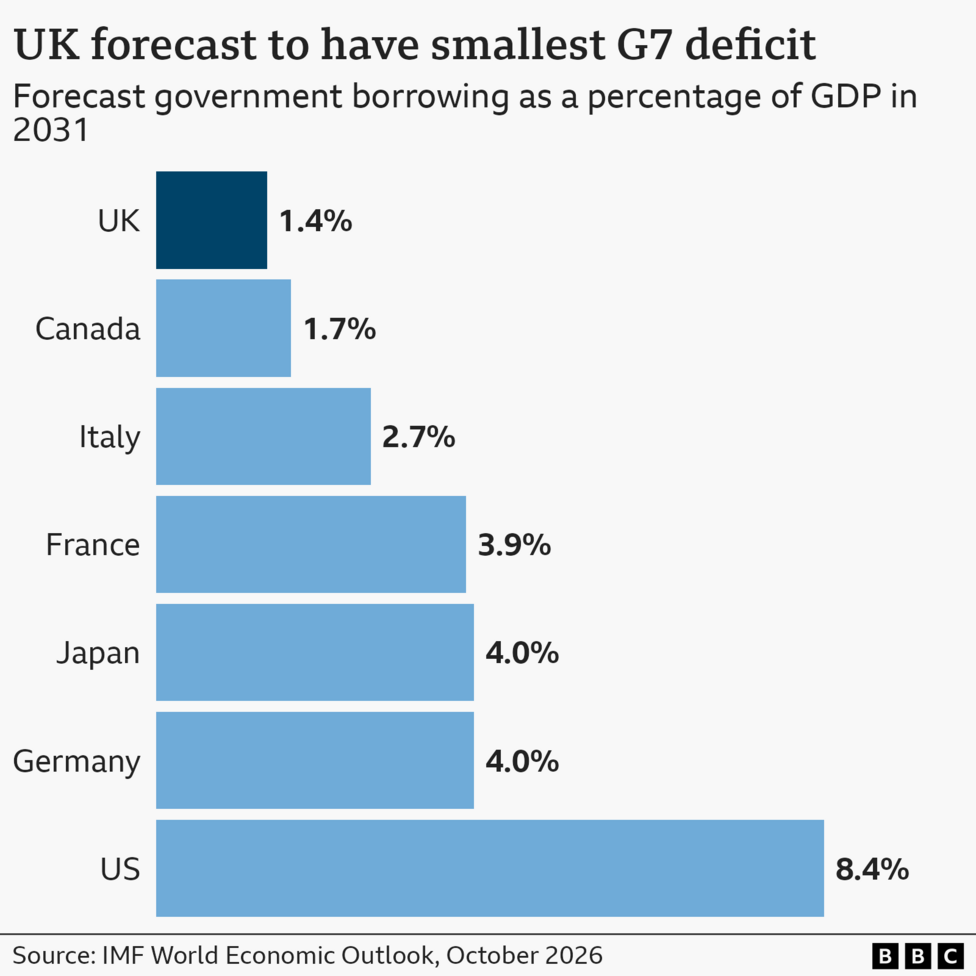
By 2031, the UK is forecast to have the lowest annual borrowing in the G7 and the longest maturity of debt, which locks in lower interest rates for an extended period. IMF Chief Economist Silvana Tenreyro highlighted this achievement, telling a national broadcaster on Tuesday that "the UK has already started the consolidation process and it is the country that basically stands out, along with India." She added that the UK should "stay the course" with its debt reduction strategy.
However, government borrowing costs have risen sharply, placing significant pressure on Healey to ensure his fiscal plans are viewed as credible by financial markets, which the UK depends on to raise funds. Economists have suggested the chancellor faces the challenge of finding approximately £35bn to avoid cuts to public services while meeting defence commitments in his first Budget.
What are the growth prospects for the UK relative to other G7 nations?
The reversal of earlier downgrades to economic forecasts, made when the US-Iran conflict began, means the UK is now expected to have the second-fastest growing economy in the G7, alongside Germany. This represents an improvement from earlier assessments that had been more pessimistic about the UK's economic trajectory.
The unemployment outlook has also improved. According to investment market data, the IMF now expects UK unemployment to average 5.3% in both 2026 and 2027, below its earlier 2026 forecast of 5.6%.
What challenges lie ahead for government policy?
Healey faces competing pressures as he prepares his Budget. The Resolution Foundation, a leading economic think tank, called on the chancellor to "make repairs" to public finances while simultaneously providing targeted support for households "struggling to heat their homes." The organisation stated:
"The challenge of continuing to bring down borrowing must be paired with the pressing need for fresh cost of living support to help families facing a difficult winter ahead."
The Institute for Fiscal Studies has warned that inflation could erode government departments' budgets, potentially requiring service cuts or additional spending to maintain service levels. Conservative shadow chancellor Andrew Griffith has cautioned that further tax rises would slow growth, arguing that
"if Healey reaches for more tax rises in his Budget, he is choosing slower growth and working people will pay for it."
Prime Minister Andy Burnham has pledged to create "good growth in every postcode" as part of his devolution agenda, though this strategy has faced criticism from within his own party. Healey is expected to meet with other finance ministers at the IMF's annual meeting in Bangkok, Thailand, on Tuesday to discuss strategies for limiting the economic impact of conflicts in the Middle East and Europe.
What happens next?
The household energy price cap is scheduled to rise in January 2027, which is expected to contribute to the inflation spike forecast for early that year. Healey will announce his full tax and spending plans on 28 October, with the Budget expected to address both the need for fiscal consolidation and support for households facing cost-of-living pressures.
Key Facts
- UK growth forecast upgraded to 1.3% for 2026, up from 1% predicted in July, but expected to slow to 1.2% in 2027
- The UK is projected to have the lowest borrowing in the G7 by 2031 and will reduce its deficit by nearly four percentage points of GDP from 2025 to 2031
- Inflation expected to average 3.3% in 2026 and 2.8% in 2027, both higher than previous IMF forecasts
- Unemployment forecast to average 5.3% in both 2026 and 2027, an improvement from earlier projections
- The household energy price cap is due to rise in January 2027, contributing to anticipated inflation pressures