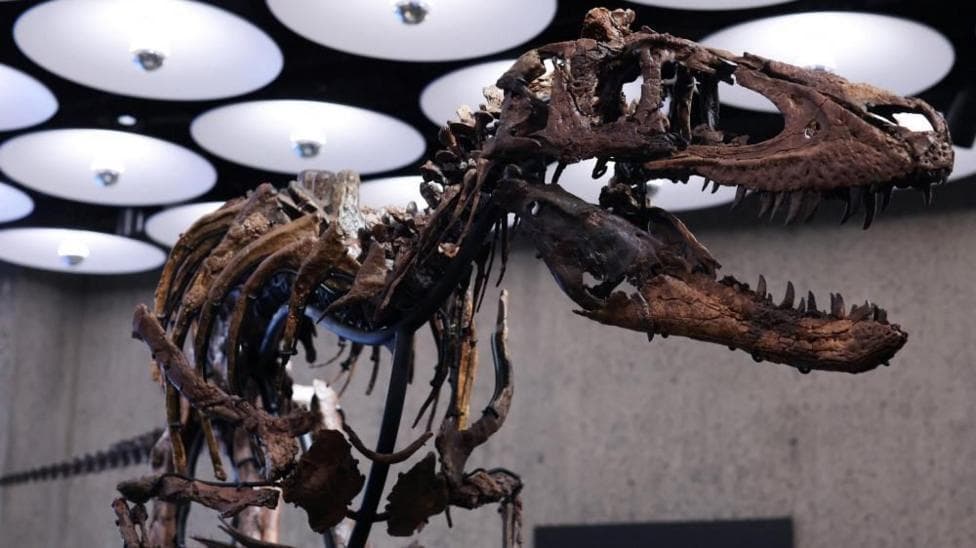
A mounted skeleton of a dinosaur once mistaken for a juvenile Tyrannosaurus rex is being offered for sale at Sotheby's in New York, with an opening bid of at least $6 million (£4.5 million). The specimen, nicknamed "Jodi", stands roughly 10 feet tall (3 metres) and represents one of only three known skeletons of its kind. According to BBC News, the auction follows confirmation by researchers that the skeleton belongs to a distinct genus rather than a young T. rex.
The Late Cretaceous carnivore is projected to sell for up to $9 million when the auction takes place. The sale marks a significant moment in palaeontology: it is the first Nanotyrannus specimen to reach the market since the genus was formally classified as separate from Tyrannosaurus rex in October 2025. Sotheby's describes the specimen as *Nanotyrannus cf. lancensis* and notes it comprises approximately 191 fossil-bone elements with a virtually complete, beautifully preserved skull.
The auction comes less than four months after Sotheby's sold a Tyrannosaurus rex specimen named "Gus" for a record $50.1 million (£37.4 million) in July 2026. That sale intensified debate within the scientific community about whether significant dinosaur remains should enter private collections or remain accessible to researchers and the public.
How is Nanotyrannus different from T. rex?
For decades, palaeontologists debated whether Nanotyrannus was a distinct species or simply a younger version of Tyrannosaurus rex. Megan Jenkins, a palaeontologist at the University of Portsmouth, explained the key differences:
"It was for a very long time believed to be sort of a teenager of T. rex. But it's a lot smaller and its a lot more gracile. So it's very sort-of sleek, slender, [with] blade-like teeth for slicing through meat."
The two predators inhabited the same landscape approximately 67 million years ago during the Late Cretaceous period. The 2025 study that established Nanotyrannus as a separate genus drew on roughly 200 tyrannosaur fossils and identified approximately 150 anatomical differences between the two animals. The research, published by Lindsay Zanno and James Napoli, resolved a scientific question that had persisted for many years.
What is the history of this particular skeleton?
"Jodi" was discovered in 2019 on private land in Montana's Hall Creek Formation by rancher Jodi Pierson. The specimen was later excavated by commercial palaeontologist Clayton Phipps, who has made other significant discoveries in the same region. Before the Nanotyrannus genus was formally classified, the skeleton was exhibited as a juvenile T. rex at London's Frieze Masters international art fair in October 2023, at which point it carried a reported $20 million price tag.
Phipps also discovered the famous "Dueling Dinosaurs" fossil, which shows the remains of a Nanotyrannus and Triceratops apparently locked in combat. That specimen was found eight miles (13 kilometres) away from "Jodi" in 2006 and became crucial evidence in the research that established Nanotyrannus as a distinct genus.
Why are scientists concerned about the sale?
The auction has sparked significant concern among palaeontologists about the future of fossil collecting and scientific research. Prof Steve Brusatte, a palaeontologist at the University of Edinburgh and consultant on the Jurassic Park films, expressed alarm at the prospect of the skeleton entering a private collection.
"We've really just found out that Nanotyrannus is real, and now one of the best skeletons is about to be sold to the highest bidder, and it's harrowing to think it could disappear into the vaults of a collector rather than displayed on a museum where it can wow and inspire kids and families and the public at large."
Brusatte had previously raised concerns about the sale of "Gus" the T. rex, noting that
"I don't know of any museum or university that can afford a price tag like that. Imagine if the Mona Lisa was just owned by a super-wealthy person and it wasn't on display and people couldn't see it, couldn't enjoy it."He expressed hope that such high-value sales would not become routine, warning that they could harm scientific research and public education.
The sale's private-land origin makes it legal under current law, though some researchers have raised concerns about whether scientists will retain access to the specimen once it enters private ownership.
Is there another perspective on the debate?
Not all palaeontologists view the auction negatively. Jenkins acknowledged the complexity of the issue, noting that significant resources are required to locate and excavate fossils.
"I don't begrudge the people involved for wanting to sell it for such a large amount of money. Although its a scary prospect, actually a lot of them have ended up in the public eye... these things without a doubt will end up in a museum at some point."
Jenkins suggested that many privately-owned specimens eventually find their way into museum collections, where they become accessible to researchers and the public. This perspective reflects the view that the private fossil market, while raising legitimate concerns, may not necessarily result in permanent loss of scientific access.
What happens next?
Sotheby's has scheduled the live auction in New York for October 27, 2026. The sale will determine whether "Jodi" remains in public view or enters a private collection, with significant implications for how future significant fossil discoveries are handled. The outcome may influence broader discussions about fossil ownership, scientific access, and the role of commercial markets in palaeontology.