
Housebuilder Crest Nicholson has issued a surprise profit warning on 2 September 2026, revealing it now expects an operating loss of around £10 million for the financial year ending 31 October, reversing an earlier forecast of £5 million to £10 million profit. The company will complete between 1,350 and 1,400 homes, down from its previous guidance of 1,400 to 1,500 units. The downgrade reflects deteriorating market conditions during the summer trading period, compounded by a sharp rise in UK government bond yields that is pushing up mortgage costs across the financial system.
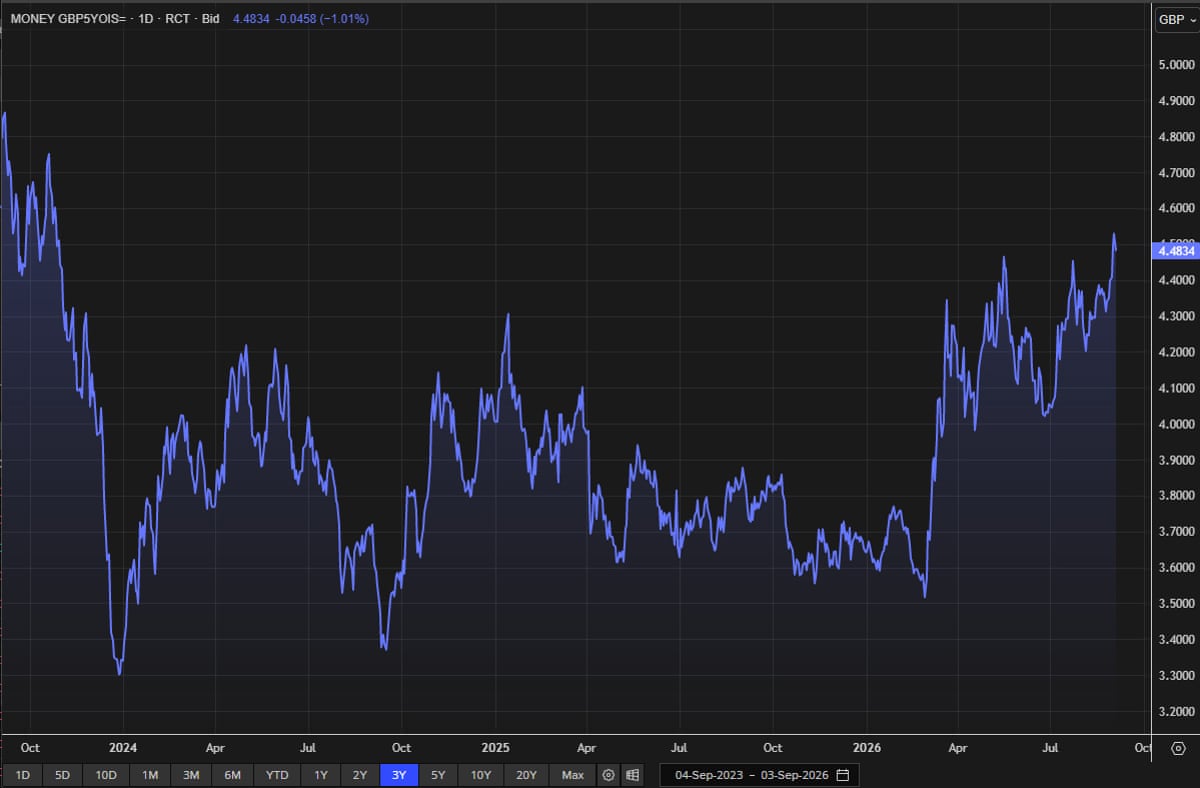
The turmoil in the gilt market, which saw 10-year yields reach their highest level since 2008 before retreating slightly, has already begun to ripple through the housing sector. Swap rates—the benchmark rates banks use when borrowing from each other—climbed to their highest point in nearly three years, with the five-year swap rate reaching 4.52% on 1 September 2026, marking its highest level since October 2023. According to mortgage rate data, the gilt move was pushing up wholesale funding costs that underpin fixed mortgage pricing.
This is Crest Nicholson's third profit warning since April 2026. The company's share price plunged more than 10% on the morning of 2 September in response to the announcement. The firm had already flagged concerns in July 2026, warning that lower customer enquiries, weaker visitor numbers and a softer land market were weighing on its outlook.
Why are mortgage rates rising?
The immediate driver is the spike in UK government bond yields, which have been pushed higher by global economic concerns and inflationary pressures. When bond yields rise, banks face higher wholesale funding costs, which they pass on to borrowers through increased mortgage rates. The five-year swap rate climbed above 4.52% on 1 September 2026, marking its highest level since October 2023. According to gilt yield data, the UK two-year gilt yield rose to 4.54% on 2 September 2026, up 0.04 percentage points on the session, reflecting ongoing pressure on shorter-dated debt.
Russ Mould, investment director at AJ Bell, explained the transmission mechanism:
Credit card, mortgage and auto loan interest rates will rise if bond yields rise, as the lenders seek to preserve loan book margins and manage their risk.
Oil prices have been a key factor in the bond market volatility, as elevated energy costs fuel inflation concerns that could prompt central banks to maintain or raise interest rates. Brent crude dropped 1.1% to $94.57 a barrel on the morning of 2 September 2026, having traded as high as $97 per barrel the previous day, offering some relief to the gilt market.
How much will mortgage rates increase?
The increases are expected to be modest compared with previous episodes of market stress. Tom Simpson, managing director of homes at Yorkshire Building Society, told the Today Programme on Radio 4 that
All things being equal, you would expect a modest increase in mortgage rates based on what we've seen so far.Simpson noted that the current volatility is considerably less severe than the swings witnessed in March 2026 during the Iran conflict, when swap rates moved 0.5 percentage points in just 10 days. The recent movement of 0.1 percentage points over a week is substantially smaller.
Current market data shows the pressure building. According to mortgage rate comparisons, average September 2026 mortgage rates stood at 5.29% for a two-year fixed rate deal at 75% loan-to-value and 5.31% for a five-year fixed rate deal at the same LTV. The Bank of England base rate remained at 3.75% as of 2 September 2026.
What is happening in the gilt market?
After hitting 18-year highs on 1 September 2026, UK government bond yields retreated slightly on 2 September as trading resumed. The 10-year gilt yield fell by over 4 basis points to 5.195%, while the 30-year yield dropped 4 basis points to 5.831%. However, the UK two-year gilt yield remained under pressure, reflecting ongoing concerns about shorter-dated debt.

The relief in the bond market came partly from the decline in oil prices, which eased some of the inflationary concerns that had driven the initial sell-off. However, the underlying tension between growth concerns and inflation expectations continues to weigh on sentiment.
Why is Crest Nicholson warning of losses?
The housebuilder attributed its downgrade to deteriorating market conditions during the summer trading period. In a statement to shareholders, Crest Nicholson said:
Market conditions have been more subdued than expected through the seasonally quieter summer trading period, with affordability constraints and competitive pricing continuing to weigh on open market sales rates.
Chief executive Martyn Clark added:
While the trading backdrop has remained difficult through the summer, we are making tangible progress on the actions within our control. Although the timing of a broader market recovery remains uncertain, the group is taking the right actions to protect liquidity and improve operational execution, while positioning the business for recovery when market conditions normalise.
The company's troubles reflect broader weakness in the UK housing market. UK asking prices fell 2% in August 2026, the steepest August drop since 2018, as sellers competed harder for buyers. This follows a period in which UK house prices remained flat in June amid rising mortgage rates and energy bills.
Anthony Codling of RBC Capital Markets commented on the scale of the impact:
Challenging market conditions will see Crest Nicholson sell 50-100 fewer homes this year than it had previously guided, small numbers which will have a big impact on financial performance, turning small profit into a small loss.
Crest Nicholson reported a pre-tax loss of £35.2 million for the six months to the end of April 2026. Building material prices remain approximately 3% to 4% higher on average, and the company has cut 50 jobs in recent months as it manages costs.
What is the silver lining for Crest Nicholson?
Despite the loss forecast, Crest Nicholson is taking steps to manage its financial position. The company expects year-end net debt of £70 million to £90 million at the end of October, down from the £100 million to £120 million flagged previously, thanks to fire remediation recoveries and land sale revenues. This represents net debt approximately £30 million better than previously expected and demonstrates a proactive approach to navigating challenging conditions.
The interim results presentation updated on 23 August 2026 showed adjusted gross profit of £13.9 million for the first half of the financial year, providing some foundation for recovery if market conditions stabilise. However, the company is renegotiating its banking covenants with lenders to ensure it has sufficient funding in the future. The firm described the talks as constructive but anticipates some slippage in the current timetable, indicating the negotiations are taking longer than expected.
What happens next?
Market participants will be watching for further developments in gilt yields and swap rates, which will determine the trajectory of mortgage pricing. Crest Nicholson's performance through the remainder of fiscal 2026, ending in October, will be critical in determining whether the company can stabilise its financial position. The company had previously projected adjusted pre-tax profit of £32 million to £40 million for the full year, a target now clearly out of reach.
Key economic data releases scheduled for 2 September 2026 included the Eurozone services purchasing managers' index at 9am BST, the UK services PMI at 9.30am BST, the ONS Business Insights report at 9.30am, the Challenger survey of US job cuts at 10.30am, and the US services PMI at 3pm BST. These figures provided further insight into economic momentum and inflation pressures that could influence central bank policy and, by extension, mortgage rates.
Key Facts
- Crest Nicholson expects a £10 million operating loss for the financial year ending 31 October 2026 and will complete 1,350–1,400 homes instead of the previously guided 1,400–1,500, marking the company's third profit warning since April
- UK five-year swap rates reached 4.52% on 1 September 2026, their highest level since October 2023, signalling upward pressure on fixed-rate mortgage pricing
- The 10-year UK gilt yield hit an 18-year high before retreating to 5.195% on 2 September 2026, though underlying inflation concerns persist
- Current market mortgage rates average 5.29% for two-year fixed deals and 5.31% for five-year fixed deals at 75% LTV, reflecting the recent upward pressure
- The housing market has weakened significantly, with UK asking prices falling 2% in August 2026—the steepest August decline since 2018—while Crest Nicholson reported a pre-tax loss of £35.2 million for the first half of the financial year