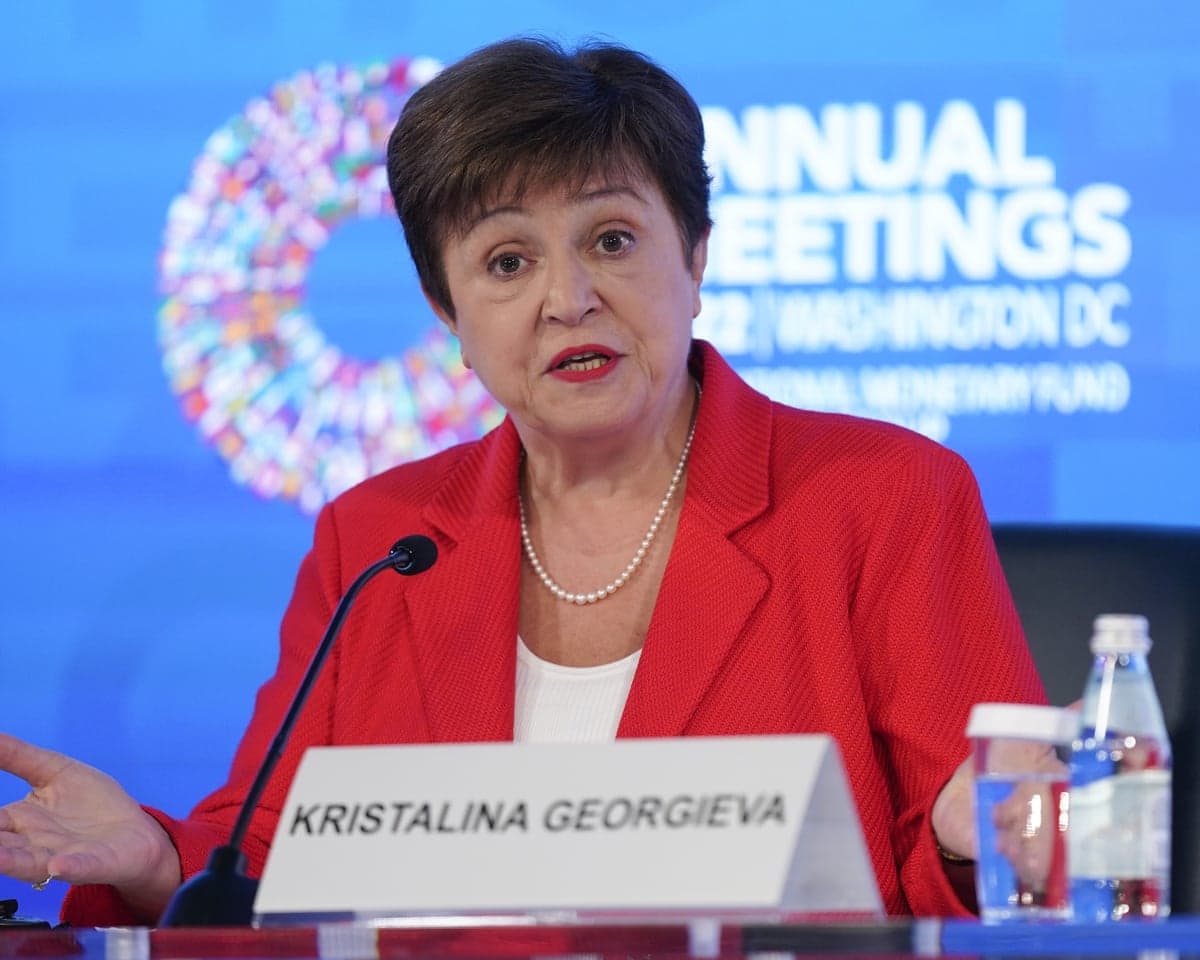
The International Monetary Fund's managing director has issued a stark warning that the world economy faces mounting threats from ballooning government debt, energy price volatility and an artificial intelligence boom that is deepening inequality between nations. Kristalina Georgieva delivered the assessment ahead of the IMF and World Bank annual meetings scheduled for October 12–18 in Bangkok, where the fund's 191 member countries will discuss the escalating fiscal challenges facing advanced economies.
Georgieva identified three interconnected pressures destabilising global growth. The first stems from geopolitical conflict: a negative energy supply shock originating from the Middle East war is pushing oil prices higher and straining economies dependent on energy imports. The second is a positive but unevenly distributed demand shock from artificial intelligence investment, which is simultaneously driving inflation in some regions while bypassing others entirely. According to reporting on her remarks, the IMF's forthcoming forecasts would reveal the largest growth downgrades in economies ravaged by war.
The third threat is the structural problem of public debt. The IMF calculates that government debt globally has reached its highest level since World War II and is forecast to exceed 100% of global GDP before 2030. This burden is simultaneously sapping economic growth and adding to inflationary pressures, leaving policymakers with fewer options to stimulate their economies.
Why are advanced economies the focus of concern?
Georgieva singled out wealthy nations, particularly the United States, as the
worst offenderson debt burdens, with debt-to-GDP ratios now higher than those in emerging markets and low-income countries. She argued that governments can no longer rely on higher growth rates alone to resolve their fiscal problems and must instead implement credible medium-term consolidation plans.
Some very tough political choices stare us in the face. My message to the world's economic policymakers next week will be this: we cannot keep delaying necessary policy action — you have the tools, now have the wisdom to use them.
She was particularly critical of inaction in high-debt advanced economies, stating:
And yet we don't see decisive action in the high-debt advanced economies where the need of the hour is for credible medium-term fiscal consolidation plans, supported in some cases by upfront fiscal measures, including to take some pressure off monetary policy.
What is the inflation picture?
After five and a half years of above-target inflation, persistent price pressures continue to emanate from multiple sources: the AI investment boom, energy and food price shocks, trade tariffs, higher defence spending and mounting debt service costs. Georgieva described oil as trading around $100 a barrel, while impaired refining capacity added another $100 per barrel in crack-spread margins for key products including diesel, further pressuring consumer prices.
In response to these inflationary dynamics, Georgieva endorsed a cautious tightening stance from central banks. She described recent interest rate increases by the US Federal Reserve, the European Central Bank and the Bank of Japan as
highly appropriate. She noted that US, German and Japanese 10-year government bond yields had reached their highest levels since 2007, 2009 and 1996 respectively, and were still climbing. The Bank of England has held borrowing costs steady but is expected to raise its base rate at its November meeting.
How could AI reshape global growth?
While artificial intelligence presents significant upside potential, its benefits are being distributed unevenly across the world. Economies with strong technology sectors—including China, India, Japan, South Korea and Taiwan—are capturing the gains, while many developing nations are being left behind. The IMF estimates that AI could add half a percentage point to annual global growth if adopted effectively, equivalent to adding an economy the size of ASEAN over a decade of growth rising from 3% to 3.5%.
However, the AI boom is creating new pressures on energy and commodity markets. AI-related data-centre investment is increasing energy demand, adding pressure to fuel, fertilizer and food prices, which compounds the inflationary challenges facing lower-income countries.
What is happening in financial markets?
Asian equity markets declined on the day of Georgieva's speech, with MSCI's broadest index of Asia-Pacific shares excluding Japan falling 0.3%. Japan's Nikkei lost 0.6%, Hong Kong's Hang Seng fell 0.5%, the Singapore market dropped 1.3% and South Korea's Kospi tumbled nearly 2%. By contrast, Wall Street closed at record levels, with the S&P 500 rising nearly 0.6% to 7,818.93 and the Nasdaq closing at 27,599.886.
Oil prices have climbed back above $100 a barrel, with Brent crude up 0.66% at $101.19 per barrel and US crude 0.5% higher at $89.86 per barrel. Investors are weighing supply constraints from a storm heading toward North American oil-producing regions and ongoing Houthi attacks on Saudi Arabia against higher supplies leaving the Middle East. According to commodities trading giant Vitol, approximately 12 million barrels per day of crude oil and 2 million barrels per day of refined oil products have departed the Middle East on tankers over the past seven to ten days.
After last week's selloff in government bond markets, a rally emerged on Tuesday, pushing yields lower. Ten-year French yields fell more than 11 basis points and the spread between French and safer German bonds, which had reached almost 160 basis points the previous week, narrowed to 132 basis points. The euro recovered from its recent declines and stabilised just above $1.1250. This morning, French 10-year yields rose nearly 5 basis points to 4.796%, while US Treasury yields increased 4.5 basis points to 5.31%. UK gilt yields meanwhile edged down slightly to 5.37%.
What is the UK housing market showing?
The British housing market has stalled ahead of the government's introduction of the Your First Home scheme, which targets first-time buyers. Latest data from Lloyds Banking Group revealed that property prices remained flat in the most recent month, following a 0.3% decline in August. The average property now costs £298,441, with annual growth also flat.
Regional variations tell a more complex story. Lloyds' regional analysis showed annual house-price declines in London (2.2%), the South East (2.1%) and Eastern England (1.6%), while Northern Ireland recorded 7.4% growth.
Andrew Asaam, mortgages director at Lloyds, observed:
While the market overall has been fairly subdued, property prices have so far proved resilient during a period of higher mortgage rates, which has been driven by changing expectations around the future path of Base Rate. That's mirrored in wider economic data, with household spending holding up better than many expected despite energy and other cost pressures arising from the Middle East conflict.
He added that consumer confidence will be crucial to the market's trajectory:
Whether that picture continues is likely to depend on how confident consumers feel that the latest cost‑of‑living pressures will prove temporary. Confidence has long been a key driver of housing market activity, and will play an important role in shaping demand over the remainder of this year and into 2027.
Despite the overall flatness, there are signs of underlying demand. New enquiries from prospective buyers have reached their highest level since February, suggesting that while higher mortgage rates and economic uncertainty are encouraging caution, the market retains some momentum.
For now, the housing market appears to be balancing buyer caution with continued underlying demand. While higher mortgage rates and wider economic uncertainty are encouraging some people to take a more measured approach, new enquiries from prospective buyers are now at their highest since February. That should help sustain activity in the near term, with any movement in house prices likely to remain modest.
What is Equinor's warning about UK investment?
Norwegian energy giant Equinor, which part-owns the Rosebank and Jackdaw oil and gas fields in the North Sea, has issued a stark warning that it may cease investing in the UK if these new projects fail to receive approval. The company's chief executive Anders Opedal stated:
The question will be: is the UK investable in the future? I hope it will not come to that.
He indicated that Equinor would
have to take a hard view about itif the UK government decides against new drilling, placing the company's future commitment to British operations in question. The government must decide whether to grant final approval for oil and gas extraction at both sites, despite a ban on new licensing pledged in Labour's election manifesto.
Opedal expressed confidence that Prime Minister Andy Burnham's stated commitment to a
pragmatic approach to oil and gassuggests both projects will ultimately be approved, but he characterised the current uncertainty as
an uncomfortable position to be in. He argued that the UK could produce more of its own oil and gas, noting:
It's a political choice. The North Sea oil and gas industry started on the UK side. We learned from the UK and it's actually the same geology on both sides of the border – several fields actually cross it.
What happens next?
The IMF and World Bank will hold their annual meetings in Bangkok from October 12–18, with the IMF's World Economic Outlook press briefing scheduled for October 13. These meetings will provide the forum for Georgieva to present the fund's updated economic forecasts, which are expected to reflect the scale of challenges facing war-affected economies and the divergent impacts of the AI boom across different regions.