China's economic expansion quickened during the third quarter, climbing to 4.5% year-on-year growth as artificial intelligence infrastructure demand lifted exports and offset persistent weakness in domestic spending. According to BBC News, the world's second-largest economy rebounded from a three-year low, though the expansion remained below the 5% rate recorded in the opening quarter of the year.
The quarterly result sits at the lower boundary of Beijing's full-year growth target range of 4.5% to 5%, a positioning that economists argue provides the government with flexibility to tackle structural economic headwinds. Year-to-date, China's GDP growth through the third quarter reached 4.7%, reflecting the gradual acceleration through the year.
This marks a recovery from the 4.3% expansion recorded in the second quarter, when growth slowed sharply amid weak domestic demand and geopolitical pressures. The rebound underscores how international demand for technology components has become critical to sustaining China's economic momentum.
How are exports driving growth?
Shipments abroad have become the primary engine of expansion as consumer spending at home remains subdued. September exports surged 36.3% year-on-year, with the monthly trade surplus reaching $133.5 billion, demonstrating the intensity of global appetite for Chinese goods.
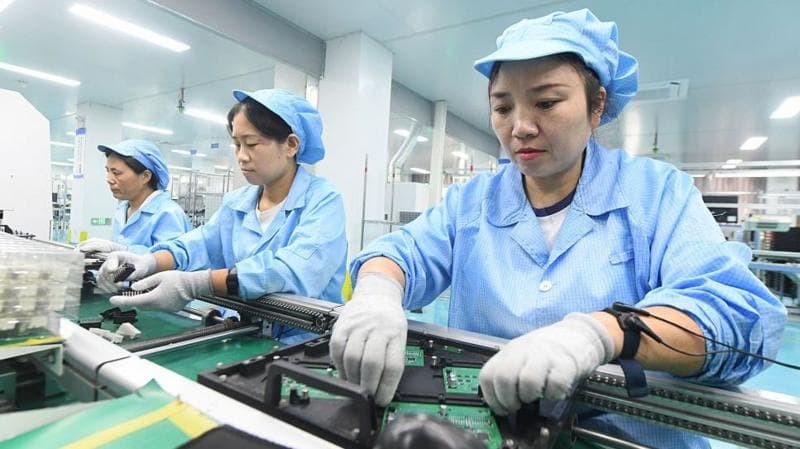
The artificial intelligence sector has emerged as a particularly potent driver. Global manufacturers are racing to secure computer chips and other components essential for constructing AI data centres, and China has positioned itself as a critical supplier in this supply chain. Within China itself, data centres are rising from rural grasslands as the country races ahead in artificial intelligence, with Inner Mongolia's Ulanqab alone signing 89 projects worth over 500 billion yuan.
China's trade surplus is now on course to surpass the record $1.2 trillion (£900 billion) achieved in the previous year, a trajectory that reflects both strong export performance and comparatively restrained import growth.
Why is domestic spending so weak?
Chinese households and businesses have curtailed spending due to multiple structural pressures that show little sign of abating. A prolonged downturn in the property sector, which historically anchored consumer confidence and wealth accumulation, continues to depress activity. Wage growth has remained anaemic, and youth unemployment has climbed, both factors that discourage discretionary purchases.
The weakness in domestic demand stands in sharp contrast to export dynamism. September industrial output was forecast to grow 5.5% year-on-year, while retail sales were forecast to rise only 0.6%, and January–September fixed-asset investment was forecast to fall 7.3%, illustrating the divergence between production and consumption.
What policy steps has Beijing taken?
In September, the government announced a package of measures designed to stimulate economic activity and address the imbalance between exports and domestic demand. These included reductions in interest rates for certain business categories and subsidies aimed at property purchasers, signalling policymakers' determination to revive consumer confidence.
However, these interventions have not yet translated into a decisive shift in household behaviour, suggesting that deeper structural reforms may be required to restore robust domestic consumption.
What external pressures are mounting?
China faces mounting friction from Western trading partners as manufacturers in the United States and European Union struggle to compete with the volume and price of Chinese exports. Both regions have begun implementing or considering trade restrictions and tariffs in response to what they characterise as unfair competition.
Simultaneously, questions are surfacing about the sustainability of the AI investment boom itself. Billions of dollars are flowing into data centre construction and AI infrastructure globally, yet uncertainty persists about whether the companies making these investments can deliver on their promises of generating proportionate returns. This scepticism could dampen future demand for the components that have recently buoyed Chinese exports.
What does the data reveal about economic momentum?
A Reuters poll of 50 economists had forecast 4.4% year-on-year GDP growth for the third quarter, below the 4.6% forecast in its July poll, indicating that expectations had been revised downward in the months leading to the release. The actual 4.5% result exceeded this consensus, providing some reassurance about China's near-term trajectory.
The National Bureau of Statistics' release on 19 October included September industrial production, retail sales, investment and property-sector indicators alongside third-quarter GDP, offering a comprehensive picture of economic conditions across multiple dimensions.
What lies ahead for China's economy?
The outlook remains clouded by competing forces. Export strength provides a near-term cushion, but its dependence on global AI investment cycles introduces vulnerability. Policymakers must navigate the challenge of reviving domestic consumption without triggering the asset bubbles and debt accumulation that characterised previous stimulus episodes. The coming months will reveal whether the September policy measures gain traction or whether more aggressive intervention becomes necessary.